
Every step, every platform, every document, from someone who watches this process happen every week.
You can legally hire employees in Saudi Arabia without a local company by using an Employer of Record (EOR) that holds an ISTIQDAM manpower license under the Ministry of Human Resources and Social Development (MHRSD, hrsd.gov.sa). The EOR employs the person under its own Saudi entity while you direct the day-to-day work. Onboarding takes about 19 working days for a candidate already in Saudi Arabia and 68 working days for a candidate entering from abroad. No entity registration, no resident director, no Ministry of Investment filing required on your end.
I run marketing at Masdar EOR, a direct Employer of Record with our own licensed Saudi entity and Green Nitaqat status. This guide is the honest version of the process: what happens, which government platform handles which step, and where quotes fall apart if you do not ask the right questions upfront. If you are also weighing the cost of an EOR in Saudi Arabia, that is covered in a separate deep-dive linked below. For the regional picture, see our complete 2026 Employer of Record GCC hiring guide.
Quick answers
- Legal without a Saudi entity? Yes, through a licensed EOR under the ISTIQDAM manpower framework
- Onboarding time: 19 working days (in-country transfer) or 68 working days (outside country)
- Minimum documents (outside-country hire): passport, photo, MOFA-attested degree, medical certificate, police clearance; an in-country transfer needs only passport, photo, Iqama copy, and the previous sponsor’s release approval
- Contract language: Arabic, registered on QIWA (qiwa.sa) under Saudi Labor Law
- First paycheck: salary lands between the 26th and 28th of the month by bank transfer, with WPS filing through Mudad (mudad.com.sa)
- Nitaqat tier requirement: the EOR must be Green or Platinum to onboard expat hires
- Saudi VAT: 15%, administered by ZATCA (zatca.gov.sa)
The three legal paths (only one works fast)
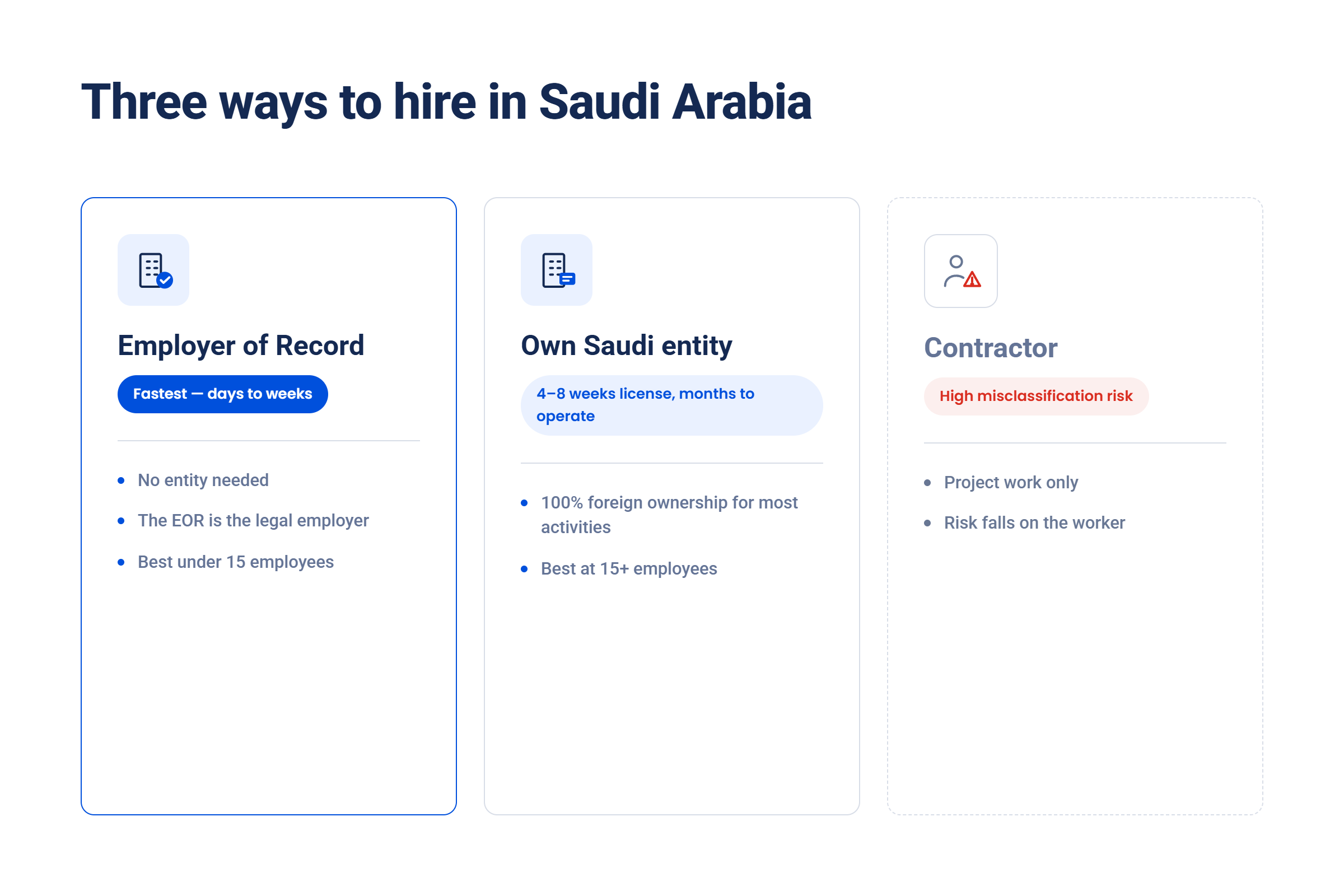
Every foreign company hiring in Saudi Arabia has three options. Two of them work. One will get you fined.
Path 1: Employer of Record
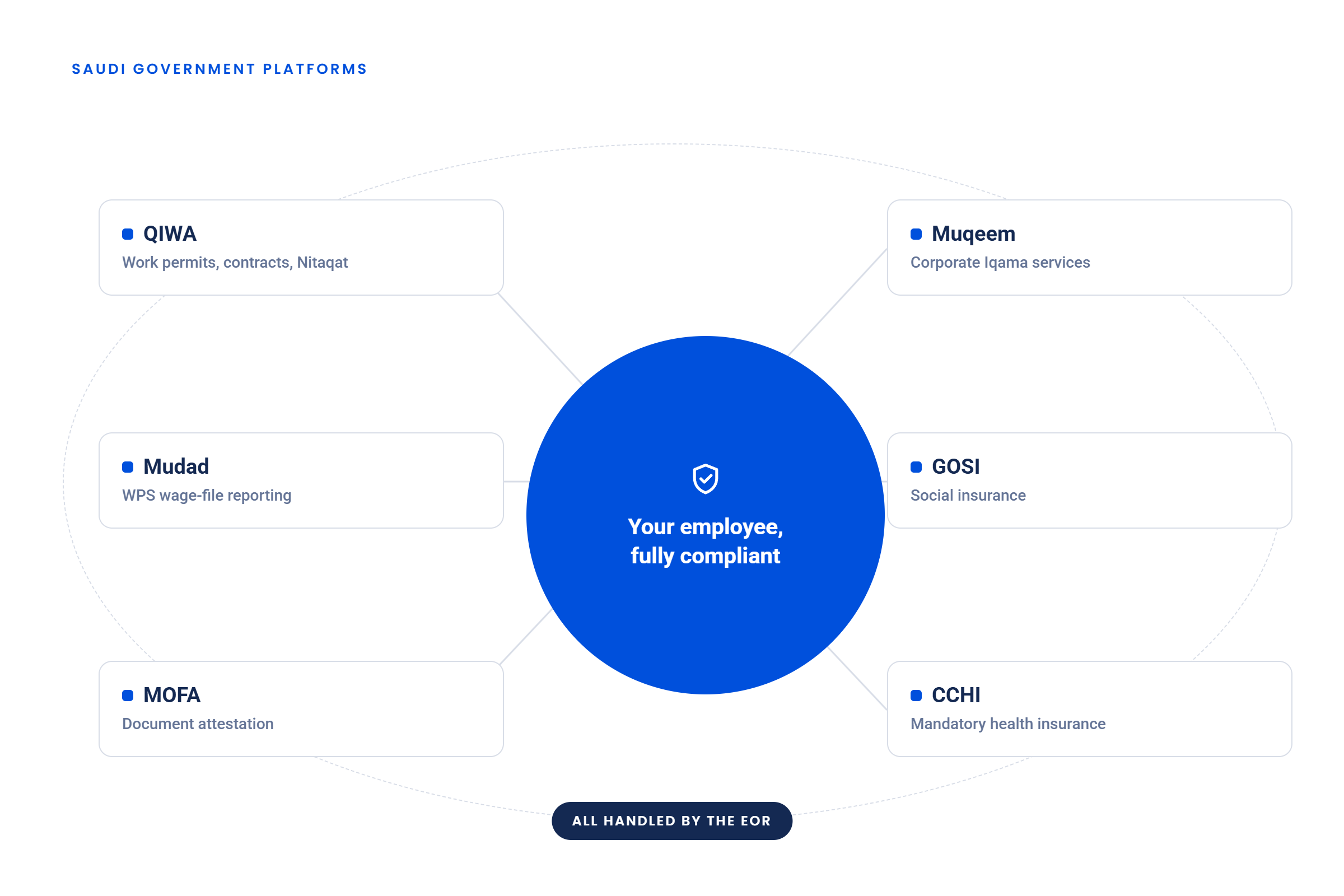
Specifically, an EOR licensed under ISTIQDAM legally employs the person under its own Saudi entity. In practice, you direct the work, sign a service agreement with the EOR, and pay one monthly invoice. The EOR handles the Arabic-language employment contract, QIWA registration, GOSI (gosi.gov.sa), mandatory medical insurance, WPS payroll through Mudad, EOSB accrual, and offboarding.
Therefore, best for: any company with fewer than 20 people in Saudi Arabia, or any company that wants to hire the first person quickly and decide later.
Path 2: Open your own Saudi entity
Alternatively, you register a company through the Ministry of Investment (MISA, misa.gov.sa), obtain commercial registration, and appoint a resident General Manager (a foreign national can hold the role; 100% foreign ownership is permitted for most activities). The MISA license and Commercial Registration typically take 4 to 8 weeks; full operational setup, including bank onboarding and office leasing, takes several months and costs USD 15,000 to USD 50,000 upfront. After that, you handle everything an EOR would, in-house.
Conversely, best for: companies that already have 15 or more employees in Saudi Arabia (or expect to reach that quickly), where the per-head cost advantage justifies the setup burden.
Path 3: Independent contractor (usually the wrong call)
Cheaper on paper. However, it is legally risky in practice. If the person works full-time, on your equipment, on your schedule, they are an employee under Saudi labor law, regardless of what your invoice calls them. MHRSD audits do find these arrangements. Because an offshore company has no Saudi entity to fine directly, the immediate legal risk (fines, deportation, re-entry bans) falls on the worker, and the arrangement can trigger hiring bans that follow you into any later Saudi setup.
By contrast, best for: genuinely project-based work performed by someone who has their own clients, their own hours, and their own tools.
For everyone else, the EOR path is how you hire employees in Saudi Arabia without a local company, and it is what this guide walks through.
Why an EOR is the way to hire employees in Saudi Arabia without a local company
There are three reasons. Firstly speed, secondly cost, and thirdly compliance.
First, speed. An EOR that holds the right Nitaqat tier and has active QIWA and Muqeem workflows can put an in-country candidate on payroll in about three weeks. A new entity takes six months minimum.
Second, cost. The EOR service fee (SAR 1,875 to SAR 3,000 per employee per month for a direct provider) plus statutory contributions is dramatically cheaper than the upfront and ongoing cost of running your own Saudi entity for your first 20 employees. The full pricing breakdown lives in the Saudi EOR cost guide (see internal link at the bottom).
Third, compliance. GOSI registration, WPS filing through Mudad, Nitaqat tier maintenance, Iqama processing, and Arabic contract requirements are all handled by the EOR team, not yours. If a Ministry of Labor letter arrives, it goes to the EOR.
When you hire employees in Saudi Arabia without a local company, the trade-off is that you inherit the EOR Nitaqat tier. That is why the choice of EOR matters more than the choice of any other vendor in your operations.
The full step-by-step: outside-country hire (~68 working days)
Meanwhile, most companies hiring in Saudi Arabia are onboarding a candidate who is currently in another country. Here is what happens, in order, with realistic timelines.
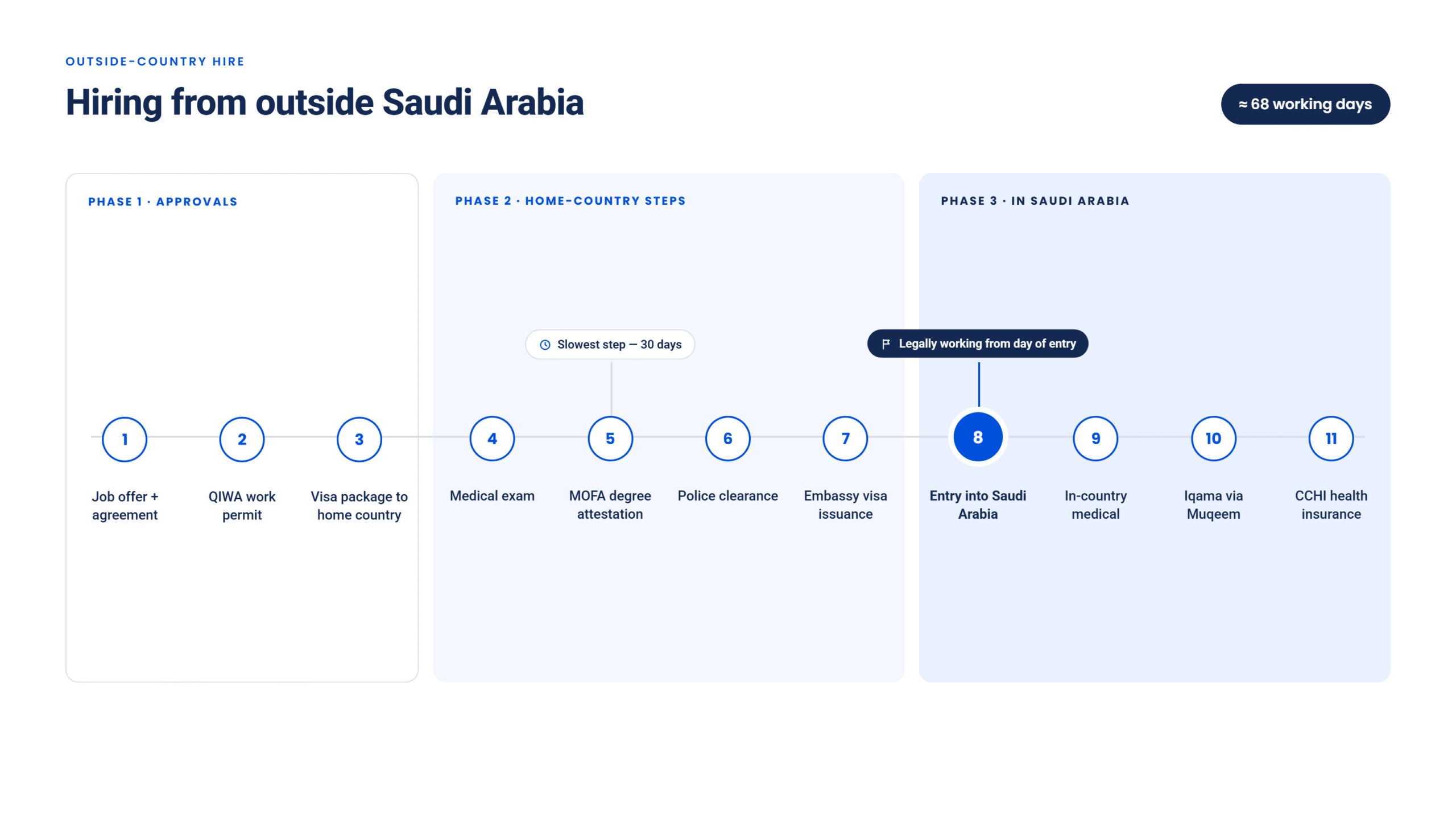
Step 1: Sign the job offer and service agreement (~2 days)
First, the candidate signs a job offer with terms that match Saudi Labor Law. You sign a service agreement with the EOR. The EOR now becomes the legal employer.
Step 2: EOR submits QIWA application (~3 days)
Next, the EOR applies for a new expat work permit through the QIWA platform (qiwa.sa) under MHRSD. This is the government-side approval that unlocks everything downstream.
Step 3: Ship original documents to the candidate home country (~7 days)
Then, the EOR issues an authenticated work visa package for the candidate to present at the Saudi embassy in their home country. This step exists because the visa is issued in the country of origin, not in Saudi Arabia.
Step 4: GAMCA medical certification (~2 days)
For example, candidates from specific countries (India, Pakistan, Bangladesh, Sri Lanka, Nepal, the Philippines, Indonesia, and several African nations) must complete a medical exam at an accredited GAMCA centre in their home country. Screenings include HIV, TB, Hepatitis B and C, and Syphilis. The certificate is valid for a limited window, so timing matters.
Step 5: MOFA-attested degree certificate (~30 days)
Meanwhile, the candidate highest educational degree must be attested three ways: by the awarding country authority, by the Saudi embassy in that country, and by MOFA in Saudi Arabia (mofa.gov.sa). This step is the single slowest part of the whole process. Start it in parallel with everything else.
Step 6: Police clearance certification (~7 days)
Similarly, the candidate obtains a police clearance certificate from their country of residence. Required for most nationalities.
Step 7: Embassy submission and visa issuance (~9 days)
After that, the candidate submits the full document set (visa package, medical, degree, police clearance, passport, photo) to the Saudi embassy. The embassy issues the entry visa, typically within a week or so of receipt.
Step 8: Candidate enters Saudi Arabia
As a result, on entry the candidate can be deployed and can legally start working for you. Payroll starts. GOSI registration begins.
Step 9: In-country medical screening (~1 day)
Additionally, a second medical screening in Saudi Arabia is required for the Iqama process. Includes HIV, TB, and Hepatitis tests.
Step 10: Iqama (residency ID) issuance (~7 days)
Subsequently, the EOR processes the Iqama through Muqeem (muqeem.sa), the dedicated corporate residency portal for business immigration services. This is the physical residency card the employee needs for banking, mobile phone contracts, driving, and every other daily task. For the full process, see our Saudi Arabia visa and Iqama guide.
Step 11: Health insurance activation (~14 working days)
Finally, mandatory medical cover under CCHI (cchi.gov.sa) is activated. For a Family Status contract, spouse and dependent cover comes in at the same time.
Total elapsed: about 68 working days from signed offer to fully documented, insured, Iqama-holding employee. The candidate is legally working from the day of entry (step 8), so the last three weeks are documentation, not delay.
The full step-by-step: in-country transfer (~19 working days)
On the other hand, if your candidate is already in Saudi Arabia on someone else Iqama, the process is much shorter.
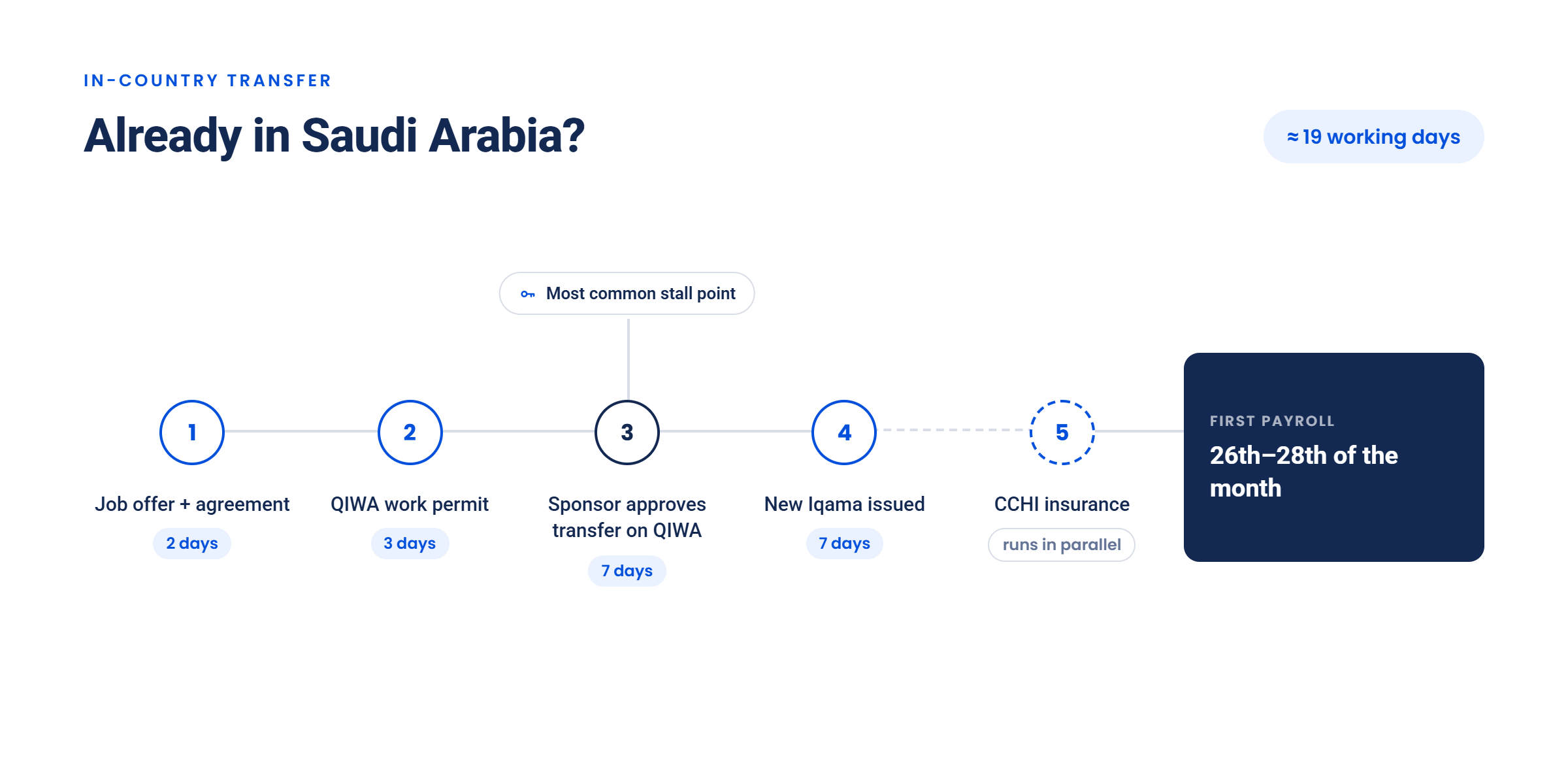
Step 1: Signed job offer and service agreement (~2 days)
Same as outside-country: offer signed, service agreement in place.
Step 2: EOR submits QIWA application (~3 days)
Same as outside-country: new work permit filed through QIWA.
Step 3: Iqama sponsorship transfer (~7 days)
Notably, the current employer must approve the transfer through QIWA. Without their approval, no transfer happens. This is the single most common reason in-country transfers stall. Get the release letter before you sign anything.
Step 4: New Iqama issuance under new sponsor (~7 days)
Afterward, once transferred the Iqama is reissued under the new EOR sponsor. The employee is now legally working under the new arrangement.
Step 5: Health insurance activation (~14 working days)
Meanwhile, this runs in parallel with the transfer. CCHI cover under the new sponsor is activated.
Total elapsed: about 19 working days from signed offer to fully compliant employee.
What the whole process actually costs
Because “how do I hire” and “what does it cost” are the same decision, here is the short version. Full breakdown, including salary-tier examples and every employer contribution, lives in the full Saudi EOR pricing guide.
- EOR service fee: SAR 1,875 to SAR 3,000 per employee per month for a direct provider (VAT-inclusive at 15%).
- Statutory contributions: GOSI at 11.75% of Basic + Housing for Saudi nationals, 2% for expats; CCHI medical insurance SAR 250 to SAR 800/month; EOSB accrual at half-month of Basic per year (years 1-5).
- Security deposit: one month gross salary as a refundable deposit, billed at start.
- Outside-country onboarding one-time costs: GAMCA medical fee (~USD 100), MOFA degree attestation fee (~USD 200 total across three attestations), courier and translation (~USD 100), embassy fee (varies by country).
- First-arrival airfare: mandatory for expat hires, one-time, paid by employer.
For a Saudi national at SAR 15,000 gross monthly, total employer cost is roughly SAR 19,500 to SAR 20,000 per month.
Nationality-specific rules that change the process
However, not every candidate follows the standard 68-day path. Here are the exceptions worth knowing.
For example, GCC nationals (UAE, Kuwait, Bahrain, Qatar, Oman) do not need an expat work visa or Iqama, and GAMCA medical is not required. They still cannot start undocumented: the EOR registers them on QIWA under the GCC path and enrolls them in GOSI under the Unified GCC Protection Extension Program. Onboarding time drops significantly.
Candidates from GAMCA countries (India, Pakistan, Bangladesh, Sri Lanka, Nepal, the Philippines, Indonesia, plus specific African nations) must complete the pre-arrival medical exam at an accredited centre in their home country. Add 2 to 5 days depending on centre availability.
US, UK, EU, Canada, Australia, and other Western passport holders fall outside the GAMCA network; the pre-arrival medical is completed instead through embassy-approved practitioners in the home country, and police clearance requirements are often simpler. Processing is often faster than the GAMCA-country path, but consular timing varies.
Some nationalities face additional administrative review under Saudi visa policy. Processing times fluctuate with current Ministry of Interior directives, so confirm the live timeline for the specific passport before committing a start date.
Furthermore, female employees face no differential legal restrictions under 2021 labour reforms. Male family members are no longer required as sponsors for female workers.
The takeaway: always ask the EOR “how long for a candidate holding [nationality] passport?” before committing to a start date. A blanket “68 days” quote glosses over meaningful differences.
Required documents (checklist)
For an outside-country hire, the candidate needs to provide:
- Passport copy with at least six months of remaining validity
- Passport-size photo (JPEG, white background)
- MOFA-attested highest educational degree
- Medical certificate (via the GAMCA network for listed nationalities; embassy-approved practitioners otherwise)
- Police clearance certificate (required for most nationalities)
- Completed New Hire Form from the EOR
For an in-country transfer, the candidate needs to provide:
- Passport copy with at least six months of remaining validity
- Passport-size photo
- Existing Iqama copy
- Release letter from the previous sponsor, approved through MHRSD
- Completed New Hire Form
For your side (the client company), the EOR will ask for:
- A signed service agreement
- The employment offer letter with agreed salary, structure (60/25/15 Basic/Housing/Transportation is standard), and start date
- Authorized signatory details
In summary, that is the whole document set. If an EOR asks you for more before you have signed, it is usually onboarding overengineering. If they ask you for less, you are likely dealing with a partner-network provider that will hit you with document requests later.
Regulated professions: extra licensing steps
In addition, some roles need professional-body registration on top of the standard EOR onboarding. If your hire is in one of these fields, budget more time.
For instance, engineers must register with the Saudi Council of Engineers (SCE, saudieng.sa). Registration requires a verified engineering degree and typically adds 2 to 4 weeks to onboarding. Many EORs handle SCE registration as an add-on service; confirm before signing.
Likewise, doctors and healthcare professionals must register with the Saudi Commission for Health Specialties (SCFHS). This is a substantial process. Expect 4 to 8 weeks and specific credential-verification requirements.
Lawyers work as legal consultants rather than licensed attorneys, and legal-consultancy roles must be engaged through a law firm licensed with the Ministry of Justice; an EOR generally cannot sponsor foreign legal consultants for corporate advisory work.
Accountants and auditors need Saudi Organization for Chartered and Professional Accountants (SOCPA) registration, which applies to accounting, auditing, and finance-specific job titles.
For non-regulated commercial roles (marketing, sales, engineering-adjacent, HR, finance operations, tech), standard EOR onboarding applies without professional-body registration.
The employment contract: what must be in it
Notably, Saudi Labor Law requires specific contract elements. A competent EOR handles all of this for you, but here is what should be in the document:
- Arabic-language version. The Arabic contract is the legally binding one. English translation is customary but not legally controlling.
- Registration on QIWA under the Saudi Labor Law article that applies to your employee type.
- Salary broken down into Basic (usually 60%), Housing (25%), and Transportation (15%). This is standard market practice rather than a legal mandate; the Basic plus Housing figure determines GOSI and EOSB calculations.
- Contract type stated: fixed-term is the norm for all nationalities. Non-fixed is available only for Saudi nationals.
- Probation period stated (up to 90 days, extendable to 180 with written consent).
- Notice period stated (30 to 60 days depending on contract type).
- Working hours: 8 per day, 48 per week maximum, Sunday to Thursday.
- Leave entitlement: 21 days annual (years 1 to 5), 30 days (5+ years).
- EOSB terms referenced under Saudi Labor Law.
- Termination-without-notice grounds under Article 80 (this protects both parties).
Finally, if you want to negotiate specific clauses (equity vesting, non-compete, IP assignment), raise them before contract issuance. Changes after the fact require re-registration on QIWA.
The first month of operations
Then, once the employee is on payroll, four things happen every month, in this order:
Between the 10th and 15th, the EOR sends you a payroll invoice for the full monthly cost (salary + statutory contributions + service fee + VAT).
Then, you pay the invoice. Standard net-15 terms are typical. Some EORs require net-7.
Between the 26th and 28th, the salary lands in the employee local Saudi bank account by bank transfer, with the WPS file submitted through Mudad. The GOSI contribution is remitted by the 15th of the following month. The CCHI premium is paid.
End of the month, the employee receives a payslip.
That is the operating rhythm you commit to when you sign. The EOR handles it. You review it.
Who handles what after the hire is live
Afterward, once your Saudi hire is onboarded, responsibilities split cleanly. Knowing which side owns which task prevents finger-pointing at renewal time.
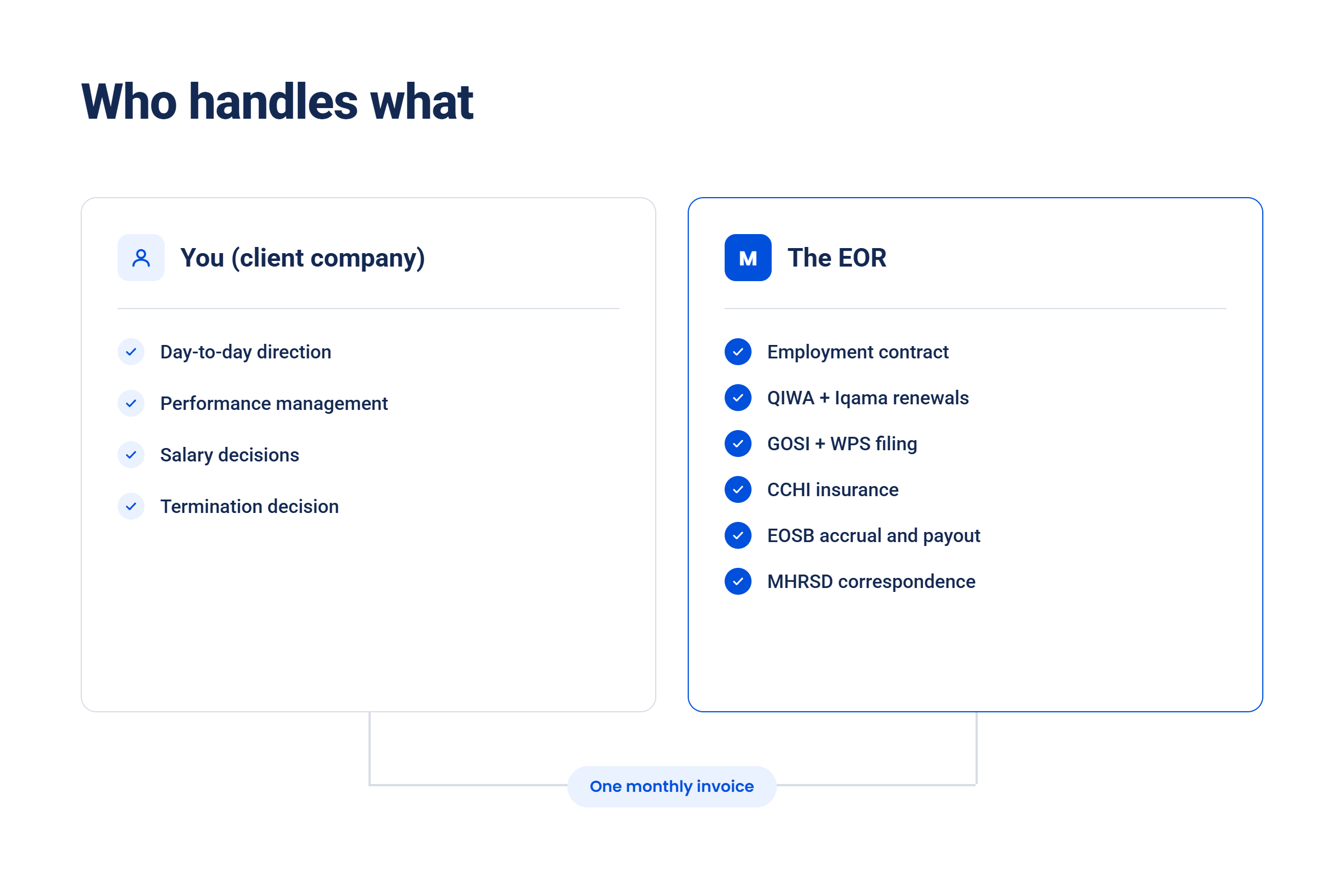
| Responsibility | Client company (you) | EOR |
|---|---|---|
| Day-to-day work direction | ✓ | |
| Performance management | ✓ | |
| Salary decisions and bonuses | ✓ | |
| Employment contract | ✓ | |
| QIWA registration and renewals | ✓ | |
| GOSI registration and monthly remittance | ✓ | |
| WPS payroll filing (Mudad) | ✓ | |
| CCHI health insurance | ✓ | |
| EOSB accrual and payout | ✓ | |
| Iqama processing and renewals | ✓ | |
| Annual leave tracking | Approval | Records |
| Termination decision | ✓ | |
| Termination execution (visa cancellation, EOSB payout) | ✓ | |
| MHRSD correspondence | ✓ | |
| Nitaqat tier maintenance | ✓ | |
| Tax filings in your home country | ✓ | Supporting documentation |
If a Ministry letter arrives at your desk, forward it to your EOR. The letter should have gone to them, not to you.
Five things that can go wrong (and how to avoid them)
Ultimately, these are the actual failure modes I see, not hypothetical ones.
1. The EOR Nitaqat tier slips mid-onboarding
If the EOR is on Yellow or Red, no new visas are issued at all. Your outside-country hire waits until the tier is fixed, which can take months.
Prevention: get the current Nitaqat tier in writing before signing. Ask again quarterly.
2. The previous sponsor will not sign the release letter
For in-country transfers, the candidate current employer has to approve the transfer through MHRSD. If they refuse or drag their feet, the transfer stalls (QIWA runs an automatic countdown if the request is ignored, but the delay still costs you the start date).
Prevention: confirm the candidate has a signed release letter (or an approved transfer request on QIWA) before you commit a start date.
3. Degree attestation gets stuck at MOFA
The 30-day degree attestation is the most fragile part of an outside-country hire. Missing seals, name mismatches between passport and degree, or a degree from an unrecognized institution can add weeks.
Prevention: send the degree for attestation on day one, in parallel with everything else. Verify the awarding institution is on the Saudi embassy recognized list.
4. The employment contract salary split is wrong
If Basic is under 60% of gross, GOSI and EOSB calculations are lower. That lowers the employer’s contributions, but it also cuts the employee’s EOSB and GOSI base.
Prevention: stick to the 60/25/15 Basic/Housing/Transportation split for standard contracts; any structure is lawful as long as Basic is clearly stated and total pay meets the applicable minimum for the role.
5. The EOR uses a partner network without telling you
Many global providers “operate” in Saudi Arabia through a local partner. The partner is the employer of record on paper. You inherit the partner Nitaqat tier and communication speed, not the global brand.
Prevention: ask directly: “Do you own the Saudi entity, or do you contract with a local partner?” Get the answer in writing.
When you should NOT use an EOR
Overall, the EOR route is the right call for most first-time Saudi hirers. It is the wrong call in three specific scenarios.
Firstly, you already have 15 or more employees in Saudi Arabia. At that scale, running your own Saudi entity often costs less per head than an EOR. The break-even point is roughly 10 to 15 employees, pulled down by Saudization (Nitaqat) quota management, which forces meaningful Saudi hiring well before the 30-headcount mark.
Secondly, you need a formal Saudi corporate presence to bid on government contracts. Under the Regional Headquarters (RHQ) Program, bidding on contracts with government bodies, ministries, and state-backed funds (including the Public Investment Fund) requires an RHQ entity; neither a basic MISA-registered entity nor an EOR qualifies you. An EOR is an employer of record, not a bidding vehicle.
Thirdly, you want long-term brand equity as a Saudi-registered company. For strategic positioning reasons, some multinationals want the “we have a Saudi entity” line on their materials. An EOR does not provide that.
In short, for everyone else the EOR path saves six months and six figures. If you are not sure which category you are in, hire the first person through an EOR while you decide.
How to pick a Saudi EOR
Additionally, the provider comparison is a full article of its own (see internal link below to “Best EOR Companies in Saudi Arabia 2026”). The short version: ask five questions of any provider before signing.
- Do you own the Saudi entity, or do you use a local partner?
- What is your current Nitaqat tier, in writing?
- What is your ISTIQDAM license number?
- What is the fixed SAR fee per employee per month, inclusive of VAT?
- How long from signed offer to first paycheck for an in-country transfer?
Ultimately, the answers decide the shortlist, not the marketing website. These five questions are the fastest way to vet any partner you use to hire employees in Saudi Arabia without a local company.
Frequently asked questions
Common questions about how to hire employees in Saudi Arabia without a local company, answered below.
Can I hire employees in Saudi Arabia without a local company?
Yes. A licensed Employer of Record (EOR) under the ISTIQDAM framework can legally employ your workers under its own Saudi entity while you direct the day-to-day work. You do not need to register a Saudi entity, appoint a resident director, or file with MISA.
How long does it take to hire in Saudi Arabia through an EOR?
About 19 working days for an in-country transfer (candidate already in Saudi Arabia on someone else Iqama). About 68 working days for an outside-country hire from a GAMCA country. Western-passport hires are often faster, subject to consular processing.
Do I need a Saudi entity to hire employees?
No. The EOR model is legally recognized in Saudi Arabia under the ISTIQDAM manpower licensing framework administered by MHRSD. A licensed EOR is the legal employer. You are the operational client.
Can I hire independent contractors in Saudi Arabia instead?
Only if the work is genuinely project-based and the person has their own clients, tools, and hours. If they work full-time for you, they are an employee under Saudi labor law regardless of what your invoice says. The misclassification risk lands first on the worker (fines, deportation, re-entry bans), since MHRSD cannot easily fine an offshore company, and the record can block your future Saudi hiring.
What documents does the candidate need?
For an outside-country hire: passport (6+ months validity), photo, MOFA-attested degree, medical certificate, and police clearance. For an in-country transfer: passport, photo, existing Iqama copy, and a release letter from the previous sponsor.
What is QIWA?
QIWA (qiwa.sa) is the Saudi government platform run by MHRSD for labor and visa management. Employers use it for work permit applications, contract registration, Nitaqat status, and sponsorship transfers.
What is Mudad?
Mudad (mudad.com.sa) is the Wage Protection System (WPS) platform. Every private-sector salary in Saudi Arabia must be reported through Mudad; salaries themselves are paid by bank transfer, and Mudad carries the WPS file that proves the payment was made correctly. Your EOR handles WPS filing on your behalf.
What is Nitaqat?
Nitaqat is the Saudi nationalization program. Every company operating in Saudi Arabia sits in one of five tiers (Platinum, Green, Yellow, Red) based on its Saudi-to-expat headcount ratio. When you hire through an EOR, you inherit the EOR Nitaqat tier. Green or Platinum tier EORs can onboard expats fast. Yellow or Red tier EORs cannot onboard them at all.
What is the probation period in Saudi Arabia?
Specifically, standard probation is 90 days, extendable to 180 with written consent from both parties. No EOSB accrues during probation. Either party can terminate during probation without notice.
How does payroll work?
Typically, the EOR invoices you between the 10th and 15th of the month. You pay. The salary lands in the employee Saudi bank account between the 26th and 28th by bank transfer, with the WPS file submitted through Mudad. GOSI is remitted by the 15th of the following month. Payslips are issued at month-end.
Can I hire in NEOM through an EOR?
Indeed, NEOM operates under the Saudi national labor framework, so a licensed EOR with active QIWA workflows can onboard NEOM-based employees under standard Saudi employment rules. Some NEOM-specific incentives (residence-permit categories, tax treatment) may apply. Check with the EOR before signing.
Can EU, UK, US, and Canadian citizens legally work in Saudi Arabia?
Yes. In particular, Western passport holders can work under the standard Saudi employment framework via an EOR. The GAMCA network does not apply to them; the pre-arrival medical runs through embassy-approved practitioners instead. Iqama processing follows the same 68-day (or faster) outside-country path.
Do I need to file Saudi taxes if I hire through an EOR?
Importantly, for your company outside Saudi Arabia, hiring through an EOR does not by itself create a taxable presence in Saudi Arabia. The EOR handles Saudi corporate income tax and Zakat obligations for its own entity. Consult a tax advisor before assuming. Specific facts (contract structure, sales into KSA, permanent-establishment risk) can change the answer.
What happens if my EOR loses its ISTIQDAM license?
This is rare but not impossible. Consequently, if it happens, your Saudi employee sponsorship must transfer to another licensed provider or to your own entity within a defined window (typically 60 days) to avoid becoming an overstay case. Ask your candidate EOR: “What is your business continuity plan if your ISTIQDAM license lapses?” A serious provider will have one.
What to do next
If you want to hire employees in Saudi Arabia without a local company and want a direct EOR that handles the full sequence above (QIWA registration, ISTIQDAM licensing, Green Nitaqat, Mudad payroll, GOSI, CCHI), send us a message. We employ people in Saudi Arabia through our own entity every month. If your situation calls for a different provider, we will say so. If your team size means you would be better off opening your own entity, we will say that too. The EOR vs entity comparison has the math (see related articles below).
Related articles on masdareor.com
- How Much Does an Employer of Record Cost in Saudi Arabia? (Full 2026 pricing breakdown)
- Best EOR Companies in Saudi Arabia 2026: 7 Providers Compared
- EOR vs Setting Up a Legal Entity in Saudi Arabia: Full 2026 Cost and Time Comparison
- Direct EOR vs Aggregator EOR in Saudi Arabia (Saudization Angle)
Authoritative references
- QIWA (labour and visa platform): qiwa.sa
- MHRSD (Ministry of Human Resources and Social Development): hrsd.gov.sa
- GOSI (social insurance): gosi.gov.sa
- Mudad (WPS payroll): mudad.com.sa
- Muqeem (corporate residency and Iqama services): muqeem.sa
- MOFA (foreign affairs, degree attestation): mofa.gov.sa
- MISA (Ministry of Investment): misa.gov.sa
- ZATCA (tax and customs): zatca.gov.sa
- CCHI (health insurance): cchi.gov.sa
- Saudi Council of Engineers: saudieng.sa
Last updated: July 2026. Regulations and platform interfaces update over time. Verify specific processes against QIWA, MHRSD, and MOFA official channels before final commitment.hire employees in Saudi Arabia without a local company
More guides in: EOR & PEO