


Every week, I get the same email from a different company.
“We want to hire someone in Dubai. We don’t have a UAE entity. What are our options?”
It’s a fair question. Setting up a UAE company takes months and costs a small fortune. Most foreign employers don’t want that headache for their first one, five, or even fifteen hires.
The good news: you don’t need to. UAE law gives foreign companies three legal paths to hire employees in UAE without a company of your own. The catch is that only one of them works well for most use cases. The other two have traps that catch out almost everyone the first time.
I’ve spent 10 years in this industry. In that time, I’ve watched companies do this brilliantly. I’ve also watched them get hit with MoHRE fines, visa cancellations, and tax demands they didn’t see coming. This guide is everything I wish more foreign employers knew before they made their first UAE hire.
Talk to a UAE EOR specialist →
Why hiring in UAE without a company is now common
A decade ago, a foreign company hiring in UAE usually meant setting up a free-zone entity first. The process took 8 to 12 weeks. The cost ran into tens of thousands of dirhams. And once you had the entity, you carried the overhead forever — even if your UAE team stayed small.
That model still exists. But it stopped being the default about five years ago. Three things changed.
First, UAE law made it easier for licensed local providers to sponsor visas on behalf of foreign clients. Direct Employer of Record arrangements became the norm. Second, the rise of global remote work pushed more companies into UAE without a permanent commitment. They wanted speed and flexibility, not a five-year office lease. Third, the 2023 introduction of 9% UAE Corporate Tax changed the maths. Now even an established entity comes with compliance costs that didn’t exist before.
Today, the large majority of foreign companies hiring their first UAE employee skip entity setup entirely. They use one of three legal paths — Employer of Record, independent contractors, or staffing agencies. Most stick with that model until their UAE team grows beyond 25 employees. Some never set up an entity at all.
TL;DR: your 3 legal paths to hire in UAE
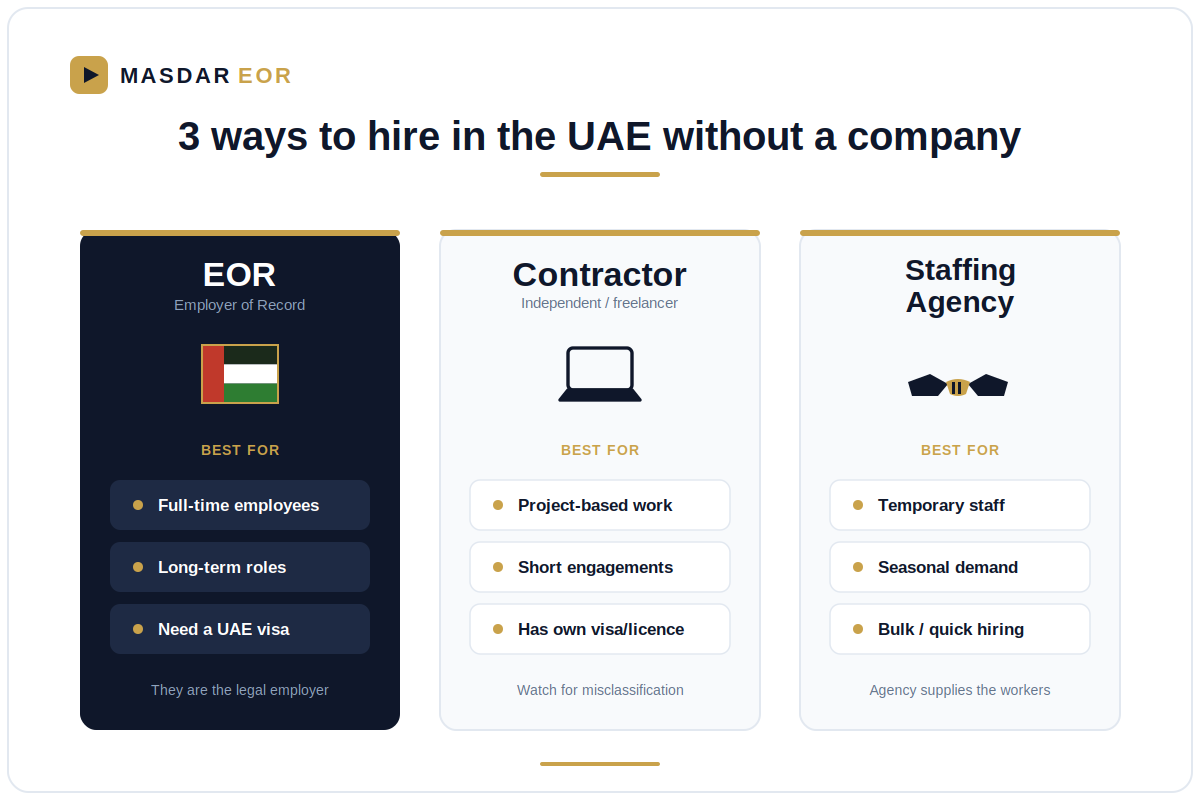
Here is the short version. The detailed breakdown follows below.
| Path | Best for | Compliance risk | Speed |
|---|---|---|---|
| Employer of Record (EOR) | Full-time hires, long-term workforce, visa sponsorship | Low — direct compliance with UAE labour law | ~20 days in-country |
| Independent contractors | Genuinely project-based work with clear end dates | High if misused — strict misclassification rules | Days, if contractor already has a UAE permit |
| Staffing agencies / secondment | Temporary, rotational, or short-project labour | Medium — varies by agency model | 1–3 weeks |
In practice, EOR covers most foreign-employer use cases. Contractors work for niche scenarios — short projects, freelancers with their own visas, dual-arrangement consultants. Staffing makes sense for rotational labour on a project. The trick is choosing the right one. Pick wrong and you’ll end up with a MoHRE complaint, a tax exposure, or a worker you can’t legally retain.
Path 1: Employer of Record (EOR) — the recommended route
An Employer of Record is a UAE-licensed company that legally employs your team on your behalf. The EOR holds the MoHRE establishment licence, sponsors the visa, runs WPS payroll, and handles every employment-related compliance step. You manage the day-to-day work, deliverables, and performance.
How an EOR works in UAE
The legal employer of your hire is the EOR — not you. That’s the entire mechanism.
Here is what that looks like in practice. You find the candidate. You agree salary and start date. The EOR drafts a bilingual UAE Labour Law contract in its own name. The employee signs with the EOR. The EOR sponsors the work visa, runs the medical, issues the Emirates ID, and processes payroll monthly through a UAE-licensed bank account using the Wage Protection System.
You and the EOR sign a separate service agreement. That agreement covers all your current and future UAE hires. You pay the EOR a monthly fee per employee, plus the statutory costs (visa, medical, EOSB accrual). The employee reports to you, uses your systems, and works on your projects. From your perspective, they’re your team. From UAE’s perspective, they’re the EOR’s employee.
This is a fully legal arrangement under UAE Labour Law and the licensing framework that governs direct manpower providers. It’s the same model used by Fortune 500 companies, defence contractors, and global tech firms entering the GCC.
What’s included in an EOR engagement
A direct UAE EOR typically takes care of:
- UAE work entry permit application via MoHRE
- Medical fitness coordination and Emirates ID registration
- Residence visa stamping via GDRFA
- Bilingual employment contract (English + Arabic)
- WPS-compliant monthly payroll
- Mandatory health insurance enrolment
- End-of-service gratuity (EOSB) monthly accrual
- Full UAE Labour Law compliance
- Emiratization handling via the NAFIS programme
- Termination, visa cancellation, and final settlement when the engagement ends
You shouldn’t have to chase any of this separately. If a provider tells you that visa processing, payroll, or Emiratization is handled by a “local partner,” you’re not talking to a direct EOR. You’re talking to an aggregator who’ll add 20–40% margin on top of what the partner charges. More on that distinction later.
When EOR is the right path
EOR is the right answer if any of these apply:
- You want a full-time UAE employee with visa sponsorship
- The relationship will run longer than 6 months
- You don’t have a UAE entity (or your headcount is under ~25)
- You need clean compliance and one accountable team
- You’re entering UAE to test the market before deciding on entity setup
In 10 years of running EOR engagements, I’ve yet to see a use case where EOR was the wrong path for a foreign employer hiring 1–20 people. Larger teams sometimes outgrow the model. Most don’t.
Get a UAE EOR quote — typically returned within hours →
Path 2: Independent contractors — when it works (and when it doesn’t)
Hiring UAE contractors looks like the easy way out. No visa to sponsor. No MoHRE filings. No mandatory benefits. You just pay invoices.
It works — but only in narrow scenarios. Use it wrong and you’ll end up paying back-dated EOSB, dealing with MoHRE complaints, and potentially exposing your foreign company to UAE corporate tax.
When contractor engagement is legal in UAE
A contractor relationship is legitimate when the contractor:
- Has their own valid UAE freelance permit or business licence
- Works on defined deliverables with a clear end date
- Works for multiple clients — not exclusively for you
- Controls how, when, and where the work gets done
- Issues invoices in their own name through their own legal entity
- Owns their own tools and equipment
Think: a marketing consultant running an agency, a freelance designer with a Green Visa, a fractional CFO who serves five companies. They’re genuinely independent. Their relationship with you is project-based.
How UAE law determines worker classification
Here’s where most foreign employers get into trouble. UAE labour authorities don’t care what your contract calls the relationship. They look at how it actually functions.
The key factors UAE authorities weigh:
- Control: who decides when, where, and how the work happens?
- Exclusivity: does the person work full-time for you, or for multiple clients?
- Duration: is the engagement a defined project, or an open-ended role?
- Tools and systems: whose laptop, whose email, whose workflow?
- Integration: is the person part of your team meetings, reporting lines, performance reviews?
- Payment structure: regular monthly retainer that looks like salary, or genuine project invoices?
If the relationship looks like employment — full-time hours, your direction, your systems, ongoing — UAE law treats it as employment. The “contractor” label doesn’t matter. The contractor gets reclassified, and you get the bill.
The permanent establishment (PE) tax risk
This part almost nobody talks about. It might be the most expensive mistake foreign employers make.
UAE introduced 9% corporate tax in June 2023. The tax applies to UAE-source business income. If your foreign company pays UAE-based individuals to do core business work for you, UAE tax authorities can argue your company has a permanent establishment in UAE — and tax your foreign entity at 9% on the UAE-attributed profit.
PE risk is highest when:
- The “contractor” does core work (sales, engineering, account management — not just admin)
- The arrangement is long-term and continuous
- The person represents your company externally
- The work generates revenue attributable to UAE
PE risk is fact-specific — consult a UAE tax advisor for an assessment of your particular arrangement.
A direct EOR removes this risk entirely. The EOR is the legal employer on its own UAE entity. Your foreign company has no UAE-source income, no UAE workforce, no PE exposure.
A long-running “contractor” relationship doesn’t remove the risk. It often creates it.
For more on the classification rules, see our guide on contractor vs employee compliance in the GCC.
Path 3: Staffing agencies and secondment — narrow use cases
Staffing agencies and secondment arrangements suit specific situations. They rarely fit long-term workforce building.
Staffing agencies
A UAE staffing agency employs the worker on its own licence and assigns them to you on a contract basis. You direct the day-to-day work; the agency handles employment, benefits, and visa.
This works for rotational labour — warehouse workers on a six-month project, event staff for an exhibition, security personnel for a construction site. Fees are usually high. Worker continuity is limited. And the agency typically charges a markup of 15–30% above gross salary on top of the worker’s wage.
For full-time, role-based hires, staffing usually costs more than EOR and offers less continuity.
Secondment from your foreign entity
Some companies want to “second” an employee from their home-country payroll to UAE temporarily. The idea: keep them on the home contract, just have them work in UAE for a while.
In strict legal terms, UAE labour law requires anyone working in UAE to be sponsored by a UAE-licensed entity. True cross-border secondment without local sponsorship usually creates compliance gaps. The seconded employee technically needs a UAE visa, which requires a UAE sponsor — which means an entity or an EOR.
A direct EOR can support a secondment-style arrangement compliantly. The EOR employs the seconded individual on its own UAE entity. The foreign parent pays the EOR. The employee keeps reporting to you. This is common for assignments lasting 3–24 months.
Comparing the 3 paths: cost, speed, and compliance
| Factor | EOR | Contractor | Staffing agency |
|---|---|---|---|
| Visa sponsorship | Yes — by the EOR | Contractor sponsors themselves | Yes — by the agency |
| Speed to start | ~20 days in-country, ~33 days outside | Days if already permitted | 1–3 weeks |
| Compliance burden on you | Minimal — EOR handles it | High — you carry classification risk | Low — agency handles it |
| Long-term suitability | Excellent | Poor (most cases) | Poor — agency model adds cost |
| Scaling | Easy — same model, more hires | Difficult — each hire is separately permitted | Possible but expensive |
| PE tax risk | None | High if long-term, full-time | None |
| Emiratization | Handled by EOR | Not relevant | Handled by agency |
| Termination handling | EOR runs cancellation + EOSB | You negotiate with the contractor | Agency handles |
| Cost transparency | Itemised fee + statutory pass-throughs | Invoice-based, often opaque on total cost | Markup over salary, often 15–30% |
| Best use case | Full-time UAE roles, 1–25 employees | True project-based work, freelance professionals | Rotational labour, short projects |
The honest answer in most situations: EOR wins on every dimension except the very specific “I need a UAE freelancer for one project” scenario.
UAE visa types every foreign employer should understand
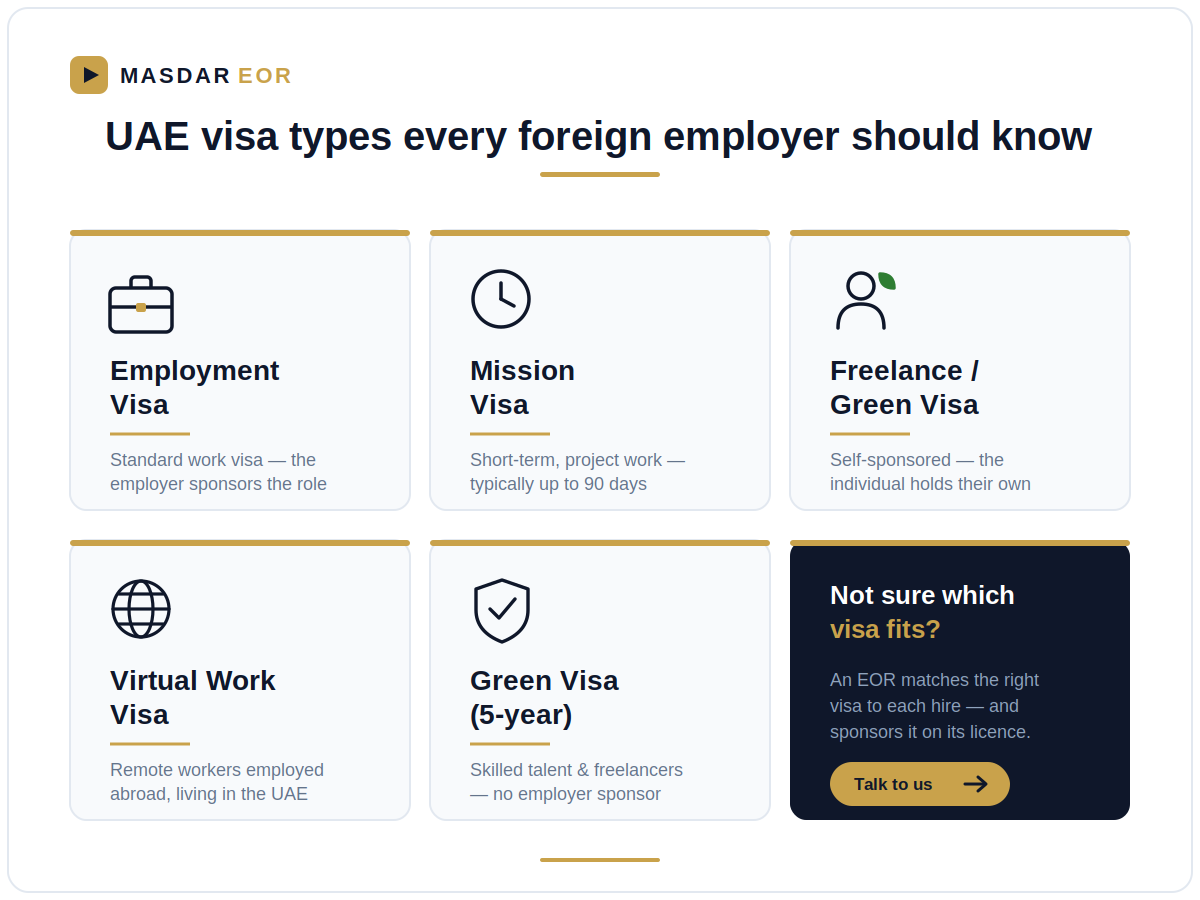
The UAE has more visa types than most countries. Knowing which one fits your hire matters — both for compliance and for cost.
Employment Visa (standard work visa)
The most common visa. The employer (you, via your entity or EOR) sponsors the employee for a residence visa valid 2 years (renewable) and a MoHRE work permit. The employee gets an Emirates ID, residence stamping, and labour card. This is what an EOR sponsors.
Most foreign employees in UAE work on Employment Visas. If you’re hiring someone full-time and they don’t already live in UAE, this is the visa they’ll need.
Mission Visa (short-term assignment)
A short-term work permit issued for up to 90 days, typically renewable once. Doesn’t include a residence visa. Used for engineers flown in for a specific installation, consultants on a defined assignment, or trainers running a 60-day programme.
Mission Visas suit very narrow use cases. They aren’t a substitute for proper employment for long-term roles.
Freelance and Green Visa
UAE has expanded freelance permits significantly since 2022. A freelancer with a valid permit (issued by free zones like Dubai Media City, Dubai Internet City, or by federal Green Visa programmes) can legally invoice multiple clients.
For you as a foreign employer, this matters: if the contractor you want to engage already holds a freelance permit, you can hire them as a contractor compliantly. They sponsor themselves. You just pay invoices.
The Green Visa is a 5-year self-sponsored residence visa, available to skilled professionals meeting income and qualification thresholds. It removes the need for employer sponsorship — useful for highly-skilled independent consultants.
Virtual Work (Remote Work) Visa
Introduced in 2021, the Virtual Work Visa lets foreign employees live in UAE while working for a non-UAE employer. The visa is sponsored by the individual, not the employer. The individual proves they meet a minimum monthly income threshold, hold valid health insurance, and continue working for their overseas company. The exact income requirement is set by the UAE government and is updated periodically — confirm the current figure on the official UAE portal before applying.
The Virtual Work Visa is a useful option for digital nomads and individual remote workers. It is not a vehicle for building a UAE team. Each employee sponsors themselves, you remain a foreign employer with UAE-based individuals, and the PE tax question still applies if those individuals do core work for you.
Dubai vs Abu Dhabi — what differs for foreign employers
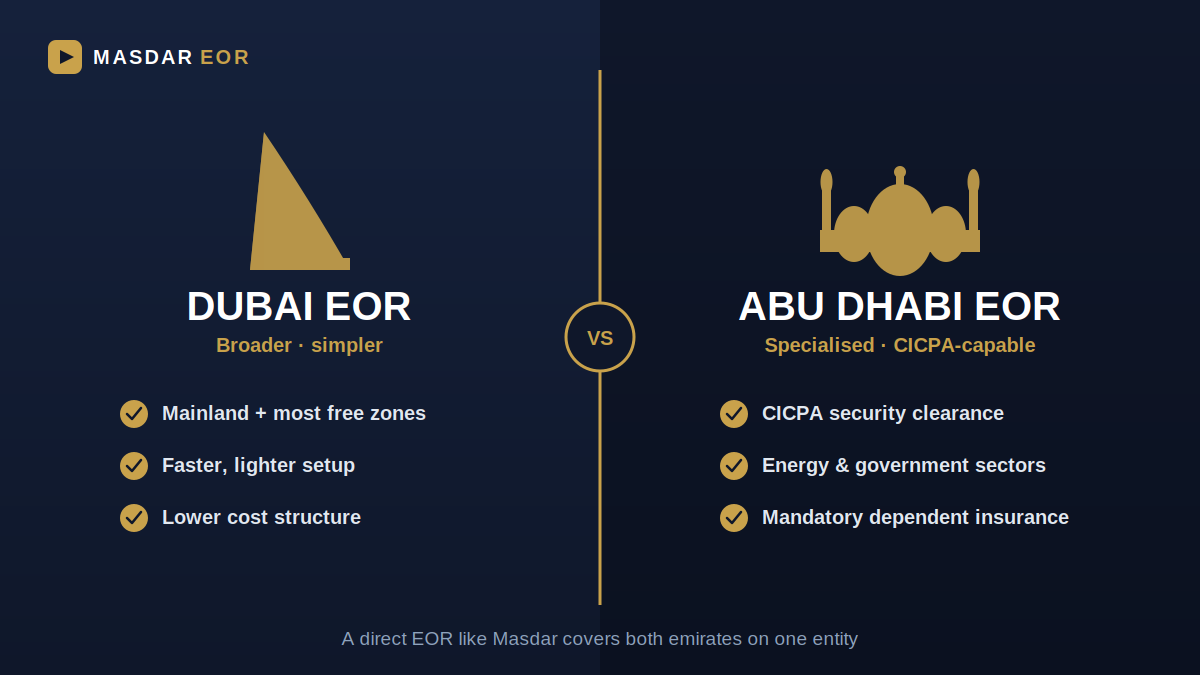
Most foreign employers think of “UAE” as one market. It isn’t.
Dubai — broader, cheaper, simpler for most hires
Dubai handles the large majority of foreign-employer UAE hires. Tech, sales, marketing, operations, finance, customer success — Dubai is the default choice.
What Dubai gives you:
- Broad free-zone coverage (DMCC, JAFZA, Dubai Internet City, Dubai Media City, and more)
- Mandatory health insurance for the employee only (spouse and children optional)
- Cleaner Emiratization compliance for foreign-employer EOR setups
- Generally lower management fees
Abu Dhabi — specialised, stricter, costlier
Abu Dhabi makes sense for specific roles. Three things drive that:
CICPA security clearance — required for anyone working on critical infrastructure sites in Abu Dhabi. Oil and gas, energy, government, defence, and certain transport sectors all need CICPA-cleared workers. You can only get CICPA passes through an Abu Dhabi entity or an EOR with Abu Dhabi capability.
Dependent insurance mandate — Abu Dhabi requires the employer to provide health insurance to the employee, spouse, and up to three children. Dubai doesn’t.
Stricter Emiratization rules — Abu Dhabi quotas can be harder to manage for specific industries.
Net effect: Abu Dhabi EOR fees typically run 30–50% higher than Dubai. Default to Dubai unless your role requires CICPA or Abu Dhabi-specific sponsorship.
DIFC and ADGM — the financial zones
DIFC (Dubai International Financial Centre) and ADGM (Abu Dhabi Global Market) operate under their own English common-law-based employment frameworks — not federal UAE Labour Law. If you’re hiring for finance, legal, asset management, or fintech roles physically based inside DIFC or ADGM, the employment contract follows the zone’s specific rules.
Most direct UAE EORs cover DIFC and ADGM through their mainland establishment plus zone-specific arrangements. Verify with any provider before signing.
Realistic UAE hiring timelines (not the marketing claims)
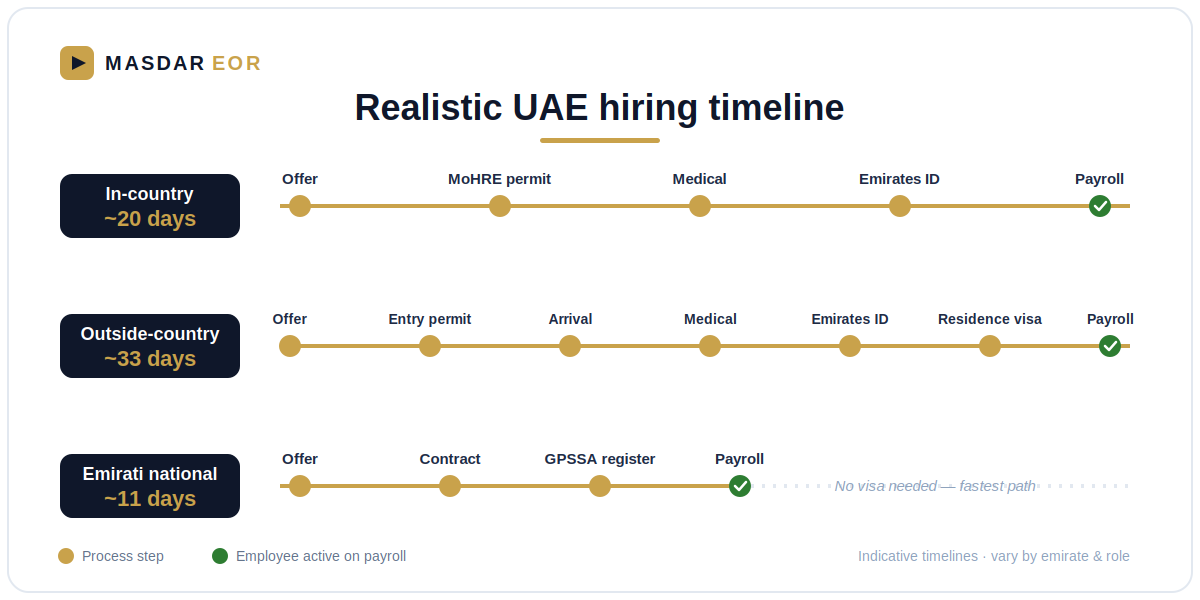
Almost every EOR website promises “hire in 3 to 5 days.” That number is misleading for most cases. Here are the realistic timelines based on our actual MoHRE processing experience.
Candidate already in UAE with active residency
If your hire currently lives in UAE on another sponsor’s visa, the process involves cancelling the previous visa, then re-onboarding under the new sponsor. Realistically, this takes about 20 days end-to-end. The steps:
- Days 1–3: Offer signed, MoHRE labour application submitted
- Days 4–10: Work permit issued, employee can legally start working
- Days 11–15: Medical screening and Emirates ID biometrics
- Days 16–20: Residence visa stamped, Emirates ID issued
Health insurance enrolment runs in parallel and takes about 14 working days.
Candidate outside UAE
If your hire needs to be brought into UAE from abroad, the process is longer. Plan for about 33 days end-to-end. Steps include MoHRE application, GAMCA medical (for some nationalities), police clearance (if required), work entry permit, travel to UAE, in-country medical, EID biometrics, residence visa stamping, and EID issuance.
Emirati national hires
UAE national onboarding is faster — typically about 11 days — because there’s no visa sponsorship step. GPSSA or ADPF pension registration runs in parallel.
If a provider promises faster timelines than these for a fresh visa-sponsored hire, ask them to break down which steps they’re skipping. The MoHRE process steps aren’t optional and the times are largely fixed by regulation.
For more on the cancellation side of the timeline, see our guide on cancelling a previous UAE work visa.
UAE Labour Law essentials every employer needs to know
UAE Labour Law is governed by Federal Decree-Law No. 33 of 2021 — the most significant overhaul in decades. Here are the parts that matter for every foreign employer hiring through any of the three paths.
Working hours
Maximum 48 hours per week, 8 hours per day. Reduced by 2 hours daily during Ramadan. Overtime pays a 25% premium on regular hours, 50% at night, 150% on holidays.
Probation period
Maximum 6 months. Once set, it can’t be extended. Notice during probation: 14 days if the employer terminates, 30 days if the employee resigns and stays in UAE, 14 days if they’re leaving the country.
Annual leave
30 calendar days per year after one year of service. Employees who have completed 6 months get 2 days per month. Unused days can be carried over with employer consent. Unused leave must be paid out on termination.
Sick leave
Up to 90 days per year after probation. The first 15 days at full pay, days 16–45 at half pay, the remaining 45 days unpaid. A medical certificate is required.
Maternity leave
60 days for female employees: 45 days at full pay, 15 at half pay. An additional 45 days unpaid if there’s a pregnancy-related medical condition. After birth, an hour per day for nursing breaks until the child is six months old.
End-of-service gratuity (EOSB)
The big one. Every employee with one year or more of service is entitled to gratuity on termination:
- First 5 years: 21 days of basic salary per year
- After 5 years: 30 days of basic salary per year
- Cap: total gratuity can’t exceed 2 years of basic salary
A common UAE practice splits gross salary into 60% basic + 40% allowances. Gratuity is calculated on the basic component. A direct EOR accrues gratuity monthly on your invoice, so the liability never piles up unexpectedly. For the full calculation method, see leave salary and EOSB in the UAE.
Notice period (post-probation)
Minimum 30 days, maximum 90 days, depending on the employment contract. Senior roles often carry 90-day notice. Either party can terminate with proper notice; either party can pay in lieu of notice.
Mandatory health insurance
Required for every employee. Dubai requires DHA-compliant plans. Abu Dhabi requires DOH-compliant plans plus mandatory coverage for spouse and three children. For full details, see our guide on UAE Labour Law.
Emiratization and NAFIS — what foreign employers need to know
Emiratization is the UAE government’s programme to increase the share of UAE nationals in private sector workforces. If you’re hiring at scale, this matters.
The current rules: private companies with 50 or more skilled employees must hire UAE nationals under the NAFIS programme. The annual target increases by 2% per year, with a cumulative goal of approximately 10% of the skilled workforce by the end of 2026. Compliance is tracked through the NAFIS platform. Missing the quota triggers a fine of AED 96,000 per year per missing Emirati hire — and exclusion from government contracts.
For foreign employers below 50 skilled employees, Emiratization isn’t yet mandatory. But once you scale, it becomes critical.
A direct UAE EOR handles this in two ways. First, it registers eligible Emirati hires on NAFIS and tracks your quota progress. Second, it processes GPSSA (Dubai-based Emiratis) or ADPF (Abu Dhabi-based Emiratis) pension contributions — at the rates set under Federal Decree-Law No. 57 of 2023.
Most global EOR platforms don’t address Emiratization on their UAE pages. If yours doesn’t, you’ll face the gap alone once you cross 50 employees.
5 common mistakes when hiring in UAE without a company
Ten years in this industry, the same five mistakes show up again and again. Here’s what to watch for.
1. Paying a UAE-based individual without sponsorship
Working remotely from UAE for your foreign company sounds simple. Legally it isn’t. If the person doing the work lives in UAE, they need legal status in UAE — either their own visa, or sponsored employment. Paying them as a “remote contractor” while they physically live in UAE creates compliance exposure for both sides.
Working without proper documentation can trigger fines starting at AED 50,000 plus deportation and re-entry bans for the employee. The employer faces the same fines plus possible imprisonment.
2. Treating a long-term contractor like an employee
If your “contractor” works exclusively for you, follows your schedule, uses your tools, attends your team meetings, and has done so for many months — UAE labour law will treat them as an employee. The contractor wins back-paid EOSB, benefits, and notice. You face MoHRE complaints and potential fines.
The rule of thumb I give clients: if you’d be uncomfortable describing the contractor’s role to a labour inspector, you have a classification problem.
3. Choosing an EOR that sub-contracts
Most “global EOR” platforms route UAE employment through a local partner. Sometimes they’re transparent about it. Often they aren’t.
The signs you’re dealing with an aggregator rather than a direct EOR: their UAE page references “our local partner,” they can’t show you their own MoHRE establishment card, the WPS bank account is in someone else’s name, they can’t quickly answer Emiratization questions.
The cost of using an aggregator: 20–40% extra in stacked margin, slower visa processing, split accountability when things go wrong. For more on this distinction, see our guide on direct EOR vs aggregator EOR in the GCC.
4. Believing the “1-day hiring” marketing
I’ve seen providers advertise UAE hiring in as little as 24 hours. For visa-sponsored employment, that’s marketing fiction. The MoHRE and GDRFA process steps have fixed minimum times. Anyone claiming faster is either describing a different scenario (contractor onboarding, not employment) or skipping compliance steps you’ll regret later.
Be sceptical of any provider whose hiring promises sound too good for UAE’s regulatory reality.
5. Ignoring Emiratization until it’s too late
I’ve watched companies grow from 12 employees to 60 in 18 months without anyone tracking Emiratization. The day they cross 50 skilled employees, they’re out of compliance. The MoHRE notice arrives. The fines start at AED 96,000 per year per missing Emirati hire.
If you plan to scale in UAE, build Emiratization into your hiring plan from day one. A direct EOR will track this for you. Most aggregators won’t.
Direct EOR vs aggregator EOR — the distinction that decides cost and risk
This single distinction matters more than any other when choosing an EOR. I’ve covered it in depth elsewhere, but here’s the short version.
A direct EOR holds its own MoHRE establishment licence. It employs your team on its own UAE entity. WPS payroll runs through its own UAE-licensed bank account. Visa applications go through its own PRO team. One accountable provider.
An aggregator EOR doesn’t hold a UAE licence. It resells a local partner’s licence and adds margin on top. Your employee is legally employed by a third party you’ve never contracted with. Visa and payroll go through extra handoffs. Accountability splits across vendors.
The cost gap is real. Aggregators typically add 20–40% margin on top of the local partner’s fee. Pass-throughs (visa, medical) often carry additional markup. The same UAE hire usually costs 15–30% less through a direct EOR.
The risk gap is also real. When something goes wrong — a delayed visa, a labour case, a WPS rejection — direct EORs resolve it in-house. Aggregators escalate to the partner, who escalates back to the platform, who responds to you. Days become weeks.
For the full evaluation framework, see our UAE EOR buyer’s guide. It includes the seven questions to ask any UAE EOR before signing.
How to choose the right path for your hire
Here’s a quick decision framework. It works for most foreign employer situations.
Choose EOR if any of these apply:
- You want a full-time UAE employee with visa sponsorship
- The relationship will run longer than 6 months
- You don’t have a UAE entity (or your headcount is under 25)
- You need one accountable team handling visa, payroll, and compliance
- You’re testing the UAE market before committing to entity setup
Choose contractor if all of these apply:
- The work is genuinely project-based with a defined end date
- The contractor holds their own freelance permit or business licence
- They work for multiple clients, not exclusively for you
- They control how, when, and where the work happens
Choose staffing agency if:
- You need temporary or rotational labour
- The work is operational (warehouse, events, security) rather than strategic
- Continuity isn’t critical
Choose your own UAE entity if:
- You’re committing to 25+ UAE employees long-term
- You need your own licence for a regulated activity
- You have the revenue and operational scale to absorb the overhead
Most foreign employers in their first 1–2 years in UAE land on EOR. It’s the only path that combines speed, compliance, and scalability. The other paths fit narrower scenarios.
Talk to a UAE EOR specialist about your specific hire →
When to transition from EOR to your own UAE entity
EOR isn’t forever. Here’s when the maths typically flips.
The cost trade-off works like this. EOR is variable cost — you pay per employee per month. Entity setup is fixed cost — you pay for the licence, office, audit, and PRO retainer whether you have 1 employee or 50.
Below about 15 UAE employees, EOR is almost always cheaper. The fixed costs of an entity outweigh the per-employee management fees of an EOR.
Between 15 and 25 employees, the maths gets close. The right answer depends on your visa quota needs, growth velocity, and whether you need to do things only an own-entity can do (apply for government contracts, hold certain regulated licences, raise UAE capital).
Above 25 employees long-term, entity setup usually wins on cost alone. The fixed costs spread across more headcount, the per-employee EOR fee gets expensive at scale.
A good direct EOR will tell you honestly when you’ve crossed the threshold. The smart ones run the maths for you. We’ve helped multiple clients transition from EOR to their own entity once their UAE team grew past 25–30 employees. The transition itself usually takes 8–12 weeks while we run both arrangements in parallel.
Step-by-step: hiring your first UAE employee through an EOR
Five steps. Roughly 20 to 33 days end-to-end depending on whether your candidate is in-country or not.
Step 1 — Select your candidate
You identify the person. Either a new hire, a contractor you’re converting, or someone transferring from your home country.
Step 2 — Sign one Master Service Agreement
The EOR provides a single MSA that covers all current and future UAE hires. You don’t need a new contract for each employee.
Step 3 — Issue the UAE employment contract
The EOR drafts a bilingual UAE Labour Law-compliant contract in its own name as legal employer. The employee signs it. You sign the service agreement.
Step 4 — Sponsor the visa and onboard
The EOR’s PRO team handles MoHRE work permit, GDRFA residence visa, medical fitness, Emirates ID, labor card, bank account opening, and health insurance enrolment. Your involvement here is minimal — you provide candidate documents, the EOR runs the process.
Step 5 — Monthly WPS payroll begins
The EOR processes monthly payroll through a UAE-licensed bank account. WPS submission to MoHRE happens on time, every month. EOSB accrues on your invoice. You approve hours and any variable pay; the EOR executes.
That’s the whole loop. Subsequent hires just repeat steps 1, 3, 4, 5 — the MSA from step 2 already covers them.
Industry-specific UAE hiring scenarios
Different industries face different UAE realities. Here’s how the paths shake out by sector.
Tech and SaaS
Most tech hires fit cleanly into EOR under a Dubai mainland or Dubai Internet City arrangement. Roles are knowledge-based, salaries fit standard structures, no special clearances needed. Companies usually start with EOR for the first 5–15 hires, then transition to entity setup once the UAE team becomes a genuine engineering or sales hub.
Energy, oil and gas, defence
These industries need CICPA security clearance for personnel working on critical infrastructure sites in Abu Dhabi. EOR is still the right path — but it has to be an EOR with Abu Dhabi capability, not just a Dubai provider. CICPA pass processing adds a step and a fee, but it’s worth it because the alternative (entity setup with CICPA capability) is significantly more complex.
Finance, fintech, asset management
Roles based inside DIFC or ADGM follow each zone’s English common-law employment regulations, not federal UAE Labour Law. Many global financial firms hire through a direct EOR’s mainland licence with zone-specific contract arrangements. Regulated activities (banking, securities, insurance) usually require own-entity licensing eventually, but early-stage hires often go through EOR.
Back-office, support, operations
Roles that don’t need to be in Dubai or Abu Dhabi (customer support, back-office processing, certain technical roles) often work well from Sharjah, Ajman, RAK, or Fujairah. Lower insurance costs, same federal labour law, generally lower overall hiring cost. A direct UAE EOR covers all seven emirates from its mainland licence.
Frequently asked questions
Can a foreign company hire in UAE without a company or license?
Yes. UAE law allows foreign employers to hire UAE-based staff through a licensed Employer of Record, through compliant contractor engagements, or through staffing agencies. The most common path is EOR, which lets you build a long-term, fully compliant UAE workforce without setting up your own entity, licence, or office.
What is the cheapest way to hire in UAE?
For full-time roles, a direct Employer of Record is usually the cheapest legal path. Entity setup carries fixed costs that don’t pay off until you cross roughly 25 employees. Aggregator EOR platforms charge 20–40% more than direct EORs because they stack margin on top of a local partner’s fee. Genuine contractor engagement is cheaper still — but only if the relationship truly fits contractor classification rules.
How long does it take to hire in UAE?
For an in-country candidate (already living in UAE on another sponsor’s visa), full onboarding takes about 20 days. For an outside-country candidate, about 33 days end-to-end including visa, medical, residence stamping, and Emirates ID. Onboarding a UAE national is faster — about 11 days. Health insurance enrolment runs in parallel and takes about 14 working days.
Can I hire someone in Dubai as a contractor without a company?
Yes, if the contractor has their own valid UAE freelance permit or business licence and the relationship is genuinely project-based. If the “contractor” works exclusively for you, full-time, over many months, UAE law will likely reclassify them as an employee. That triggers back-paid EOSB, mandatory benefits, and potential MoHRE penalties. For full-time relationships, EOR is the safer path.
Do I need an office in UAE to hire employees?
No. With an EOR, you don’t need a UAE office, licence, or address. The EOR handles all legal employer responsibilities on its own entity. Your team can work remotely, from a co-working space, or from a client site.
How much does an EOR cost in UAE?
EOR provider management fees in UAE typically range from USD 199 to USD 800 per employee per month. Statutory pass-through costs (visa, medical insurance, EOSB, Emiratization) add roughly 10–20% of gross salary on top. For an exact figure tied to your role, salary, and jurisdiction, request an itemised quote. For a full cost-structure breakdown, see our UAE EOR cost guide.
Can I sponsor a UAE visa without my own company?
You can’t sponsor a UAE work visa as a foreign company directly. But a UAE-licensed Employer of Record can sponsor the visa on your behalf. The EOR holds the MoHRE establishment licence, processes the work permit, and sponsors the residence visa through GDRFA. Your employee gets a legitimate UAE work visa; the legal employer of record is the EOR.
What’s the difference between an EOR and a staffing agency in UAE?
An EOR employs your full-time team for the long term — the EOR is the legal employer, but the employee belongs to your operation in every practical sense. A staffing agency provides temporary or rotational workers under the agency’s licence, often on shorter projects with the agency retaining most of the relationship. EOR suits sustained workforce building; staffing suits short, defined labour needs.
When should I set up my own UAE entity instead of using an EOR?
Entity setup typically pays off once you cross 25–30 UAE employees long-term. Below that, the operational overhead (licence, office, audit, PRO retainer) rarely justifies the cost. Most foreign companies start with EOR, validate the market, scale, then evaluate entity setup once growth justifies it. A good direct EOR will run the cost crossover for you honestly.
What is the best EOR in UAE?
The best UAE EOR is the one that holds a direct, verifiable UAE entity and matches your hiring footprint. For multi-country GCC hiring, a provider with direct owned entities in every Gulf country simplifies operations significantly. For full evaluation criteria, see our UAE EOR buyer’s guide.
Ready to hire in UAE without a company?
Masdar EOR is a direct UAE Employer of Record with owned mainland entities in Dubai and Abu Dhabi, plus direct entities across all six GCC countries. We’ve spent 17 years helping foreign employers — Fortune 500 companies, energy and defence contractors, tech firms, and global workforce platforms — hire compliantly in UAE without setting up their own entities.
If you’re ready to make your first UAE hire, request a quote. We’ll come back within hours with an itemised breakdown — management fee, visa, medical, EOSB, Emiratization — tailored to your role, salary, and jurisdiction. No marketing fluff. No buried margins. Just the numbers you need.
✍️ About the author
Prosenjit Biswas is Head of Marketing at Masdar EOR, where he works with foreign employers entering the GCC market. He has spent 10 years in the GCC employment and workforce solutions industry, helping companies navigate UAE labour law, visa sponsorship, Emiratization, and multi-country workforce builds. He writes regularly about UAE hiring strategy — the practical parts most providers won’t tell you. Connect with him on LinkedIn.
More guides in: EOR & PEO