


The employer of record UAE cost in 2026 is shaped by six line items: management fee, visa, medical insurance, EOSB, Emiratization and 5% VAT. This guide breaks down every component, explains how Dubai and Abu Dhabi pricing differs, and shows how to get an exact, itemised quote tailored to your role.
Employer of record UAE cost in 2026
The employer of record UAE cost has two parts. First, the provider’s management fee — what your EOR charges to act as the legal employer. Second, statutory pass-through costs paid to the UAE government. These cover visa sponsorship, mandatory medical insurance, end-of-service gratuity (EOSB), and an Emiratization contribution under the official NAFIS programme.
However, the exact employer of record UAE cost depends on the role, salary band, jurisdiction, headcount, and your EOR’s billing model. As a result, no two quotes look the same. This guide walks through every line item, explains how Dubai and Abu Dhabi pricing differs, the hidden costs to watch for, and how to get an exact, itemised UAE EOR quote in hours.
What employer of record UAE cost actually includes
Employer of record UAE cost is not one number. In fact, every quote contains six elements. Understanding each one helps you compare providers fairly.
| Cost element | What it covers |
|---|---|
| EOR management fee | Platform, payroll, compliance, HR support, MoHRE filings |
| UAE work visa & permit | MoHRE work permit, GDRFA residence visa, medical fitness, Emirates ID |
| Mandatory medical insurance | DHA (Dubai) or DOH (Abu Dhabi) compliant plan |
| End-of-service gratuity (EOSB) | Statutory accrual under UAE Labour Law |
| Emiratization contribution | NAFIS programme participation |
| 5% UAE VAT | On the provider’s service component |
Each of these moves with the role, salary, emirate, and your headcount. Therefore, the only way to know your real employer of record UAE cost is an itemised quote tailored to your hire.
The 4 components of employer of record UAE cost (explained)
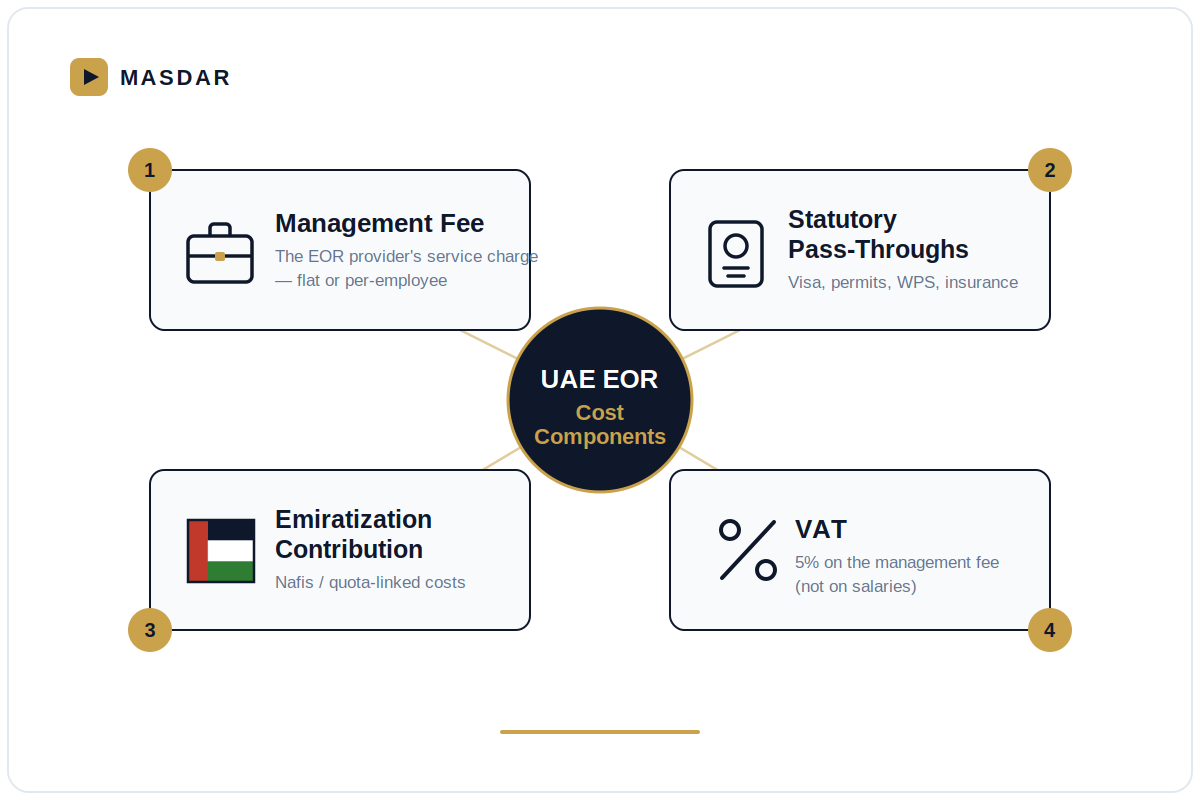
1. EOR provider management fee
In essence, this is what the provider charges to act as the legal employer. Furthermore, it covers payroll, contracts, MoHRE filings, HR support, and platform access.
Notably, pricing models vary widely. For example, some providers charge a fixed monthly fee per employee. Others charge a percentage of payroll (often 8–20% of gross salary). As a result, the same role can cost very different amounts depending on the provider’s billing model and how senior the hire is.
2. Statutory pass-through costs
The UAE government and regulators directly charge these costs. Therefore, every EOR must pay them. The important question is whether your provider passes them through at cost — or marks them up.
Statutory pass-throughs in UAE include:
- UAE work visa & permit (renewed every 2 years) — see the official UAE work permits guide
- Mandatory medical insurance (annual)
- Emirates ID issuance
- End-of-service gratuity (EOSB) accrual
- Workmen’s compensation (Abu Dhabi)
A direct UAE EOR typically passes these through at cost. As a result, the line items on your invoice match what the government and insurers charge.
3. Emiratization contribution
Dubai-based EOR engagements typically include an Emiratization contribution per employee. This goes toward UAE national hiring compliance under the NAFIS programme.
In Abu Dhabi, Abu Dhabi providers usually bundle Emiratization into the management fee rather than billed separately. However, that’s also why Abu Dhabi management fees run higher than Dubai ones.
Importantly, not every EOR addresses Emiratization on their UAE page. As a result, you may face NAFIS compliance gaps once your headcount crosses 50 skilled employees.
4. VAT
The UAE charges 5% VAT on the EOR’s service fee. As a result, this is a small line item, not a major cost. Some providers absorb VAT into their published pricing. Others add it on top. Consequently, always ask: “Is VAT included or extra?”
Why employer of record UAE cost varies — what moves your quote
Two providers can quote very different prices for the same role. As a result, headline rates can be misleading. Here are the five factors that move your employer of record UAE cost.
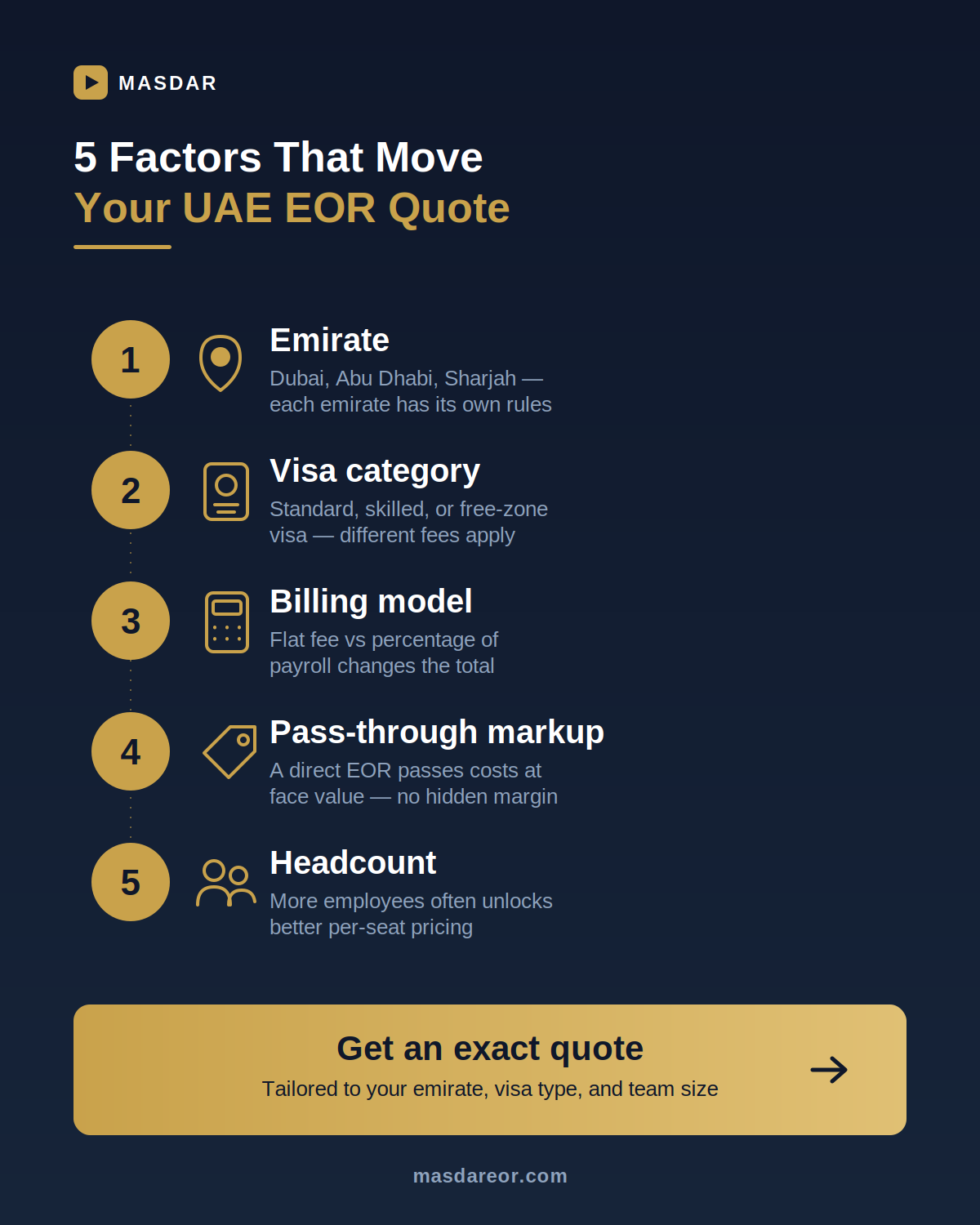
1. The emirate you hire in
In general, Dubai is the more commercial choice. By contrast, Abu Dhabi runs higher because of stricter Emiratization quotas, mandatory dependent medical insurance, and Workmen’s Compensation.
2. The visa category
In contrast, Abu Dhabi management fees are tiered by visa skill level. Skilled visas (covering most professional roles under MOHRE Levels 1–3) carry higher management fees than Unskilled visas.
3. The provider’s billing model
By comparison, fixed monthly fees scale better than percentage-of-payroll models. As a result, senior roles can cost significantly more under a percentage model.
4. Pass-through markup
On the one hand, a direct EOR passes statutory items through at cost. On the other hand, some platforms add 20–40% margin onto these. Therefore, this single factor can move your true employer of record UAE cost by thousands of dirhams per year per employee.
5. Headcount
Moreover, higher headcounts often unlock volume tiers. As a result, the per-employee management fee usually drops as you scale.
The takeaway: the only useful comparison is an itemised quote for your specific role. Generic ranges hide too much.
Get an exact UAE EOR quote tailored to your role →
UAE EOR providers in 2026: what each is known for
Many EOR providers operate in the UAE. However, each one approaches the market differently. Here is a neutral summary of what each platform is known for.
| Provider | Approach | Known for |
|---|---|---|
| Masdar EOR | Direct UAE EOR — owned mainland entity (Dubai + Abu Dhabi) | In-country PRO team, direct entities across all 6 GCC countries, 17+ years in the region |
| Deel | Subscription platform | Advanced AI-powered HR platform, modern self-serve UX, broad global automation |
| Remote | Subscription platform | Polished global HR experience, strong onboarding tooling |
| Globalization Partners | Custom enterprise model | Enterprise-grade compliance resources, deep legal infrastructure |
| Skuad | Tiered subscription | Self-serve global platform with clean UX |
| RemoFirst | Cost-focused subscription | Wide international reach, competitive entry pricing |
| Asanify | Subscription | India–UAE corridor focus |
| FMC Group | Consultancy-led | UAE-focused regional expertise |
Each platform has its strengths. The right fit depends on whether you want global self-serve tooling, enterprise compliance infrastructure, regional consultancy, or a direct in-country UAE provider. For multi-country GCC hiring specifically, a provider with direct owned entities in every Gulf market simplifies operations significantly.
For a side-by-side criteria-based comparison, see our UAE EOR buyer’s guide.
Dubai vs Abu Dhabi: employer of record UAE cost by emirate
The employer of record UAE cost differs by emirate. Generally, Dubai costs less than Abu Dhabi for the same role. Here is why.
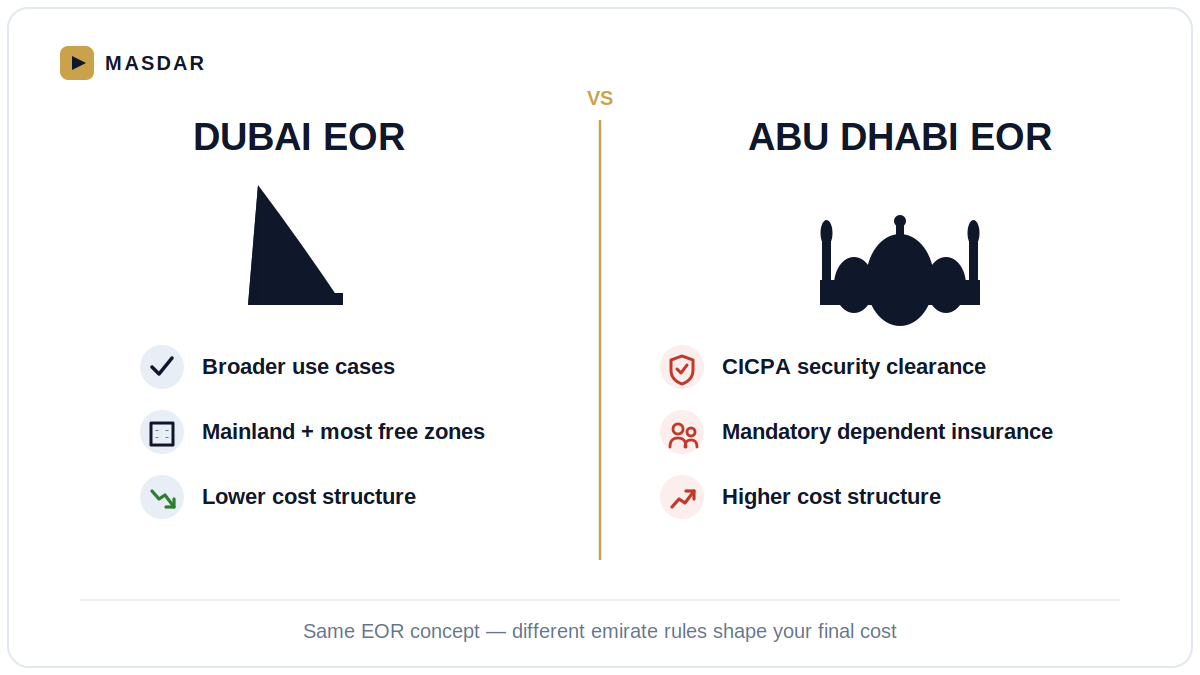
Dubai EOR — broader use case
In practice, Dubai EOR engagements typically cover roles in software, sales, marketing, operations, finance, and customer success — around 90% of foreign hires in UAE. Engagements usually span Dubai mainland and most free zones (DMCC, JAFZA, Dubai Internet City, Dubai Media City). In addition, Dubai keeps the pricing structure cleaner. In addition, Dubai providers usually bill Emiratization as a separate line item rather than bundling it in.
Specialised Abu Dhabi EOR use case
Abu Dhabi EOR fees run higher because of stricter Emiratization quotas, mandatory dependent medical insurance (covering spouse and up to 3 children), and Workmen’s Compensation. In addition, pricing is tiered by visa category in this emirate. Importantly, Abu Dhabi makes sense when the role requires CICPA security clearance — for example, oil & gas, energy, government, or defence projects.
Quick rule of thumb
In short, default to Dubai EOR. By contrast, use Abu Dhabi only when the role specifically requires CICPA clearance or Abu Dhabi entity sponsorship.
For role-specific pricing for either jurisdiction, request a UAE EOR quote — typically returned within hours.
What UAE Labour Law requires you to budget for
These statutory items apply to every UAE hire — no provider can avoid them. They are mandated under UAE labour rights legislation.
Mandatory medical insurance
In short, UAE law requires private medical insurance for every employee. Dubai requires DHA-compliant plans. Abu Dhabi requires DOH-compliant plans — plus mandatory coverage for spouse and up to 3 children. Plan tiers vary widely. Therefore, your actual medical cost depends on plan quality and family status.
End-of-service gratuity (EOSB)
Specifically, UAE Labour Law requires gratuity for any employee with 1+ year of service. The calculation is:
- First 5 years: 21 days of basic salary per year
- After 5 years: 30 days of basic salary per year
- Cap: Gratuity caps at 2 years of basic salary
In practice, a common UAE practice splits gross salary into 60% basic + 40% allowances for EOSB purposes. However, contracts vary. Therefore, always confirm the basic:allowance split with your EOR.
A direct UAE EOR accrues gratuity monthly on your invoice. As a result, you avoid a surprise liability at termination. For the full calculation method, see our guide on leave salary and EOSB in the UAE.
Salary deposit
Typically, most UAE EOR engagements require a refundable deposit of one month’s gross salary at engagement start. You receive the deposit back when the engagement ends.
Annual leave, sick leave, maternity
For example, UAE Labour Law requires 30 calendar days of paid annual leave after one year of service. Sick leave runs up to 90 days per year. Maternity covers 60 days. Payroll administration usually includes these accruals — but always confirm with your EOR.
Hidden employer of record UAE cost items to watch for
Some providers quote a low headline fee. Then they add hidden costs later. For this reason, check for these before signing your employer of record UAE cost agreement.
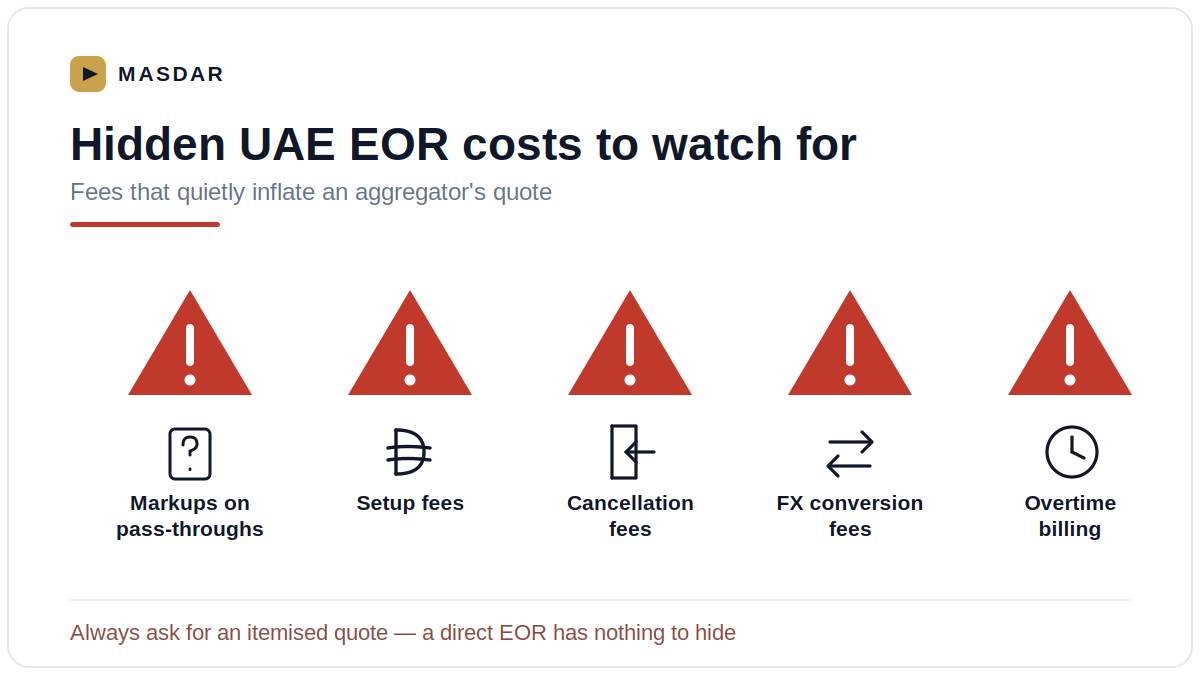
1. Markups on visa and medical pass-throughs
A direct UAE EOR invoices statutory costs at cost. Some platforms add margin here. Consequently, always ask: “Are pass-throughs at cost or marked up?”
2. Setup fees
On the one hand, some providers charge a one-time setup fee per employee. On the other hand, others waive it entirely. So, verify upfront.
3. Cancellation fees
Notably, termination involves visa cancellation, EOSB payout, and Emirates ID cancellation. In most cases, direct EORs include this in the management fee. However, some providers charge separately.
4. Bank transfer and FX fees
If you pay in a currency other than AED, FX conversion may add costs. Consequently, check whether the EOR absorbs FX fees or passes them through.
5. Overtime and public holiday billing
In addition, UAE has ~14 public holidays per year. UAE law pays overtime at higher rates — 25% premium during regular hours, 50% at night, 150% on holidays. Verify how your EOR handles overtime billing.
For more detail on UAE overtime and leave rules, see our guides on overtime calculation in the UAE and UAE Labour Law.
How to get an accurate employer of record UAE cost quote
Headline rates don’t tell the full story. For this reason, follow this 4-step process to compare providers like-for-like on employer of record UAE cost.
1) Ask for an itemised quote, not a blended fee
Specifically, demand line items: management fee, visa, medical, EOSB, Emiratization, VAT. In other words, if the quote shows one blended monthly number, request a detailed breakdown.
2) Compare on total monthly cost, not just management fee
In reality, a low management fee can hide markup elsewhere. For this reason, always compare like-for-like on total monthly cost.
3) Get a 12-month total
Medical insurance bills annually. Setup and salary deposit hit only once. As a result, only a 12-month total reveals the true cost.
4) Verify whether the provider is a direct EOR
In summary, this is the highest-impact check. A direct UAE EOR — such as Masdar — holds its own MoHRE establishment licence and employs your team on its own entity. For the full verification checklist, see our UAE EOR buyer’s guide.
Request an itemised UAE EOR quote from Masdar → — typically returned within hours.
Frequently asked questions about employer of record UAE cost
How much does an employer of record UAE cost in 2026?
Employer of record UAE cost depends on the role, salary band, jurisdiction, headcount, and your EOR’s billing model. Every quote contains six elements: management fee, visa, medical insurance, EOSB, Emiratization, and VAT. As a result, the only way to know your exact cost is an itemised quote tailored to your hire. Request one here.
Why is employer of record UAE cost higher than in other countries?
Employer of record UAE cost runs higher than many countries for three reasons. First, every hire requires a sponsored work visa and Emirates ID. Second, mandatory health insurance is significant. Third, UAE Labour Law requires EOSB accrual on every contract. Because of this, even a budget EOR cannot avoid these statutory items.
Is Dubai EOR cheaper than Abu Dhabi EOR?
Yes — indeed, Dubai is usually meaningfully cheaper than Abu Dhabi for the same role. Abu Dhabi pricing runs higher because of stricter Emiratization quotas, mandatory dependent medical insurance, and Workmen’s Compensation. As a result, default to Dubai unless your project requires CICPA passes.
What’s typically included in employer of record UAE cost?
Typically, a complete UAE EOR engagement includes: visa and permit sponsorship via MoHRE and GDRFA, WPS-compliant payroll, mandatory health insurance enrolment, EOSB monthly accrual, Emirates ID processing, employment contract drafting, and full UAE Labour Law compliance. In addition, a direct EOR includes Emiratization handling.
Are there hidden employer of record UAE cost items?
In particular, common hidden costs include setup fees, cancellation/termination fees, markups on visa and medical pass-throughs, and FX conversion fees. Consequently, always demand an itemised quote and ask directly: “Is this the total cost — including statutory pass-throughs?”
How do I compare UAE EOR providers on cost?
In practice, compare on 12-month total cost, not headline management fee. Sum up management fee, visa amortised, medical insurance, EOSB accrual, and Emiratization. Furthermore, ask whether pass-throughs are billed at cost or marked up. Direct UAE EORs typically charge at cost.
Can I get an exact employer of record UAE cost without speaking to a provider?
No. Employer of record UAE cost depends on role, salary, emirate, headcount, and visa category. As a result, generic online calculators give rough estimates that rarely match the final invoice. The fastest path to a defensible number is an itemised quote from a direct UAE EOR — usually returned within hours.
Get your employer of record UAE cost in hours, not days
Employer of record UAE cost depends on your specific hire. As a result, the only number that matters is the one tailored to your role, salary band, and jurisdiction.
In contrast, Masdar — a direct UAE Employer of Record — returns role-specific quotes within hours, with every line item shown openly. There are no hidden fees, no markups on statutory pass-throughs, and zero surprise costs at exit.
Request your UAE EOR quote now →
More guides in: EOR & PEO