
Quick summary: The best EOR UAE provider is not the biggest brand in the pitch deck — it is the one whose own licensed entity employs your staff and whose invoice still adds up once 5% VAT lands on it. This ranking of the top 10 Employer of Record providers in UAE 2026 compares every name you are likely to shortlist on exactly those two things, and hands you a 20-minute playbook for verifying any provider’s UAE licence before you sign.
By Prosenjit Biswas, Head of Marketing at MasdarEOR · Reviewed by the MasdarEOR legal and compliance team · Competitor pricing verified from public pricing pages, August 2026 Hiring in the United Arab Emirates should be one of the easiest decisions your company makes this year. The market is growing, the talent pool is deep and international, there is no personal income tax, and the government has spent a decade digitizing everything from work permits to wage payments.
Choosing who employs that talent for you is where companies get burned. And almost never for the reasons the sales decks talk about. I hear these stories for a living. Many of the companies that contact MasdarEOR, where I run marketing, aren’t new to hiring through an employer of record in the UAE at all. They’re leaving a provider that looked great in the demo. Ask what actually happened, and the answers cluster around the same two problems. So consistently that I sat down with our legal team and built this guide around them.
Three Traps to Watch for When Choosing the Best EOR in UAE
Every Employer of Record (EOR) provider selling into the UAE says roughly the same three things: we have local entities, our pricing is transparent, and we know the local rules. In 2026, all three claims deserve scrutiny, because two of them hide the traps that actually cost you money:
- The entity trap. “We operate in 150+ countries” does not mean the provider’s own licensed company employs your staff in the UAE. Many global platforms deliver some or all of their in-country employment through third-party local partners — a layer you often can’t see until something goes wrong with a visa, a wage file, or an end-of-service settlement. The provider’s own websites usually admit this, but only in the fine print.
- The VAT trap. A fee that looks cheap in a pricing table can stop being cheap the moment the first invoice arrives. Under UAE Federal Tax Authority guidance, VAT on manpower services is calculated on the full consideration — including employee salaries and benefits — not just the service fee. A provider that quotes you $499 and then applies 5% VAT across your entire monthly invoice is charging you far more than a provider whose all-in price already accounts for VAT.
What This Guide Covers
This guide compares the ten best EOR UAE providers you are most likely to shortlist in 2026, whether the role sits in Dubai, Abu Dhabi, or one of the Northern Emirates. The comparison runs on entity status, VAT and invoice behaviour, pricing, local expertise, and support. It also gives you something I’ve never seen another EOR comparison include: a step-by-step playbook for independently verifying any provider’s UAE entity claims before you sign anything. And let me be upfront about the obvious. MasdarEOR is my employer, and we rank it first.
I won’t pretend that’s a coincidence. What I will do is show you exactly why, with numbers, licence-verification steps, and law citations you can check yourself, and tell you plainly where a global platform is the better choice. A few of the providers on this list are excellent at things we don’t do.
TL;DR: Best EOR UAE 2026 — The Top 10 Employer of Record Providers in UAE
- MasdarEOR — Best overall: 100% direct licensed entities across the UAE and all six GCC states, VAT-inclusive fixed pricing, and local expertise built since 2007
- Deel — Best global platform for scale and technology-driven automation
- Remote — Best for published flat-rate pricing across 100+ countries
- Multiplier — Best lower-cost global option with visa support
- Atlas HXM — Best direct-model enterprise platform for 160+ country coverage
- Globalization Partners (G-P) — Best for enterprise risk management and data security
- Oyster HR — Best for distributed-team employee experience
- Skuad — Best low-cost entry point for testing international hiring
- GoGlobal — Best for hands-on, human-led multi-country support
- Connect Resources — Best UAE-local option for bundled recruitment, staffing and EOR
Quick Comparison: Best EOR UAE Providers at a Glance
| Provider | UAE delivery model (as advertised) | Listed starting price / employee / month | VAT treatment on the invoice | Regional focus |
|---|---|---|---|---|
| MasdarEOR | 100% direct — own MOHRE-licensed UAE entity; own entities in all 6 GCC states | From AED 1,277.50 (~USD 350), fixed | VAT-inclusive — where VAT applies it’s already built into the price; nothing added on top at invoice time | GCC specialist (UAE, KSA, Qatar, Kuwait, Bahrain, Oman) since 2007 |
| Deel | Hybrid (owned + partner) model globally — verify UAE delivery with the playbook | $599 (~AED 2,200) | Quoted fee excludes VAT — confirm invoice treatment in writing | Global, 150+ countries |
| Remote | Owned-entity model in the countries it serves | $599 annual / $699 monthly | Quoted fee excludes VAT — confirm invoice treatment in writing | Global, 100+ countries |
| Multiplier | Hybrid (direct operations + local partners) | From ~$400 (~AED 1,470) | Quoted fee excludes VAT — confirm invoice treatment in writing | Global, 150+ countries; APAC strength |
| Atlas HXM | Direct EOR model, 160+ countries | $599 platform fee | Quoted fee excludes VAT — confirm invoice treatment in writing | Global enterprise |
| G-P | Direct entities in most markets | Custom, unpublished (estimates: ~15–20% of salary or flat $599–$1,000+) | Quoted fee excludes VAT — confirm invoice treatment in writing | Global, 180+ countries |
| Oyster HR | Hybrid (~130 direct entities + partners elsewhere) | $699 (~AED 2,570) | Quoted fee excludes VAT — confirm invoice treatment in writing | Global, 180+ countries |
| Skuad | Hybrid (direct + partner network) | From $199 (~AED 730) | Quoted fee excludes VAT — confirm invoice treatment in writing | Global, 160+ countries |
| GoGlobal | Hybrid (direct in major markets + partners) | Not published (reported from ~$50) | Quoted fee excludes VAT — confirm invoice treatment in writing | Global, 100+ countries |
| Connect Resources | Own MOHRE-licensed Dubai entity (on-demand labour supply licence); delivery outside UAE unspecified | Not published (custom quote) | Not published — confirm VAT treatment in writing | UAE-based local firm; lists 8 MENA countries incl. KSA, Qatar, Egypt |
Prices are the providers’ publicly listed or reported starting rates as of August 2026 and exclude statutory employment costs (salary, gratuity accrual, insurance, visa fees). Always confirm current pricing, and the VAT base, directly with the provider.
Before You Compare Features, Ask These Two Questions
Most EOR comparison articles (including the ones several of these vendors publish about themselves) compare dashboards, country counts and onboarding speed. Those matter. But in the UAE, two structural questions decide whether your provider relationship works or blows up, and they rarely appear in the marketing.
Question 1: Whose licence actually employs my people?

An Employer of Record is only as real as the legal entity on the employment contract. In the UAE, the entity that employs your staff must:
- Hold a valid trade licence for an activity that permits it to employ and supply staff
- Be registered with the Ministry of Human Resources and Emiratisation (MOHRE) with an active establishment card
- Sponsor the employee’s work permit and residence visa under its own immigration file
- Run payroll through the Wage Protection System (WPS) under its own establishment ID
- Carry the statutory liabilities: end-of-service gratuity, health insurance, workplace injury cover, and labour-dispute exposure
Where the partner-delivered model shows up
What many buyers only learn after signing: a number of global EOR platforms do not perform these functions themselves in every market they sell. Their own public materials describe “hybrid” models, meaning direct entities in some countries and “vetted local partners” or “in-country partners” in others. Oyster, for example, publicly describes direct entities in around 130 of the 180+ countries it serves, with partner firms covering the rest.
Skuad, Multiplier, and GoGlobal all describe hybrid direct-plus-partner structures in their own documentation. We unpack the mechanics in our guide to direct EOR versus aggregator EOR models in the GCC. A partner-delivered model is not automatically bad. But it means:
- Two layers sit between you and your employee. Questions, escalations and document requests pass through an extra company, usually in an extra time zone.
- Accountability splits. If the local partner mishandles a WPS file or lets a visa lapse, your contract is with the platform, but the failure sits with a company you’ve never met.
- Costs stack. The platform’s fee has to cover the partner’s fee. Someone pays for the extra layer, and it isn’t the platform.
- Continuity risk. If the platform and its partner part ways, your employees’ sponsorship may need to be migrated. That’s a legal event for each employee, not a software toggle.
Don’t take anyone’s word on this, including ours. Verify. The next section gives you the four questions that expose the answer; the whole check takes about twenty minutes and costs nothing.
Question 2: What will the invoice actually total after VAT?
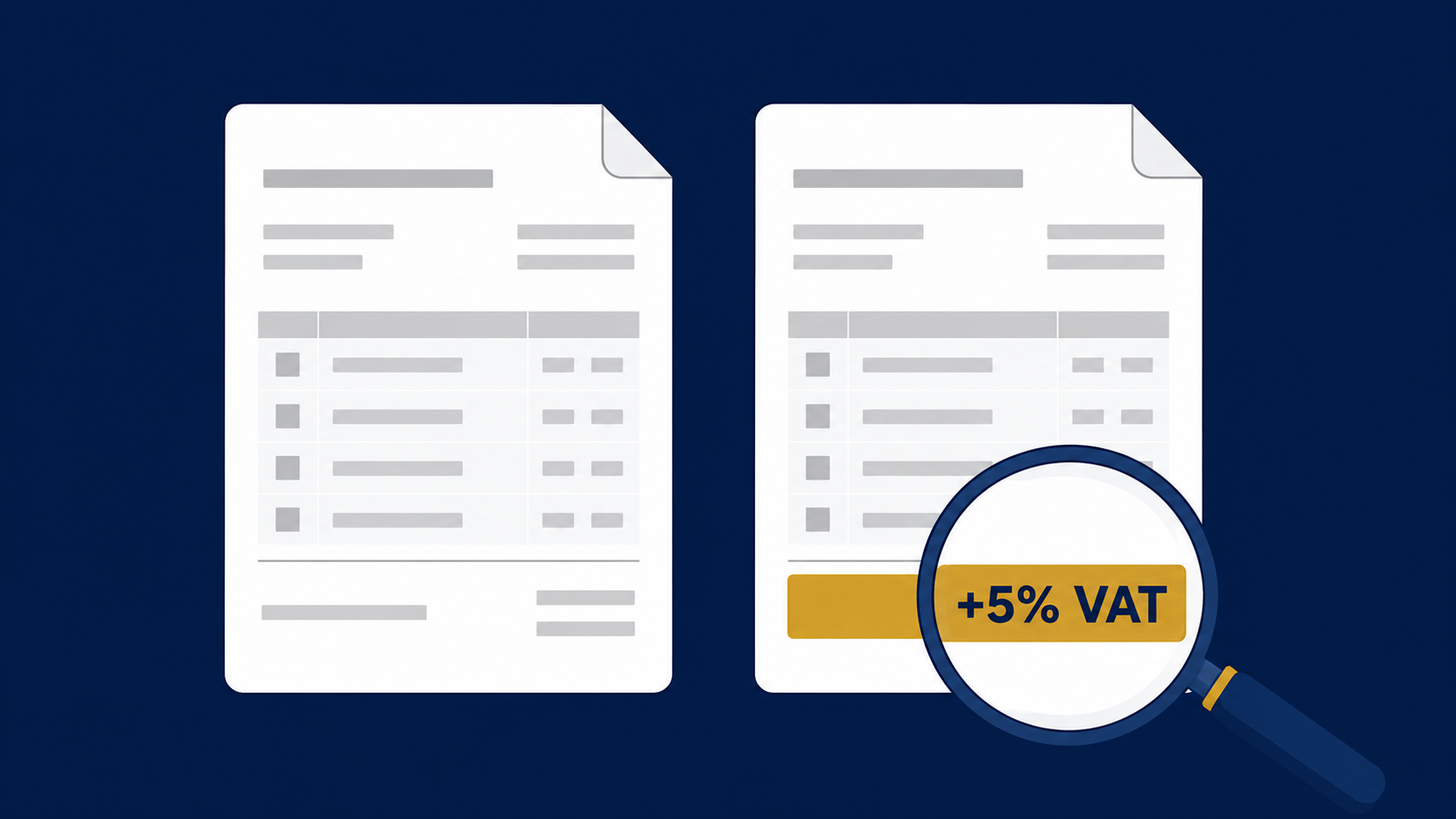
The UAE has charged 5% VAT since 2018. What most buyers don’t know is what the 5% applies to on an EOR invoice. The difference is enormous. On 31 May 2024, the UAE Federal Tax Authority issued Public Clarification VATP038, which distinguishes two arrangements (see analysis by Deloitte):
- Manpower services: the supplier employs the workers, holds their visas, pays their salaries, and supplies them to a client. Here, VAT is calculated on the entire consideration: all costs charged to the client plus salaries and benefits, even where the client pays employees directly.
- Visa facilitation services: a narrow arrangement, generally only available within the same corporate group, where the facilitator merely sponsors visas while the client is the real employer. Only here is VAT limited to the facilitation fee and administrative recharges.
Why most EOR invoices count as a manpower supply
A classic EOR arrangement (provider employs your staff, sponsors the visas, runs payroll, invoices you) is manpower supply. Which means the default VAT base is your whole invoice: salary, benefits, and fee, not the fee alone. Run the numbers on a typical hire with AED 25,000 monthly gross salary:
| Line item | Monthly amount (AED) |
|---|---|
| Gross salary | 25,000.00 |
| Gratuity accrual, insurance, visa amortization (typical) | ~1,400.00 |
| EOR management fee (illustrative market rate of ~$399/month) | ~1,465.00 |
| Invoice subtotal | ~27,865.00 |
| 5% VAT applied to the full invoice | ~1,393.00 |
| 5% VAT applied to the fee only | ~73.00 |
Assumes a basic salary of AED 15,000; gratuity accrues on basic salary, not gross, under UAE law. That’s a difference of roughly AED 1,320 per employee per month, about AED 15,800 per employee per year, between two providers whose headline fees looked nearly identical. Multiply by a ten-person team and the “cheap” quote is costing you an extra AED 158,000 a year that never appeared in any pricing table. Whether and how VAT lands on your invoice depends on how the provider is structured, where your company is established, and how the contract characterizes the services.
When zero-rating might apply
Foreign clients with no UAE presence sometimes qualify for zero-rating on parts of the service. Sometimes. I’m not claiming every provider handles this badly; most handle it lawfully. But the pricing page will never tell you, so before you sign with anyone, ask three questions in writing:
- Does 5% VAT apply to my invoices — and on what base: the full invoice, or the fee only?
- If my company has no UAE establishment, will you assess zero-rating for our situation, and will you confirm the treatment in the service agreement?
- Can you show me a real sample invoice for an employee at my salary level, with every line item and every tax shown?
For our part, MasdarEOR quotes VAT-inclusive prices. Where VAT applies, on health insurance for example, it is already built into the number we quote you. Nothing is added on top at invoice time: the figure in your quote is the figure on your invoice. Still unsure how this lands on your own invoice? Send us an inquiry for a detailed breakdown, or get an instant quote and see your all-in figure the same business day.
How to Verify Any EOR Provider’s UAE Entity Status (20-Minute Playbook)

You don’t need a law firm for this. Four questions, all free to ask, and together they take maybe twenty minutes. Run them on every provider on this list, including us.
Step 1: Ask whose name goes on the work permit and visa
The single most reliable test. In the UAE, the employee’s MOHRE work permit and residence visa carry the sponsor’s name. Ask the provider: “Whose name will appear as sponsor on our employee’s work permit and residence visa?” Then, after onboarding, look at the documents; your employee can see the sponsor name on their own visa. If the sponsor is a company you’ve never heard of, your “direct” provider delivers through a partner. (Our breakdown of employee visa sponsorship costs across the GCC shows what each step should actually cost.)
Step 2: Ask who submits the WPS wage file
Salaries in the UAE must be paid through the Wage Protection System, and the wage file is submitted under the employing establishment’s MOHRE ID. Ask: “Which establishment submits our employees’ WPS files?” Same test, same logic. A provider that runs WPS under its own establishment controls payroll end to end. One that can’t answer is forwarding your payroll to someone else.
Step 3: Read the contract for the partner clauses
Before signing, search the service agreement for: “local partner,” “in-country partner,” “third-party provider,” “subcontractor,” “affiliate,” and “substitution.” Then read what those clauses permit. Many agreements allow the platform to swap the in-country employer at its discretion. Ask what happens to your employees’ visas and continuity of service if they do.
Step 4: Weigh tenure and regulatory standing
Licences can be new; expertise can’t be. Ask how long the provider’s UAE entity has been operating, how many employees it currently sponsors, and, if they also cover Saudi Arabia, what their Nitaqat (Saudization) rating is. A provider holding Green Nitaqat status in Saudi Arabia is demonstrating, via a government-published classification, that it runs compliant workforces at scale in the region’s strictest market. Regulators grade these companies so you don’t have to guess.
What you’ll find if you run this playbook on MasdarEOR: our own MOHRE-licensed UAE entity on the contract, our name on the work permit and visa, our establishment ID on the WPS file, and entities we own across all six GCC countries, operating since 2007. That’s what “100% direct” should mean. We’re happy to be tested on it. Request our entity details here.
7 Questions to Ask Any Best EOR UAE Provider Before You Sign
 Use these as a buyer-side checklist. Any genuine direct UAE EOR can answer all seven with documentary proof. Furthermore, they can do it within 48 hours.
1. “Can I see your MoHRE establishment card?”
The establishment card is legal proof of a direct UAE entity. Good answer: a copy in the provider’s own name. Red flag: any answer involving a “partner” name.
2. “Whose name appears on the UAE employment contract?”
The contract names the legal employer. Good answer: the provider’s own UAE entity. Red flag: a third-party company you’ve never heard of.
3. “Whose UAE bank account is used for WPS payroll?”
WPS requires salaries to flow from a UAE-licensed bank account. Also, the account must be in the legal employer’s name. Good answer: the provider’s own UAE entity. Red flag: “we use our partner’s WPS account.”
4. “Are you registered with GPSSA or ADPF?”
You may hire UAE nationals at some point. After all, NAFIS rules apply once you cross 50 skilled employees. Therefore, the EOR must be registered with GPSSA (Dubai) or ADPF (Abu Dhabi). Good answer: registration numbers on request. Red flag: “we don’t handle Emiratization.”
5. “Can you provide an itemised quote?”
Direct EORs separate provider fee from statutory pass-throughs. Good answer: clear line items for management fee, visa, medical, EOSB. Red flag: one blended monthly number.
6. “Who do I call if there’s a labour case or visa delay?”
Direct EORs route everything through one team. Good answer: a named UAE-based contact with a direct line. Red flag: “we’ll escalate to our local partner.”
7. “What happens to my employee if you change partners?”
This question reveals the model instantly. Good answer: “Your employee stays on our entity throughout.” Red flag: any answer involving a partner relationship.
5 Red Flags When Comparing the Best EOR UAE Providers
 Most aggregator EORs market themselves like direct EORs. However, you can spot the difference. Here is how — without naming names.
1. The provider’s UAE page says “our local partner”
Read the UAE page carefully. Phrases like “our local partner” or “in-country partner” usually signal partner-based. This stays true even when the headline says “we own our UAE entity.”
2. Pricing is “low” but not itemised
UAE EOR cost equals provider fee plus statutory costs. Aggregators often quote a low headline fee. Then they add 20–40% margin onto the statutory pass-throughs. As a result, you can’t verify the real cost. If the proposal isn’t itemised, walk away.
3. No mention of Emiratization, NAFIS, GPSSA or ADPF
A direct UAE EOR handles Emiratization in-house. Therefore, they mention it on their UAE page. Aggregators usually skip it. After all, their partner handles it — or doesn’t. Once you cross 50 UAE skilled employees, missing Emiratization triggers MoHRE penalties.
4. Promises of “1-day onboarding” for visa-sponsored hires
Realistic UAE onboarding takes ~20 days in-country. For outside-country candidates, it takes ~33 days. Any promise faster than that signals marketing exaggeration. Alternatively, it means the provider isn’t handling the visa themselves.
5. Vague answers on free-zone coverage
UAE free zones operate under different rules. For example, DMCC and JAFZA use federal labour law. However, DIFC and ADGM use English common-law-based frameworks. A direct UAE EOR will tell you exactly which zones they cover. Aggregators often give vague answers.
How We Ranked the Best EOR UAE Providers
We ranked the EOR providers in UAE on five criteria, weighted for what goes wrong in real UAE engagements:
- Entity status in the UAE: direct licensed employment capability versus partner-delivered, and how transparent the provider is about it
- True cost: headline fee, what the invoice totals after VAT and pass-throughs, and pricing predictability
- Local expertise: depth on UAE-specific compliance, from WPS and gratuity to Emiratisation, the 2025 nationwide health-insurance mandate, and free-zone versus mainland employment
- Support model: response times, whether you get a person or a ticket queue, and Gulf-time-zone coverage
- Platform and scale: technology, integrations, and multi-country reach for teams hiring beyond the Gulf
We used each provider’s own published materials, publicly listed pricing, and aggregated customer reviews on platforms like G2. Where a provider doesn’t publish something (several don’t publish pricing), we say so. If you want the shorter decision framework rather than the full field, see our guide to choosing the best EOR in the UAE.
1. MasdarEOR — Best EOR UAE Overall for 2026
Best for: companies that want their UAE and GCC hiring done by the regional specialist, with direct entities, fixed VAT-inclusive pricing, and on-the-ground expertise built since 2007

MasdarEOR is not a global platform, and doesn’t pretend to be one. It’s a GCC employment specialist: fully owned, licensed entities and manpower platforms in all six Gulf states (the UAE, Saudi Arabia, Qatar, Kuwait, Bahrain and Oman), no intermediaries, no local partners, operating in the region since 2007. If your hiring map is the Gulf, that focus is the point.
Direct by design
In the UAE, MasdarEOR employs your staff through its own MOHRE-registered mainland entity. Your employees’ work permits and residence visas carry MasdarEOR’s sponsorship, their contracts are issued bilingually (Arabic and English, as UAE practice requires), and their salaries run through WPS under MasdarEOR’s own establishment ID.
Run the verification playbook above on us. Every step checks out, and we’ll hand you the licence details before you ask.
Pricing you can forecast
UAE management fees start at AED 1,277.50 per employee per month in Dubai (roughly USD 350, among the lowest direct-entity rates in the market) and scale with role and emirate up to around AED 3,200 for skilled expat roles in Abu Dhabi. The fee is fixed, never a percentage of salary, so a senior hire doesn’t triple your service cost.
Pricing is also VAT-inclusive: where VAT applies, on health insurance for example, it’s already built into the number we quote, and nothing is added on top at invoice time. The figure in your quote is the figure on your invoice. No setup fees, no surprise deposits, no FX games.
Local expertise you can measure
MasdarEOR has sponsored 10,000+ employees for 200+ companies across the GCC and processes dozens of onboardings a day. UAE onboarding runs approximately 20 days for candidates already in-country, 33 days for overseas hires, and 11 days for Emirati nationals. Emiratisation management (Nafis registration, GPSSA contributions, quota tracking) is handled as part of the service, which matters now that 2026 Emiratisation targets carry AED 9,000-per-month contributions for each unfilled position.
In Saudi Arabia, MasdarEOR holds Green Nitaqat status, a compliance grade issued by the regulator, not by us. Every inquiry reaches a real person on the team within one business day, in your working hours, because the team works in the region it serves.
Where MasdarEOR is not the right choice
Honesty cuts both ways. We cover six countries, not 160. If you’re hiring five people across Brazil, Poland and Japan next quarter, you need a global platform, and several good ones are below. There’s no crypto payroll, no self-serve contractor app, no AI chatbot. There are specialists who answer within a business day.
Companies that want a single global vendor for everything will find the global platforms a better organizational fit; many of them pair one with MasdarEOR for the Gulf.
Pricing
- UAE EOR: from AED 1,277.50/employee/month (Dubai), fixed fee — full cost breakdown here
- VAT-inclusive quotes: where VAT applies, it’s already built into the price, with nothing added on top at invoice time
- Zero setup cost; instant quote available
Pros
- 100% direct: own licensed entities in the UAE and all six GCC countries, verifiable through official registries
- Fixed, VAT-inclusive pricing; the quote is the invoice
- Deep UAE compliance capability: WPS, gratuity accrual, mandatory health insurance, Emiratisation/Nafis, PE and tax shielding
- Operating in the Gulf since 2007, longer than any platform on this list has existed in its current form
- 24-hour human response; onboarding in as little as 11–20 days
Cons
- GCC-only coverage — not a fit for hiring outside the six Gulf states
- Service-led rather than software-led: no self-serve SaaS dashboard bells like crypto payouts or AI assistants
- Custom quoting for complex cases rather than one global flat rate
2. Deel — Best Global Platform for Scale and Automation
Best for: companies hiring across many countries that want maximum automation in one system
Deel is the biggest name in global employment, serving 150+ countries with a slick, automation-heavy platform that handles both employees and contractors. For the UAE specifically, Deel offers locally compliant contracts, multi-currency payroll and visa support, all wrapped in the most polished self-serve product in the category.
There are extras like the Deel Card and even crypto payment options for contractors. The trade-offs come with the scale. Globally, Deel runs a hybrid model (its own entities in many markets, partners in others), so service quality can vary by country. Worth mapping if your roadmap goes beyond the Emirates, and worth running the entity playbook on the UAE itself, as with every provider on this list.
Reviews on G2 and Trustpilot keep mentioning transaction fees, occasional payment delays and limited contract customization. Support is ticket-first: efficient for routine issues, slower when a UAE-specific edge case (a gratuity dispute, say, or an Emiratisation question) needs a human who knows MOHRE process cold.
And at $599 per employee per month before statutory costs, with visa services, advanced legal reviews and some features priced separately, it sits at the premium end.
Pricing
EOR from $599/employee/month (~AED 2,200); contractor management from $49/month. Quoted fees exclude VAT — confirm invoice treatment in writing.
Pros
- Best-in-class platform automation; employees and contractors in one system
- Fast, fully digital onboarding workflows
- Flexible payment options across 150+ countries
Cons
- Hybrid entity model globally means service consistency varies by country
- Reviews cite transaction fees, payment delays, and rigid contract templates
- Premium pricing, with meaningful add-on costs for visa and legal services
How MasdarEOR compares
Deel is the stronger pick if you’re hiring in thirty countries this year. For the UAE and the Gulf, the comparison flips. MasdarEOR is 100% direct in every market it serves (no partner-delivered countries, ever), starts at roughly AED 900 less per employee per month, quotes VAT-inclusive prices, and answers with a Gulf-based specialist within one business day instead of a ticket queue. I’ve written a separate Deel alternative for the UAE comparison if you’re weighing exactly these two.
3. Remote — Best for Published Flat-Rate Pricing
Best for: budget-predictable global hiring with an owned-entity philosophy
Remote earned its reputation by doing two things unusually well: publishing its prices and refusing the partner model. The company’s stated approach is to operate through its own legal entities in every country it serves, which reduces the third-party risk this article keeps warning about.
Credit where due; that’s the right structural choice. For the UAE, Remote handles WPS-compliant payroll in AED, statutory benefits, end-of-service gratuity for expatriates, and visa sponsorship, with its IP Guard feature adding intellectual-property protection that tech companies value. The public flat rate ($599 per employee per month on annual billing, $699 monthly) makes budgeting straightforward, and startups get discounts.
The caveats: that flat rate is real money for a small team, statutory costs still arrive separately, VAT treatment on the total invoice is something to confirm before signing rather than after, and reviews on G2 mention slow support responses, payment delays and onboarding complexity when cases get non-standard.
Remote’s model is global-first. The UAE is one of 100+ countries, served well but not specially; there’s no Gulf-dedicated team, and complex regional questions (Emiratisation strategy, free-zone versus mainland structuring, GCC-wide deployments) sit outside its lane.
Pricing
$599/employee/month (annual) or $699 (monthly); contractors from $29/month. Quoted fees exclude VAT — confirm invoice treatment in writing.
Pros
- Owned-entity model — no third-party employment partners
- Transparent published pricing, rare in this market
- Strong IP protections and solid UAE payroll fundamentals
Cons
- Flat rate is high for small teams; statutory costs and taxes billed on top
- Reviews cite support responsiveness and payment-timing issues
- No regional specialization — the UAE is one market among 100+
How MasdarEOR compares
Remote deserves credit for the direct-entity principle; it’s the same principle MasdarEOR is built on. The differences are focus and the invoice. MasdarEOR applies the principle exclusively to the Gulf with entities it has operated since 2007, prices from AED 1,277.50 (about 40% below Remote’s flat rate), and publishes a VAT-inclusive fee, so no 5% lands on top of your total. For UAE-centric hiring, the regional specialist removes more unknowns.
4. Multiplier — Best Lower-Cost Global Option with Visa Support
Best for: startups and mid-size companies wanting global coverage below Deel/Remote prices
Multiplier has grown fast by hitting a pragmatic price-to-capability point: EOR from around $400 per employee per month, multi-language contracts, real-time cost estimates, insurance options and, relevant for the UAE, visa sponsorship and management support. The platform is clean and easy to drive, with useful extras like ESOP management and multi-currency payroll.
Its Asia-Pacific roots also give it real strength along the APAC–Gulf corridor many UAE employers care about. The structural caveat is the familiar one. Multiplier runs a hybrid model of direct operations and local partners, which its own materials acknowledge can mean inconsistent experiences by market.
So ask the entity question about the UAE specifically, and verify the answer with the playbook above. Reviews on G2 mention payment delays, support turnaround and occasional platform bugs during onboarding. Add-ons (global insurance, ESOP, some visa and advisory services) are priced separately; project the full invoice before you commit.
Pricing
EOR from ~$400/employee/month (~AED 1,470); contractors from $40/month; insurance, ESOP, and some visa services extra. Quoted fees exclude VAT — confirm invoice treatment in writing.
Pros
- Competitive pricing for a full-featured global platform
- Visa sponsorship support and multi-language compliant contracts
- Intuitive interface with real-time employment cost estimates
Cons
- Hybrid direct-plus-partner model varies by country
- Reviews cite payment delays and support-speed frustrations
- Add-on costs accumulate on top of the base rate
How MasdarEOR compares
on price, these two are closer than most on this list, which makes structure the decider. MasdarEOR’s AED 1,277.50 starting fee buys 100% direct employment on our own UAE licence rather than a hybrid arrangement to be clarified in due diligence. The visa is sponsored by us, the WPS file is ours, and the quote is VAT-inclusive, with nothing added on top at invoice time. When two quotes look similar, sign the one you can verify in twenty minutes.
5. Atlas HXM — Best Direct-Model Enterprise Platform
Best for: enterprises that want direct-entity coverage at maximum country count
Atlas HXM sells a “100% direct EOR” model across 160+ countries (one contract, one platform, no third-party employment partners) and backs it with an enterprise-grade stack: onboarding, payroll, benefits administration, compliance analytics, and 24-hour support with dedicated account management. Analysts at NelsonHall and Everest Group rate it well, and for a large organization consolidating global employment onto one vendor, the pitch is credible.
For UAE-focused buyers, the questions are practical. The $599-per-employee platform fee is the entry point, with mandatory contributions and local taxes billed on top; model the full UAE invoice, VAT included, before comparing it with anyone’s headline number. Contractor management runs through external partners, an odd gap in an otherwise direct story.
And the UAE is one of 160+ markets. Atlas’s direct entity there is a fine legal vehicle, but the surrounding expertise is generalist by design; Emiratisation strategy, GCC-wide structuring and Gulf market nuance aren’t the product.
Pricing
from $599/employee/month platform fee (~AED 2,200), per Atlas’s published pricing; statutory costs additional. Quoted fees exclude VAT — confirm invoice treatment in writing.
Pros
- Direct-entity model at unusual scale (160+ countries)
- Enterprise-grade compliance tooling, analytics, and certifications
- 24-hour support with dedicated account management
Cons
- Premium platform fee before any statutory costs
- Contractor management outsourced to external partners
- Generalist depth in any single market, the UAE included
How MasdarEOR compares
Atlas and MasdarEOR agree on the thesis (direct entities beat partner chains) and diverge on geography. Atlas spreads the direct model across 160 countries. MasdarEOR concentrates it on six, and has operated them since 2007, before Atlas’s platform existed. For a UAE employer, the practical differences are a starting fee roughly 40% lower, VAT already inside the quoted price rather than pending on the invoice, Gulf-resident specialists rather than a global service desk, and proof points like Green Nitaqat status in Saudi Arabia. The real choice here is enterprise breadth or Gulf depth.
6. Globalization Partners (G-P) — Best for Enterprise Risk and Data Security
Best for: large, regulated organizations prioritizing legal risk mitigation and data controls
G-P is the elder statesman of the category: founded in 2012, covering 180+ countries, with a direct-entity model in most markets and the strongest enterprise-compliance posture in the group. SOC 2 Type II, GDPR alignment, and an AI-assisted platform (the Meridian suite) aimed at complex scenarios like M&A transitions, contractor conversions, and cross-border relocations.
For a bank or a listed company moving carefully into the Gulf, that risk apparatus earns its keep. The costs of that posture are real too. Pricing is custom and unpublished; third-party estimates range from roughly 15–20% of employee salary to flat fees of $599–$1,000+ per employee per month.
Under the percentage model, the maths gets expensive fast at UAE executive compensation levels. Run it yourself: 15% of an AED 60,000/month package is AED 9,000 a month for the service layer alone, versus a fixed fee that doesn’t care what your executive earns. Reviews on G2 note slow response times, onboarding delays, and a reliance on account managers for routine changes that self-serve platforms handle instantly.
Pricing
custom quotes only; third-party estimates range from ~15–20% of salary to flat $599–$1,000+/month. Quoted fees exclude VAT — confirm invoice treatment in writing.
Pros
- Longest track record among global platforms; 180+ countries
- Enterprise-grade security, certifications, and legal depth
- Strong for complex scenarios: M&A, conversions, relocations
Cons
- Unpublished custom pricing; percentage-based structures penalize high UAE executive pay
- Account-manager dependency slows routine operations
- Custom quoting makes comparison shopping difficult
How MasdarEOR compares
under G-P’s reported percentage model, a UAE hire earning AED 60,000 a month implies roughly AED 9,000–12,000 a month in fees. MasdarEOR’s fixed fee for the same employee is a fraction of that, regardless of salary, with VAT-inclusive pricing and the same statutory protections, delivered through our own licence. You can verify that licence in the national registry instead of taking it on faith from a compliance brochure. And for the risk team: since 2007, we’ve cleared every audit the region’s regulators have put in front of us.
7. Oyster HR — Best for Distributed-Team Employee Experience
Best for: remote-first companies that put employee experience and ethical hiring first
Oyster approaches global employment from the employee’s side of the table: localized benefits through Allianz, PTO tracking, career development through Oyster Academy, and mission-driven programs around refugee employment and B-Corp values. The Pearl AI assistant walks HR teams through onboarding and compliance, and for distributed teams across many countries the experience is pleasant to use, which counts when you’re competing for talent.
Structurally, Oyster is explicit about its hybrid model: direct entities in roughly 130 of its 180+ countries, partner firms in the rest. The first question for UAE hiring is which side of that line the Emirates falls on for your engagement; the verification playbook above will tell you.
At $699 per employee per month, it’s also the most expensive listed rate in this comparison. Reviews on G2 mention payment delays and slower resolution when issues arise in partner-operated countries, with ticket-based support that can frustrate urgent cases.
Pricing
EOR from $699/employee/month (~AED 2,570), discounts for annual plans and nonprofits; contractors ~$29/month. Quoted fees exclude VAT — confirm invoice treatment in writing.
Pros
- Excellent employee-facing experience and benefits administration
- Automation-forward platform, friendly to teams new to global hiring
- Values-driven programs that resonate with modern employer brands
Cons
- Highest listed base price in this comparison
- Openly hybrid model — service depth varies between direct and partner countries
- Ticket-based support; analytics still maturing
How MasdarEOR compares
employee experience in the UAE is mostly unglamorous things done right. The visa arriving on time, WPS salaries never bouncing, the gratuity computed correctly, insurance active from day one under the 2025 nationwide mandate. MasdarEOR delivers that through its own entities at roughly half Oyster’s listed rate, with VAT-inclusive pricing and a named human in the Gulf answering within a business day. A dashboard is not what your employees will remember their employer for.
8. Skuad — Best Low-Cost Entry Point
Best for: lean teams testing international hiring on a tight budget
Skuad (acquired by Payoneer in 2024 and since rebranded Payoneer Workforce Management) is the value play: EOR from $199 per employee per month and contractor management from $19, a fraction of the big platforms’ rates, across 160+ countries, with a modern API-first dashboard covering contracts, payroll, time tracking and basic benefits.
For a startup making its first one or two international hires and watching every dollar, that entry point is attractive. The economics explain the caveats. Skuad runs a hybrid model of direct entities and local partners, support depth varies by country, support runs in regional business hours rather than 24/7, and essentials like health insurance, complex benefits and visa support are priced as add-ons.
That last one matters in the UAE, where health cover is a legal condition of the work permit, not an option. Reviews on G2 mention onboarding problems and slow responses on complex payroll cases. The $199 headline and the real UAE invoice are different numbers.
Pricing
EOR from $199/employee/month (~AED 730); contractors from $19/month; insurance, benefits, and visa support extra. Quoted fees exclude VAT — confirm invoice treatment in writing.
Pros
- Lowest listed EOR entry price among global platforms
- Clean, modern platform with practical HR tooling
- Useful cost calculators and country hiring guides
Cons
- Hybrid entity model; support depth varies by market
- Regional-hours support only; slow on complex cases per reviews
- UAE essentials (insurance, visa) are paid add-ons on top of the base fee
How MasdarEOR compares
do the honest math. Once you add the UAE must-haves (visa processing, mandatory health insurance, WPS payroll administration) and the VAT that lands at invoice level, a “$199” arrangement converges toward AED 1,000+ per month anyway, delivered through a model you’ll need to verify country by country. MasdarEOR starts at AED 1,277.50 with the employment run entirely on our own UAE licence and VAT already inside the price. The gap between the two true costs is small. The gap in structure is not.
9. GoGlobal — Best for Hands-On, Human-Led Support
Best for: companies that prefer people-first service over software-first platforms
GoGlobal zigged where the category zagged. Instead of leading with a self-serve SaaS product, it leads with local HR experts and hands-on service, supported by its BlueOcean platform for workflow, documents and regulatory updates. Onboarding is quick, the humans are responsive and knowledgeable, and reported pricing is aggressive; figures as low as ~$50/month circulate, though GoGlobal doesn’t publish pricing, so everything runs through a custom quote.
The trade-offs: coverage (100+ countries) trails the biggest platforms, the tech is thinner than Deel’s or Remote’s with fewer integrations (reviews on G2 say the same), and delivery combines direct presence in major markets with partners in niche ones. As with every hybrid provider here, ask the UAE-specific entity question and verify the answer. Unpublished pricing also makes apples-to-apples comparison, VAT projection included, impossible without a sales cycle.
Pricing
not published; reported from ~$50/month for EOR, ~$29 for contractors; pass-through costs at cost. Quoted fees exclude VAT — confirm invoice treatment in writing.
Pros
- Service-led, with responsive local HR experts
- Reported industry-low pricing with transparent pass-throughs
- Fast onboarding and flexible engagement structures
Cons
- No published pricing — budgeting requires a sales conversation
- Lighter technology and integration story than platform leaders
- Hybrid direct-plus-partner delivery varies by market
How MasdarEOR compares
GoGlobal validates something we believe: when employment gets hard, humans beat dashboards. The difference is specialization and disclosure. MasdarEOR’s people work on six Gulf countries only, have done since 2007, and answer within one business day. Our pricing is published, fixed and VAT-inclusive, so the comparison you start with is the invoice you end with. If you like GoGlobal’s philosophy and your map is the GCC, get the regional version of it.
10. Connect Resources — Best UAE-Local Option for Bundled Staffing and EOR
Best for: companies that want one local Dubai firm to source candidates and employ them
Connect Resources is the other local name you’ll meet in UAE EOR shortlists, and the closest thing to a hometown rival on this list. It’s a Dubai-based HR outsourcing house, part of the Connect Group family of 25+ companies, describing itself as 100% Emirati-owned and serving companies since 2016 from Sheikh Zayed Road under MOHRE trade licence No. 773036, a registered on-demand labour supply company.
The pitch is breadth. EOR and PEO sit alongside recruitment, staff outsourcing, contract staffing, payroll and visa services, backed by an official alliance with Randstad, and the site reports 1,000+ client companies with logos like Microsoft, Bosch and Samsung. A small set of Trustpilot reviews praises on-time payroll and responsive visa processing.
The gaps are visibility gaps. Pricing isn’t published anywhere, so budgeting and VAT projection require a sales conversation. The website lists coverage across eight countries (UAE, Saudi Arabia, Qatar, Oman, Kuwait, Egypt, Lebanon, Jordan) without specifying whose entity employs staff outside the UAE; run the verification playbook per country before assuming direct delivery.
Onboarding timelines and response-time commitments aren’t published either. And EOR is one line of a large staffing business rather than the specialism, which shows in the public materials: strong on recruitment reach, thinner on the compliance detail (gratuity mechanics, Emiratisation quotas, VAT treatment) this guide keeps testing providers on.
Pricing
not published; custom quotes only. Confirm the VAT treatment of any quote in writing.
Pros
- Local, MOHRE-licensed Dubai entity with an on-demand labour supply licence, checkable in the National Economic Register
- Recruitment, staffing and EOR under one roof, with a Randstad alliance for candidate reach
- Reviews, though few, praise payroll timeliness and visa processing
Cons
- No published pricing, onboarding timelines or SLAs; every comparison starts with a sales call
- Delivery model outside the UAE is not specified publicly; verify entity status country by country
- EOR sits inside a broad staffing group rather than being the core specialism
How MasdarEOR compares
this is the local-versus-local matchup, so credit first. Connect Resources passes the test most global platforms fail: a real UAE licence you can look up. And if you need the provider to find the candidates as well as employ them, its staffing arm and Randstad alliance are a real advantage worth weighing. From there, the differences are the ones this guide is built on. MasdarEOR has run its own entities since 2007 and owns them in all six GCC countries, rather than listing coverage without naming the employer behind it. Our pricing is published, fixed and VAT-inclusive, AED 1,277.50 in Dubai, where Connect quotes case by case. Run the playbook on both of us. It’s the fairest tiebreak there is.
Other EOR Providers in UAE You’ll See in Search Results
Worth knowing about, even though they didn’t make our ten:
- Safeguard Global — enterprise-grade, strong in complex multi-country workforces (170+ markets), custom pricing from roughly $550/month; built for large implementations rather than fast SME hiring.
- Rippling — excellent if you want EOR bundled with an entire HR/IT/finance platform (~$500/month reported for EOR); global EOR is a newer line of business than its US core.
- RemoFirst — aggressive pricing from $199/month with coverage in 180+ countries via a largely partner-based network; the entity-verification playbook above applies doubly.
- Papaya Global — payroll-infrastructure heavyweight suited to enterprises consolidating global payroll data; EOR delivered substantially through in-country partners.
- Omnipresent — acquired by Deel in October 2025, with customers migrated to the Deel platform; it no longer operates as a standalone EOR, so treat any Omnipresent comparison you find in search results as historical.
- Velocity Global — broad coverage and solid enterprise services; another custom-quote sales process.
How to Choose the Best EOR UAE Provider: 8-Point Checklist
- Verify the entity, don’t trust the slide. Run the playbook above: sponsor name on the visa, WPS establishment, partner clauses in the contract, and how long the entity has been operating.
- Get the VAT treatment in writing. Full invoice or fee only? Zero-rating assessed for your situation? Demand a sample invoice at your real salary levels before signing.
- Insist on WPS-native payroll. Salaries must flow through the Wage Protection System under the employer’s establishment ID, on time, every month. Ask who submits the file and what their on-time record is. Our GCC payroll compliance guide sets out the country-by-country rules.
- Check gratuity mechanics. End-of-service gratuity (21 days’ basic pay per year for the first five years, 30 days thereafter) is a real liability that accrues from day one. Ask whether it’s accrued monthly on your invoice or billed as a lump sum at exit; surprise five-figure exit invoices are a classic EOR complaint. Our GCC gratuity guide explains the math.
- Confirm visa capability is in-house. Work permits, medicals, Emirates ID, stamping: ask whether the provider’s own PRO team handles government interactions or whether that’s outsourced too. Get realistic timelines (in-country transfers run faster than overseas hires), and check they also handle the exit side, including cancelling an employee visa in the UAE without penalties.
- Test local knowledge with 2026 questions. Ask about the nationwide basic health-insurance mandate in force since January 2025, current Emiratisation targets and whether they affect your headcount, and mainland-versus-free-zone employment. Generalists go quiet; specialists answer from memory.
- Probe the support model. Ticket queue or named human? Gulf working hours or someone else’s? What’s the guaranteed response time in the contract, not the marketing page?
- Model the full first-year cost. Fee × 12, plus visa and onboarding costs, plus insurance, plus gratuity accrual, plus VAT under the provider’s actual invoice treatment, plus offboarding. Compare that number across providers. The ranking often inverts.
What Hiring Through an EOR in the UAE Actually Costs

Illustrative monthly picture for one expat employee in Dubai at AED 25,000 gross salary (AED 15,000 basic):
| Cost component | Typical monthly amount (AED) |
|---|---|
| Gross salary (paid via WPS) | 25,000 |
| End-of-service gratuity accrual (21 days/yr on basic) | ~865 |
| Health insurance (varies by plan/emirate) | ~150–400 |
| Work permit + visa costs, amortized over 24 months | ~300 |
| EOR management fee (MasdarEOR, from) | 1,277.50 |
| VAT added on top of the invoice (MasdarEOR) | 0 — built into the price |
| Same structure with a “$499” global provider charging 5% VAT on the full invoice | ≈ AED 1,833 fee + ≈ AED 1,400 VAT |
Two identical employees; a difference approaching AED 2,000 per employee per month in provider-side cost, driven by fee structure and VAT treatment rather than anything the employee receives. This is why we keep saying: compare invoices, not pricing pages. For a line-by-line breakdown, see our full UAE EOR cost guide, or get a real number for your role mix via an instant quote. Figures are indicative; actuals vary by emirate, role skill level, insurance plan, and contract terms.
UAE Employment Rules Your EOR Must Get Right in 2026
A fast tour of what compliant UAE employment involves, and a useful quiz sheet for any provider you interview. The full detail lives in our UAE labour law guide.
The legal framework
Private-sector employment is governed by Federal Decree-Law No. 33 of 2021 (in force since February 2022), as amended. That includes the 2022 amendment removing the cap on fixed-term contract length and the 2024 changes that raised penalties to as much as AED 1 million for violations such as fictitious Emiratisation.
All contracts are fixed-term now; bilingual Arabic-English documentation is standard practice. DIFC and ADGM free zones run their own employment laws with different end-of-service regimes (DIFC’s DEWS is a funded plan, not a gratuity accrual); an EOR employing on a mainland licence follows federal law.
Working time
8 hours/day, 48/week; two hours off during Ramadan; overtime at +25% of basic hourly pay, +50% between 10 pm and 4 am, per the overtime rules. Outdoor midday work is banned mid-June to mid-September (12:30–15:00).
Leave
30 calendar days’ annual leave after one year (2 days/month from months 6–12); up to 90 days’ sick leave per year (15 at full pay, 30 at half, 45 unpaid); 60 days’ maternity (45 full + 15 half); 5 working days’ parental leave for each parent within six months of birth; bereavement 3–5 days; study leave 10 days for eligible students.
Probation and exit
Probation max 6 months (14 days’ employer notice to terminate during it); contractual notice 30–90 days; end-of-service gratuity at 21 days’ basic salary per year for the first five years and 30 days thereafter, capped at two years’ total wage.
Payroll
Salaries must run through the Wage Protection System (WPS): MOHRE-monitored, bank-verified electronic payment under the employer’s establishment ID. Late or missing wage files trigger fines and establishment blocks.
Health insurance
Mandatory everywhere since 1 January 2025: employers across all seven emirates must provide at least basic health cover as a condition of issuing or renewing work permits (basic packages start around AED 320/year in the Northern Emirates; Dubai and Abu Dhabi schemes have their own requirements).
Unemployment insurance (ILOE)
Employees must hold ILOE cover (AED 5–10/month); non-subscription draws a AED 400 fine and blocks new work permits. A good EOR ensures enrollment during onboarding.
Emiratisation
Companies with 50+ employees must grow Emirati participation in skilled roles by 2 percentage points per year, reaching the program’s 10% goal by end-2026, with half-year deadlines (June 30 / December 31) and contributions of AED 9,000 per month per unfilled position in 2026. Companies with 20–49 staff in 14 designated sectors have separate quotas (fines reached AED 108,000 for missed 2025 targets). Whether these quotas touch you depends on structure; ask your EOR to map it before you scale, not after.
Pensions
Emirati hires require GPSSA registration and contributions (for those first employed after 31 October 2023: 11% employee, 15% employer under Federal Law 57/2023); GCC nationals contribute under their home-country schemes; expat employees receive gratuity instead.
Taxes
No personal income tax; 5% VAT on most goods and services (including, as covered above, manpower supplies); 9% corporate tax applies to business profits. Note that using an EOR reduces but does not automatically eliminate permanent-establishment risk, which depends on what your people do in-country.
Get advice for revenue-generating roles. If a provider can’t discuss every item on this list fluently, with current numbers, they’re reselling someone else’s expertise.
Frequently Asked Questions About the Best EOR UAE Providers
Who is the best EOR provider in the UAE?
Among the EOR providers in UAE compared in this guide, MasdarEOR is the strongest choice in 2026 for companies whose hiring is focused on the Emirates and the wider Gulf: it employs staff through its own MOHRE-licensed UAE entity (verifiable in the National Economic Register), owns entities in all six GCC countries, prices from AED 1,277.50/month, fixed and VAT-inclusive, and has operated in the region since 2007. For hiring spread across dozens of countries worldwide, a global platform such as Deel or Remote is the more practical fit. Many companies use both: a global platform for the world, MasdarEOR for the Gulf.
How much does an Employer of Record cost in the UAE?
Listed fees in 2026 range from about $199 to $699+ (AED 730–2,570) per employee per month, with percentage-based providers reportedly charging 15–20% of salary. The listed fee is not the real cost: add statutory items (gratuity accrual, mandatory health insurance, visa and permit costs) and, above all, VAT, which for manpower services is assessed on the full invoice value rather than just the fee. MasdarEOR’s UAE pricing starts at AED 1,277.50/employee/month, fixed, with any applicable VAT already built into the quote.
Does 5% VAT apply to EOR invoices in the UAE?
Usually yes, and on more than you’d expect. Under UAE Federal Tax Authority Public Clarification VATP038 (May 2024), the supply of manpower services is subject to 5% VAT on the full consideration, including employee salaries and benefits, not merely the service fee. A narrow “visa facilitation” carve-out (VAT on the fee only) generally applies within corporate groups, not to standard EOR arrangements. Always ask a provider, in writing, what VAT will apply to, and request a sample invoice. MasdarEOR quotes VAT-inclusive prices; where VAT applies, it’s already included in the quoted figure, and nothing is added on top at invoice time.
How do I verify that an EOR really owns its UAE entity?
Five checks: (1) get the employing entity’s exact legal name and trade licence number in writing; (2) look it up in the free National Economic Register; (3) verify the invoice TRN on the FTA portal; (4) ask whose name appears as sponsor on the employee’s work permit and residence visa; (5) ask which establishment submits the WPS wage file. If the answers point to a company other than your provider, you’re in a partner-delivered arrangement. Price and manage the extra layer accordingly.
Is it legal to use an Employer of Record in the UAE?
Yes, provided the EOR operates through a properly licensed UAE entity registered with MOHRE, sponsors employees’ work permits and visas lawfully, and complies with labour, immigration, WPS, and insurance requirements. The legal risk arises with providers whose local delivery structure is opaque, which is what the verification steps in this guide are for.
How long does EOR onboarding take in the UAE?
Plan for 2–5 weeks depending on the candidate’s location and status. MasdarEOR’s current benchmarks: roughly 20 days for candidates already in the UAE, 33 days for overseas hires (entry permit, medical, Emirates ID, visa stamping), and 11 days for Emirati nationals. Providers quoting “days, not weeks” are describing contract signature, not the immigration process.
Do Emiratisation quotas apply to employees hired through an EOR?
Emiratisation targets attach to the employing establishment, so EOR-employed staff sit on the EOR’s registration rather than yours. Your own UAE entities, if you have any, keep their obligations, and structure matters as you scale. In 2026, companies with 50+ employees owe 2-percentage-point annual growth in skilled Emirati roles (10% program goal by year-end) with AED 9,000/month contributions per unfilled position. A Gulf-specialist EOR should map your exposure and, where useful, help you hire Emirati talent through Nafis. MasdarEOR handles Nafis registration, GPSSA, and quota tracking as standard.
Can an EOR hire for me in UAE free zones or DIFC?
An EOR employs staff under its own licence, typically mainland/MOHRE, and the employee works for you under that sponsorship. That suits most commercial roles. Roles that must sit inside a specific free zone’s regime (notably DIFC and ADGM, which have their own employment laws and end-of-service schemes) may need entity setup or specialized arrangements instead. A provider with real UAE depth will tell you which of your roles fit the EOR model and which don’t, before you sign.
What happens to end-of-service gratuity with an EOR?
The employing entity (the EOR) owes each expat employee gratuity at exit: 21 days’ basic salary per service year for the first five years, 30 days thereafter, capped at two years’ wages. The operational question is billing: reputable providers accrue it monthly as a visible line item; others invoice it as a lump sum at termination, an unwelcome surprise that has soured many EOR relationships. Ask which model applies. MasdarEOR accrues EOSB transparently from month one. Full formulas and worked examples are in our gratuity guide.
Should I use an EOR or set up my own UAE entity?
Use an EOR when speed matters (weeks versus months), headcount is modest, or you’re validating the market; incorporate when you’re building a permanent commercial presence, need your own trade licence for contracts and invoicing, or want to sponsor visas at scale. Our guide to hiring in the UAE without a local company walks through the decision. The two paths also sequence well: many companies start on EOR, then transfer staff to their own entity later. MasdarEOR supports that transition, including visa and sponsorship migration, when you’re ready.
The Bottom Line: Picking the Best EOR UAE Partner for 2026
The market for EOR providers in UAE in 2026 is full of excellent software and confident claims. The providers above are all real businesses with real strengths, and for globally distributed hiring several of them are the right answer. But for the UAE and the Gulf, the decision comes down to the two questions this guide keeps returning to.
Who holds the licence that employs your people? And what will the invoice total after VAT? Answer those with evidence (sample invoices, sponsor names on visas, WPS establishment IDs) and the field narrows fast. Our answers are simple, and verifiable: licensed entities of our own in the UAE and every GCC country, no intermediaries; fixed, VAT-inclusive AED pricing from AED 1,277.50 per employee per month, with nothing added on top at invoice time; onboarding in as little as 11–20 days; and a team that has done nothing but Gulf employment since 2007, with Green Nitaqat status in Saudi Arabia to show for it.
Every inquiry gets a response from a real person within one business day. If you’re comparing providers for a UAE hire right now, do two things. Run the verification playbook on everyone’s entity claims, including ours. Then get an instant quote, or talk to our team about your specific roles via the UAE Employer of Record service page; you’ll have a real, all-in number the same business day. Compare it against any invoice on this list.
Related UAE and GCC Hiring Guides
- Employer of Record UAE cost in 2026: the full breakdown
- Best Employer of Record in the UAE: how to choose
- Direct EOR vs aggregator EOR: the key differences
- UAE labour law 2026: the complete employer guide
- UAE Wage Protection System (WPS) explained
- End-of-service gratuity in the GCC, country by country
- How to hire employees in the UAE without a local company
- Employer of Record in the GCC: your top questions answered
Disclaimer: This article is for general information only and is not legal or tax advice. Employment, immigration, and tax rules in the UAE change frequently; competitor pricing and service details reflect publicly available information as of August 2026 and may have changed. Verify current details with providers directly and seek professional advice for your specific situation.
More guides in: EOR & PEO