
Choosing the right Deel alternative in the UAE comes down to one thing: who legally employs your people in-country. This honest 2026 guide compares the leading options and shows where a direct local Gulf EOR beats a global platform.
By Prosenjit Biswas, Head of Marketing at Masdar EOR. Compliance reviewed by the Masdar EOR legal team. Last updated: July 2026.
Keep Deel for the world if you want. But for your UAE and Gulf hires, the best Deel alternative in the UAE is a direct local entity that owns its own licence.
Deel is a strong global platform, and plenty of teams happily run it across dozens of countries. But hiring in the UAE is a different job. So once the Gulf becomes a real part of your headcount, many companies start looking for a Deel alternative in the UAE, just for that region.
You are in good company. Maybe the top-tier pricing stopped adding up for a handful of local hires. Maybe you do not need a heavy, automation-first dashboard to run six people in one market. Those are valid reasons, and acting on them is smart. You are not leaving Deel behind. You are picking the right tool for the Gulf.
So we will skip the pitch and give you something more useful: a clear way to judge any Gulf EOR, plus an honest look at where each Deel alternative in the UAE actually fits.
Why smart teams look for a Deel alternative in the UAE
Start with the idea that should steer the whole decision. When your hiring is concentrated in the GCC, a local provider usually wins, because a directly owned in-country entity matters more than how many flags sit on a dashboard. The provider that owns the licensed entity where you hire is the one that signs the contract, sponsors the visa, and carries the liability. Nobody sits in between.
So who are we to say that? We are Masdar EOR. We bring more than 17 years of corporate services and employment experience across the Middle East. And we operate through fully owned, directly licensed entities in all six GCC nations. That is the seat we write from, so read this as us showing our work, not as a neutral referee.
From here, the focus stays on you. We weigh the real alternatives on what decides outcomes: who legally employs your people, how compliance gets handled, and what it truly costs. If you are new to this, first read how an employer of record in the UAE works, then come back.
One question runs under all of it. Who legally employs your people?
The question that decides your Deel alternative in the UAE: who is your legal employer in-country?
Features are noise. This is the one signal that predicts your risk.
Ask one thing before you compare features. Who legally employs your worker on the ground?
That answer decides who signs the contract, who sponsors the residency visa, and who answers to the labour authority if something breaks. So it separates a vendor you can hold accountable from a chain of handoffs you cannot see.
Most comparison pages skip one part. Yes, several major global platforms have set up their own direct entities in hubs like Dubai and Riyadh. But their core infrastructure and account management stay globally centralized. So there is a real gap between a platform that owns an entity on paper and a regional specialist with local offices, on-the-ground PROs, and a direct line to the Ministry of Human Resources and Emiratisation (MoHRE). We understand why the split exists. Holding a manpower-supply licence and running local operations in all six Gulf states takes years to build. So most platforms keep the work central. We are not pointing at any one company. We are simply describing how the industry works.
So put the question to every provider you shortlist, including us. Do you own your entity in this country, or do you use a local partner?
The answer moves your risk. When a provider owns the entity, that provider is your legal employer and your single point of accountability. When a partner sits in the middle, your provider hands the real employment to a firm you never chose and cannot audit. So the day a visa stalls, that gap is where things go quiet. This is the heart of the direct EOR versus aggregator model in the GCC, and it earns ten minutes before you sign anything.
Direct local entity vs partner-network EOR: what it means for your risk
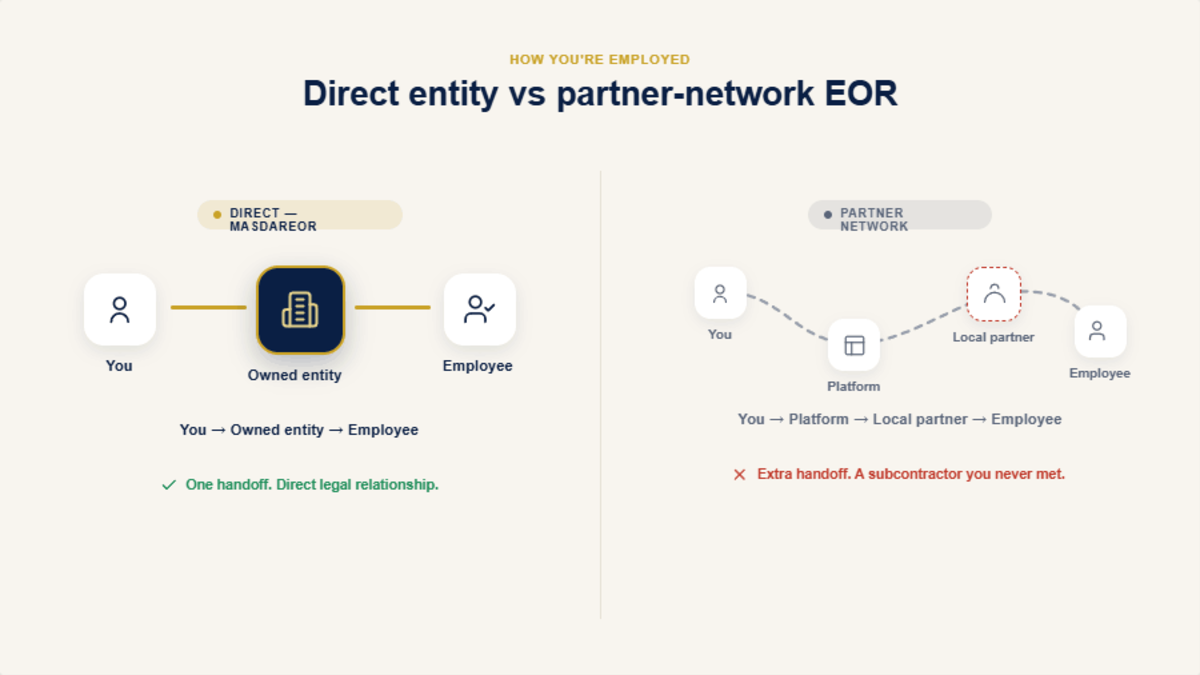
Same invoice. Very different chain underneath.
When you weigh a Deel alternative in the UAE, two models sit behind every EOR. A direct-entity EOR owns the licensed company that employs your worker. A partner-network EOR signs you up, then sub-contracts the real employment to a local firm in each country. You get the same invoice either way. Underneath, though, the chain looks very different.
You feel that difference in three places.
First, compliance liability. With an owned entity, one named company holds the legal-employer role. It answers for WPS filing, end-of-service accruals, and visa status. With a partner layer, that liability passes through a middleman, so your contract sits one step from the firm doing the work.
Second, speed. Visa sponsorship, Emirates ID, and onboarding move faster when the entity that issues them is the one you signed with. Add a partner handoff, and every step waits in a second company’s queue.
Third, accountability. One direct provider means one phone number when a payroll run or an inspection needs an answer today. A partner network makes you chase two companies that can point at each other.
Scaling matters too. When one provider owns entities across the region, you keep one relationship as you grow, instead of vetting a new partner in every country. We built our model this way on purpose. We employ directly, with no middleman, across all six GCC states. For a wider view of how to weigh providers, see our guide to the best EOR in the GCC.
Deel alternative in the UAE and GCC providers compared
Eight providers, one honest table, and who each is actually for.
Skim this first. Competitor prices are as listed publicly, per employee per month, so treat them as guide bands and confirm the live number with each provider. Our own figure is the real one from our 2026 rate card.
| Provider | Type | GCC coverage | UAE compliance (WPS / MoHRE / visa / EOSB) | Indicative price | Best for |
|---|---|---|---|---|---|
| Masdar EOR | Regional direct entity | Own entities in all 6 GCC countries | Mainland entity handles WPS, MoHRE, GDRFA visas, Emirates ID, EOSB, and Emiratisation | Fixed from AED 1,277.50/mo (Dubai), VAT included | Gulf-concentrated hiring wanting one direct, accountable local employer |
| Deel | Global platform | Broad global network (UAE included) | Fully handled via localized platform infrastructure | Premium band (~$599 / AED 2,200) | Enterprise teams hiring across multiple global countries at once |
| Remote | Global platform | Broad global network (UAE included) | WPS, visa processing, IP indemnity, and audit-ready legal documentation | Premium band (~$599 / AED 2,200) | IP protection, international equity administration, and compliance automation |
| Multiplier | Global platform | UAE and regional coverage | Arabic contract automation and continuous compliance monitoring | Mid band (approx. $300 – $400) | Multi-currency global payroll and ESOP equity support |
| RemotePass | Regional specialist | MENA and UAE focus | Automated WPS payroll, local visa sponsorship, and regional-native compliance flows | Mid band (starts from $349) | MENA-first teams wanting localized user experience and regional pension support |
| Asanify | Regional specialist | India-UAE corridor focus | Visa sponsorship and automated WPS compliant payroll | Budget band (~$199 / AED 750) | India-to-UAE hiring corridors with localized HR tools |
| RemoFirst | Global platform | UAE and wide global reach | Flat-rate UAE WPS compliant payroll | Budget band (~$199 / AED 750) | Budget-conscious teams requiring fast international onboarding |
| Links International | Regional specialist | UAE and APAC footprint | Dedicated UAE free-zone payroll and compliance expertise | Mid band (custom quoting) | Free-zone operations and multinational regional coordination |
A skimmer should get the answer from that table of Deel alternative in the UAE options alone. If you hire mostly in the Gulf and want one legal employer who owns the entity, the direct local option fits. If you hire across many countries at once, a global platform earns its premium. We would tell you the same thing on a call.
Deel vs a direct local GCC EOR: the honest tradeoff for your Deel alternative in the UAE
If your real choice is Deel versus a local EOR in the UAE, you are weighing breadth against depth. Deel hands you dozens of countries from one screen. So it is hard to beat when your team is spread worldwide. A direct local GCC EOR does the opposite. It gives you one accountable employer in-country, deeper Gulf compliance, and usually a lower fixed fee. For hiring concentrated in the Gulf, depth wins. For genuinely global hiring, breadth wins. Many teams use both: a global platform for the world, and a local entity for the Gulf.
Best Deel alternative in the UAE options, profiled
The fair rundown, including where we fit and where we do not.
Each provider below leads on something real. And we are the local pick we would recommend, not the only good name here.
Masdar EOR (that’s us)
Best for: companies hiring mostly in the Gulf who want one accountable, licensed employer in each country.
We are a direct, licensed employer of record in all six GCC countries, and we own our in-country entities instead of routing you through partners. In the UAE, that means our own mainland entity in Dubai and Abu Dhabi, handling MoHRE, GDRFA, WPS, Emirates ID, and Emiratisation. Our clients range from Fortune 500 firms to energy and defence contractors hiring into the Gulf. We have worked only in this region for more than 17 years. So we price a fixed, transparent fee, from AED 1,277.50 per month in Dubai, with VAT included and no onboarding charge.
Global platforms as a Deel alternative in the UAE
These are global platforms. If your hiring spans many countries, a global-platform Deel alternative in the UAE earns its breadth.
Deel. Best for teams hiring across dozens of countries from one screen. It offers unified contractor and employee management, multi-currency payments, more than 500 integrations, strong automation, and 24/7 multilingual support. Premium pricing, around AED 2,200 / $599 per employee per month.
Remote. Best for IP-sensitive hiring. Remote adds IP and invention-rights indemnity, equity administration, audit-ready documentation, and a 24/7 SLA. Around AED 2,200 / $599.
Multiplier. Best for multi-currency payroll with local contract handling. You get Arabic contract automation, 120-plus currencies, 24/7 compliance monitoring, and ESOP support.
RemoFirst. Best for budget-conscious teams that want speed. It runs flat-rate WPS payroll, a dedicated account manager, 185-plus country reach, and fast onboarding, at a budget-band price near AED 750 / $199.
Regional and local specialists
These focus on MENA and nearby corridors, which can feel more local than a global platform.
RemotePass. Best for MENA-first teams. It centres on the UAE and MENA, with regional payroll flows built for the market.
Asanify. Best budget-friendly Deel alternative for the India-to-UAE hiring corridor. They offer localized visa sponsorship and automated WPS payroll through an intuitive dashboard. And because their plans sit firmly in the budget tier, near AED 750 / $199 per month, they are a strong option for growing startups that want to avoid premium enterprise fees.
Links International. Best for free-zone payroll and multinational coordination. It brings strong free-zone expertise and a Dubai office, which helps when your structure spans the region.
If your roadmap runs through Saudi Arabia, look at how an employer of record in Saudi Arabia handles Saudization and GOSI, because the rules there differ from the UAE.
UAE compliance from your Deel alternative in the UAE, handled on the ground
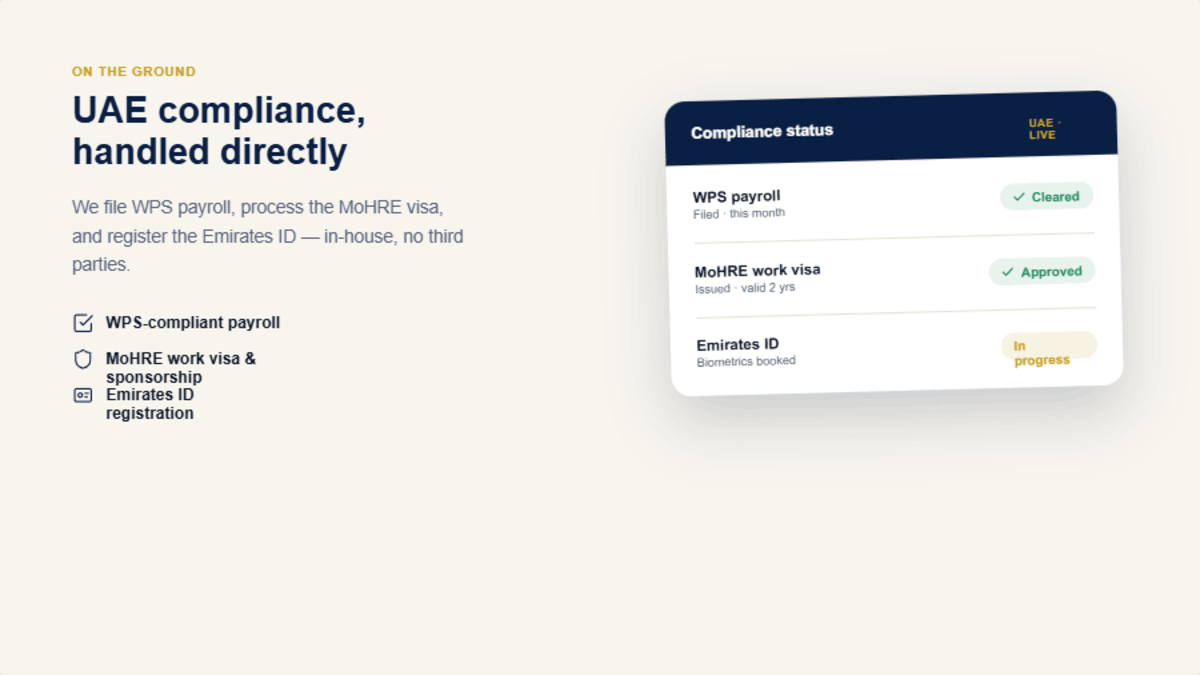
WPS, visas, gratuity, ILOE: what each means, and who owns it.
The right Deel alternative in the UAE, a compliant employer of record on the ground, has to clear every local hurdle directly, not from a distance. So here is how we handle each one at Masdar EOR, and what to check in any provider you weigh up.
What is WPS (the Wage Protection System)?
MoHRE runs WPS, the mandatory electronic salary-transfer system. It checks that every employer pays staff on time against their registered contracts. We file WPS submissions directly through our local banking portal. As a result, we cut out third-party delays and avoid the automatic visa or operational blocks that follow a late payment.
MoHRE, visas, and Emirates ID
Legal residency means clearing MoHRE quotas and General Directorate of Residency and Foreigners Affairs (GDRFA) approvals. We act as the direct sponsor, so we manage the whole chain: the employment visa and work permit (around AED 6,300 for a two-year expat visa in the UAE), the medical screening, and the physical Emirates ID. In Dubai, processing usually runs about 20 working days.
End-of-service gratuity (EOSB) and the savings scheme
Under UAE Federal Decree-Law No. 33 of 2021, gratuity is based on the employee’s basic pay and length of service. For a standard contract, that is 21 days of basic pay for each of the first five years, then 30 days for each year after, fully pro-rated. The UAE now also offers a voluntary alternative, the MoHRE-approved end-of-service savings scheme, where monthly contributions go into a regulated fund instead of building up as a lump sum. Ask us which route fits your team. Either way, we accrue the benefit monthly, so the final payment is always funded.
Who pays for insurance and unemployment cover (ILOE)?
These two sit in different places. We procure and sponsor compliant private medical insurance, with group plans priced by age and cover, because that duty sits with the employer. The Involuntary Loss of Employment (ILOE) scheme is different: it is a personal employee obligation. So each employee subscribes and pays their own premiums through the official ILOE portal, and we make sure your team knows to do it and avoids a fine.
Mainland vs free zone: which jurisdiction fits?
We handle both structures. Mainland contracts fall under federal labour law, so your employee can work anywhere in the country. Free zones like DIFC or ADGM run their own legal frameworks and local labour jurisdiction instead. Either way, we keep compliant setups for employees across both.
What it costs to hire through an EOR in the UAE
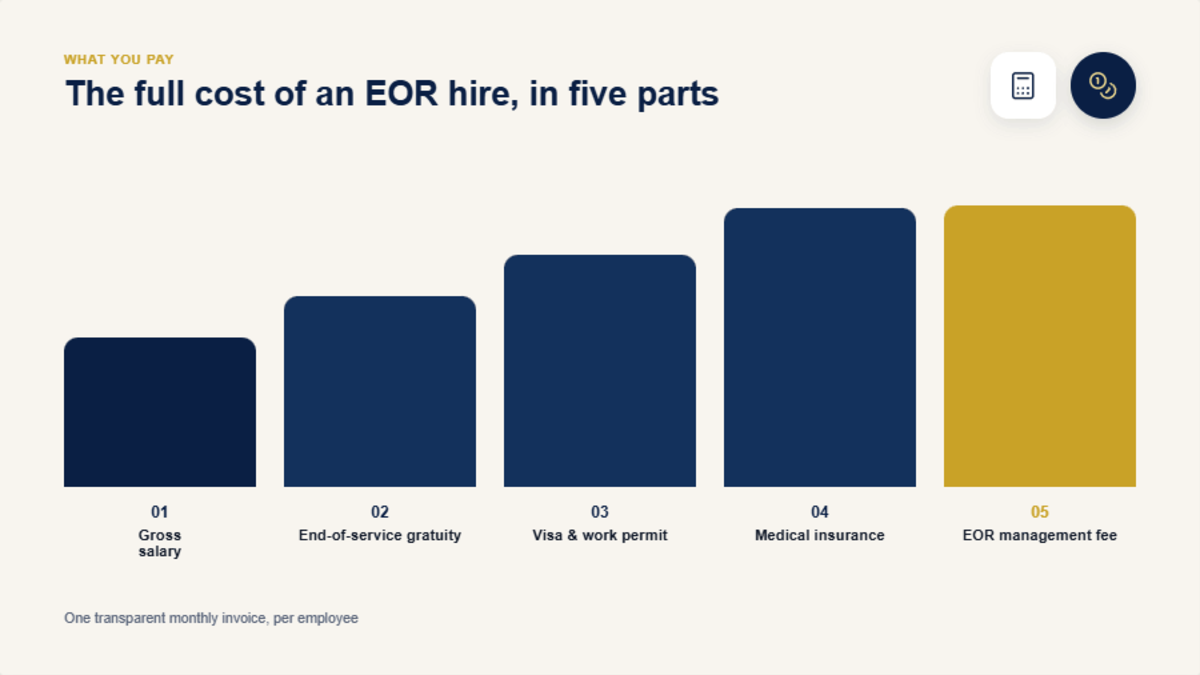
The five costs behind every quote, so nothing surprises you later.
The base fee is only one line in your real budget. A full UAE cost breakdown runs across five parts.
- Base EOR management fee: the fixed monthly cost per employee.
- Government processing fees: the work permit and employment visa, plus medical exams.
- Mandatory health insurance: group plans, priced by age and cover.
- Statutory contributions: GPSSA pension for UAE nationals, and the monthly Emiratisation fee where it applies.
- EOSB accrual: money set aside monthly for the end-of-service payment.
Premium global platforms like Deel and Remote anchor the top of the market, near AED 2,200 / $599 per employee each month for platform access alone. Budget-focused options like RemoFirst and Asanify sit lower, near AED 750 / $199, with a lighter self-service model. Our own UAE management fee is fixed from AED 1,277.50 per month in Dubai, well below the premium band, with onboarding free, the upfront deposit refundable at the end of the contract, and VAT included. For the full component-by-component breakdown, see what an EOR costs in the UAE.
So the headline fee is never the whole story. Ask every provider to itemise all five before you compare, because a low sticker price with deposits and FX markup can cost more than a higher fixed fee with none.
EOR vs PEO in the UAE
One needs you to already own a company. The other does not.
Short answer: use an EOR if you do not have a UAE company yet. Use a PEO only if you already do.
An EOR is the full legal employer. It owns the entity, sponsors the visa, and carries employer liability. So you can hire in the UAE without opening a company of your own. A PEO (Professional Employer Organization) is different. It co-employs next to your existing entity and shares HR and payroll, while you stay the legal employer.
The entity is the deciding line. A UAE PEO needs you to already hold a registered local company, because someone has to be the legal employer for the PEO to share. An EOR does not. And most teams adding their first Gulf hires have no local entity yet, which is exactly the EOR case. For a deeper comparison, see our guide on EOR vs PEO for GCC expansion.
Scaling from the UAE across the GCC
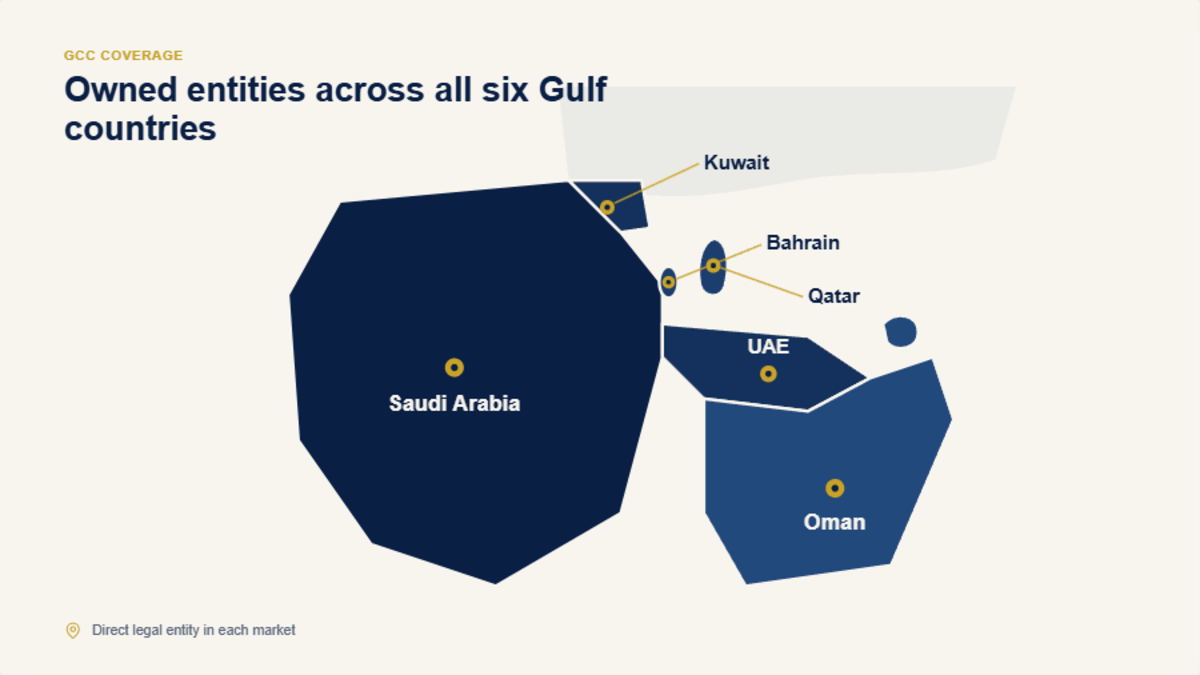
One contract for six countries beats a new partner in each.
The strongest Deel alternative in the UAE for regional growth is one direct multi-country EOR that gives you a single contract and a single accountable employer across all six Gulf states. So there is no need to onboard a new partner in each country.
Hiring in the UAE today usually means Saudi Arabia, Qatar, or Oman tomorrow. That is where the entity question compounds. With a partner-network provider, each new country can mean a new local partner, a new contract, and a new chain of accountability. With a direct provider, you keep one contract and consistent compliance as you add countries. We register and file each country’s own scheme ourselves: GOSI in Saudi Arabia, GPSSA in the UAE, PIFSS in Kuwait, PASI in Oman, and SIO in Bahrain.
We hold direct entities in all six: UAE, Saudi Arabia, Qatar, Kuwait, Bahrain, and Oman. That includes a Green Nitaqat tier in Saudi Arabia, the top Saudization band. One note on the term: GCC means the Gulf Cooperation Council, the six Gulf states, not a loose region label. So if regional growth is on your map, plan it against one employer of record across the GCC, rather than stitching partners together.
5 questions to ask before you sign an EOR
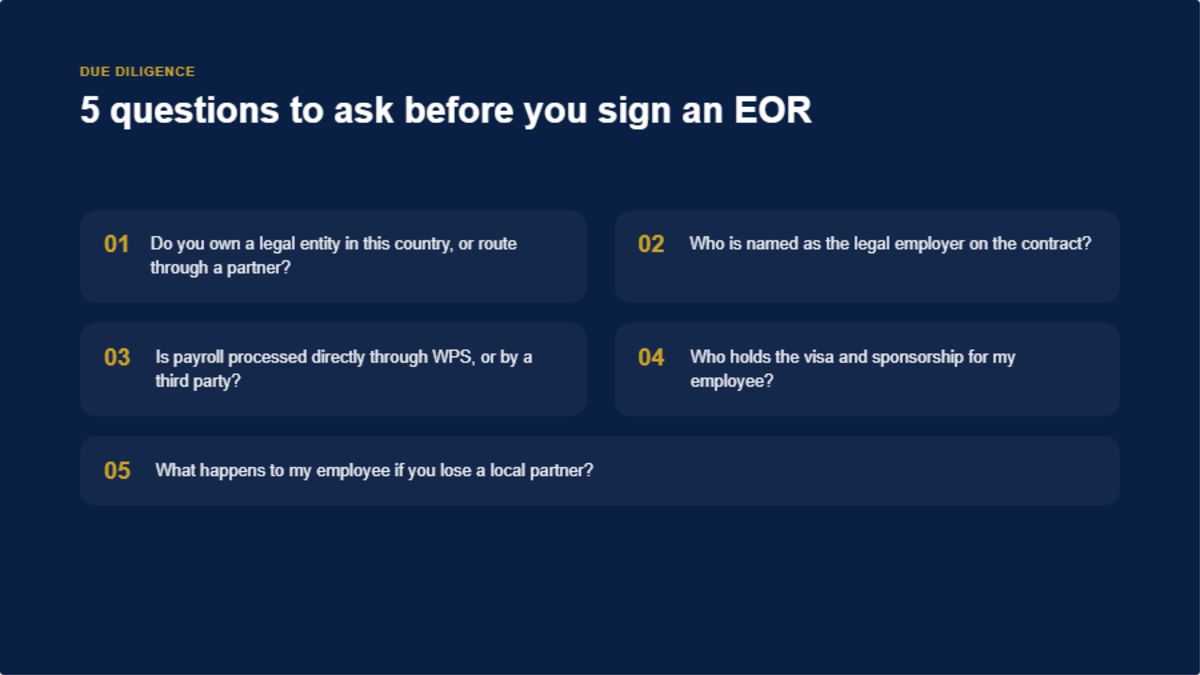
Copy these straight into your next provider call.
Run this checklist past every provider you shortlist, us included. It keeps the focus on where your risk really sits.
- Do you own your entity in each country I will hire in, or do you use a local partner?
- What labour-supply licence do you hold, for example a UAE on-demand labour-supply or MoHRE manpower licence?
- How do you handle WPS, EOSB, and visa sponsorship in each country on my list?
- How do you protect my intellectual property and confidential data?
- What is the all-in monthly cost, and are there deposits, FX markup, setup, or offboarding fees?
When the answers to one and five come back clear, you are dealing with a provider that owns its risk. When they go vague, keep asking.
Frequently asked questions
Does Deel own its own legal entity in the UAE, or use a local partner?
Deel operates in the UAE. But whether it employs through its own entity or a local partner can vary by market. So put the question to Deel and to every provider directly, including us. Ask each one to confirm, in writing, who the legal employer is in each country you plan to hire in.
What is the difference between a direct-entity EOR and a partner-network EOR?
A direct-entity EOR owns the licensed company that employs your worker. So one firm holds the contract, the visa sponsorship, and the liability. A partner-network EOR signs you up, then sub-contracts the real employment to a local firm in each country. In short, the direct model gives you one accountable employer, while the partner model puts a layer between you and the firm doing the work.
Is a local EOR cheaper than Deel in the UAE, and how do I compare total cost?
Often, yes. Premium global platforms like Deel sit near AED 2,200 / $599 per employee per month, while direct local providers usually price below that. Our own UAE management fee starts at AED 1,277.50 per month in Dubai, with VAT included. To compare fairly, add the management fee plus visa, medical insurance, statutory contributions, and gratuity accrual, then compare all-in numbers, not headline fees.
How much does an employer of record cost per month in the UAE?
UAE EOR management fees run from roughly AED 750 / $199 at the budget end to around AED 2,200 / $599 for premium global platforms, per employee per month. On top of the fee, you pay the visa and permit, medical insurance, statutory contributions, and gratuity accrual. Direct local providers often hold a fixed fee below the premium band.
Does an EOR sponsor the UAE visa and Emirates ID, and how long does it take?
Yes. The EOR is the legal sponsor, so it secures the MoHRE work permit, the GDRFA residency visa, the Emirates ID, and the medical. In Dubai, processing usually takes about 20 working days once you submit documents. And it moves faster when the entity issuing the visa is the one you contracted with.
How is end-of-service gratuity (EOSB) calculated in the UAE?
Under UAE Federal Decree-Law No. 33 of 2021, gratuity is based on the employee’s basic salary and length of service. For a standard contract, that is 21 days of basic pay for each of the first five years, then 30 days for each year after, fully pro-rated. A compliant EOR accrues it monthly so the final payment is funded when the employee leaves.
Which EOR is best for hiring across the GCC (UAE, Saudi Arabia, Qatar, Bahrain, Kuwait, Oman)?
For all six Gulf states, a provider that owns direct entities in each country gives you one contract and one accountable employer, instead of a different partner per country. We run direct, licensed entities in all six, with more than 17 years in the region. So we suit buyers expanding country by country across the Gulf.
Choosing your Deel alternative in the UAE
It comes down to one honest question.
For Gulf-concentrated hiring, the right Deel alternative in the UAE is a direct local EOR, and it usually beats platform breadth. And we will say it plainly, even though we are one of those local options: Deel is an excellent global platform. It is just built for a different job than hiring four people in Dubai and two in Riyadh.
So hold every provider to the one question that decides your risk. Do you own your entity, or rent a partner’s licence?
If your hiring sits in the Gulf, and you want to see our direct local fee next to the platform price you pay now, get an instant quote. We reply within a day.
More guides in: EOR & PEO