

The honest EOR vs entity comparison: every setup fee, every ongoing overhead, and the resident General Manager requirement that most guides quietly skip.
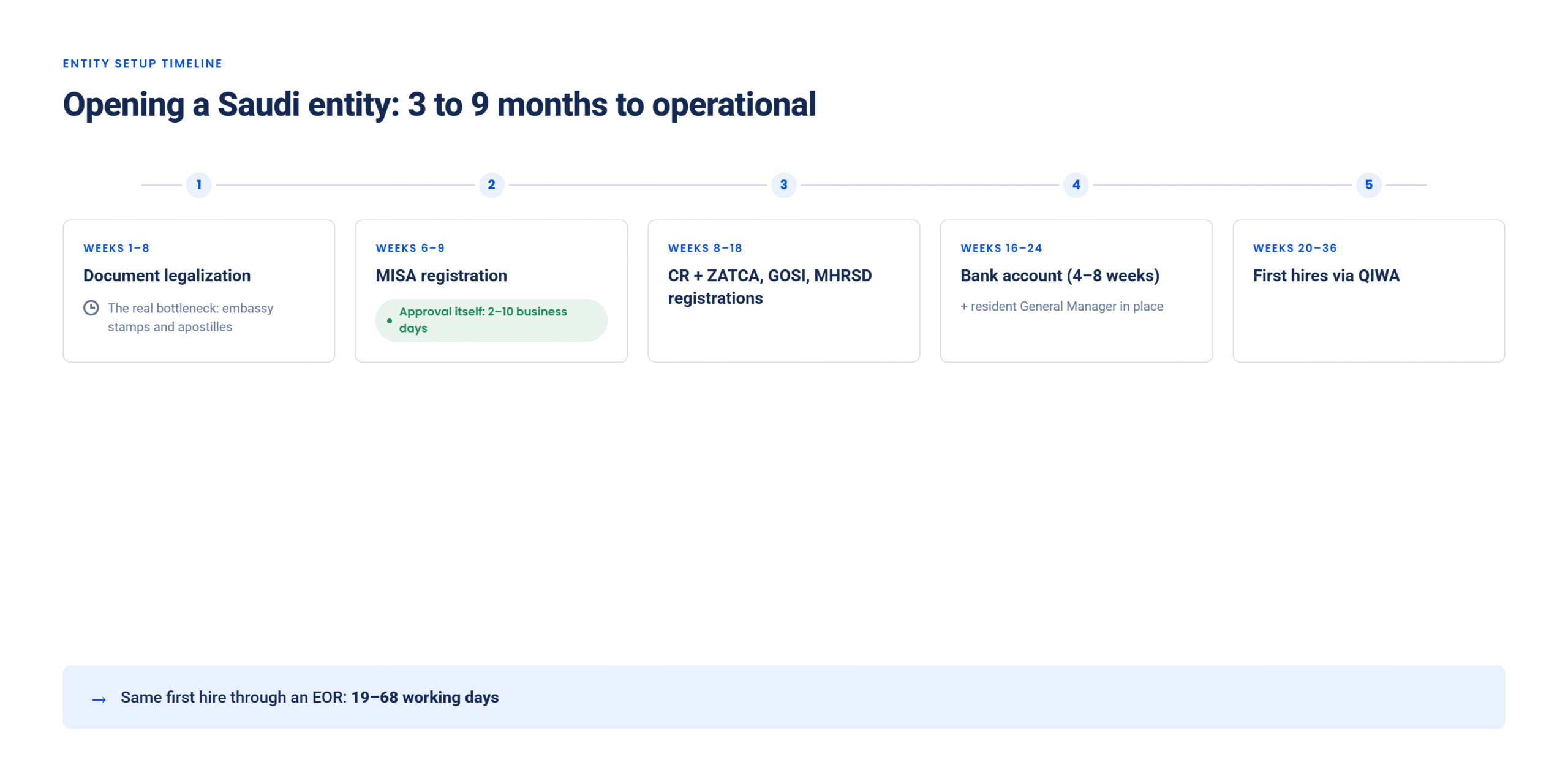
When you weigh EOR vs entity for your first 15 to 25 hires in Saudi Arabia, using an Employer of Record (EOR) is cheaper and faster than setting up your own entity. Entity setup costs USD 15,000 to USD 45,000 upfront and takes 3 to 9 months for full operational readiness. Ongoing entity overhead runs USD 25,000 to USD 70,000 per year before you employ a single person. An EOR costs SAR 1,875 to SAR 3,000 per employee per month with near-zero setup time. Break-even lands where your headcount is high enough that per-employee EOR fees exceed fixed entity overhead. Typically 15 to 25 employees, depending on salary bands and Saudization pressure. I run marketing at Masdar EOR, a direct Employer of Record with our own licensed entity in Saudi Arabia. I write this comparison as someone who watches companies weigh both paths every month. This is the honest math, including the resident General Manager cost, the Vision 2030 reforms that shifted the equation, tax implications, and where each path actually wins.
Quick answers
- EOR upfront cost: near zero. Standard security deposit is one month gross salary, refundable.
- Entity setup upfront cost: USD 15,000 to USD 45,000 (MISA registration, legal, document legalization, resident General Manager relocation or hiring, capital lock-up, office lease if required).
- EOR onboarding time: 2 to 10 weeks depending on candidate nationality and location.
- Entity full operational readiness: 3 to 9 months (MISA registration itself clears in 2 to 10 business days; the time goes to document attestation, CR, ZATCA, GOSI, MHRSD, the bank account, and the resident General Manager).
- Ongoing annual entity overhead (before any employees): USD 25,000 to USD 70,000.
- Break-even: 15 to 25 employees for most companies. Higher if you are in a sector with Saudization pressure.
- Corporate tax on the entity: 20% flat, unless RHQ status applies (30-year exemption on qualifying RHQ activities).
- Vision 2030 reforms: 100% foreign ownership now allowed for most sectors. Regional Headquarters (RHQ) Program offers 30-year tax incentives with a 10-year exemption from Saudization quotas (the requirement is 15 hires in year one, three at executive level).
EOR vs entity quick verdict: when each path wins
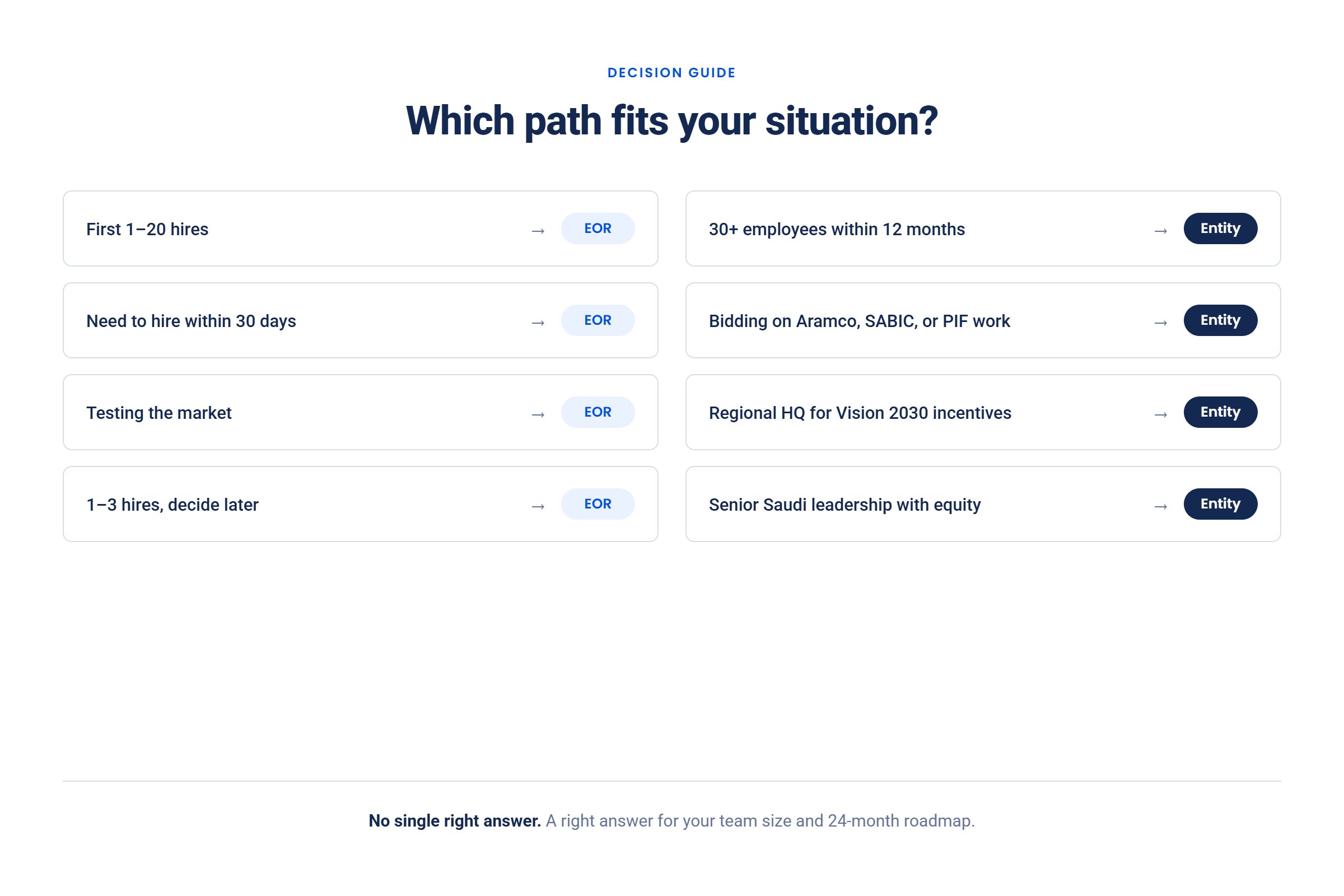
| Situation | Best path |
|---|---|
| Your first 1 to 20 Saudi employees | EOR |
| You need to hire within 30 days | EOR |
| You have 30+ Saudi employees or expect that scale in 12 months | Entity |
| You need to bid on Aramco, SABIC, or PIF contracts | Entity |
| You are piloting a Saudi market entry | EOR |
| You want to open a regional HQ for Vision 2030 tax benefits | Entity (RHQ Program) |
| You want to hire senior Saudi leadership with equity | Entity |
| You would like to test 1 to 3 hires and decide later | EOR (then transition if it works) |
There is no single right answer to EOR vs entity. There is a right answer for your team size, timeline, and 24-month roadmap.
The EOR path: setup, cost, timeline
What you pay upfront
Almost nothing. A standard direct EOR charges one month gross salary as a refundable security deposit, billed at start. That is it. No MISA registration, no capital, no legal setup, no resident General Manager recruitment.
What you pay monthly
Three components (full breakdown in the Saudi EOR cost guide):
- Employee gross salary (whatever you negotiated)
- Statutory employer contributions (12 to 20 percent of gross): GOSI, mandatory medical, EOSB accrual, WPS filing through Mudad
- EOR service fee: SAR 1,875 to SAR 3,000 per employee per month for a direct provider (VAT-inclusive)
For a Saudi national at SAR 15,000 gross, total monthly cost is roughly SAR 19,500 to SAR 20,000.
How long it takes
- In-country transfer (candidate already in Saudi Arabia): about 19 working days.
- Outside-country hire from a Western country: about 45 to 55 working days.
- Outside-country hire from a GAMCA country: about 68 working days.
Full step-by-step timeline lives in the Saudi hiring guide.
What you get
- Legal employment under the EOR Saudi entity
- QIWA registration, GOSI enrollment, WPS payroll, EOSB accrual
- Arabic contract compliance
- Iqama processing for expats
- Nitaqat tier certainty (a direct EOR publishes theirs; we put our Green Nitaqat status in writing before you sign)
- One monthly invoice, no ongoing entity admin
What you do not get
- Your own Saudi corporate presence (no “Saudi entity” line on your website)
- Ability to bid on some MISA-restricted government tenders
- Full control over hire-to-fire process (some flexibility limits vs your own entity)
- Vision 2030 RHQ tax incentives (those require your own entity)
The EOR is the operational answer. It is not the strategic-branding answer. If you want a shortlist of providers, see the best EOR companies in Saudi Arabia 2026.
The entity path: setup, cost, timeline
Opening your own Saudi entity is a real project. Here is what it actually involves.
The full setup timeline (month by month)
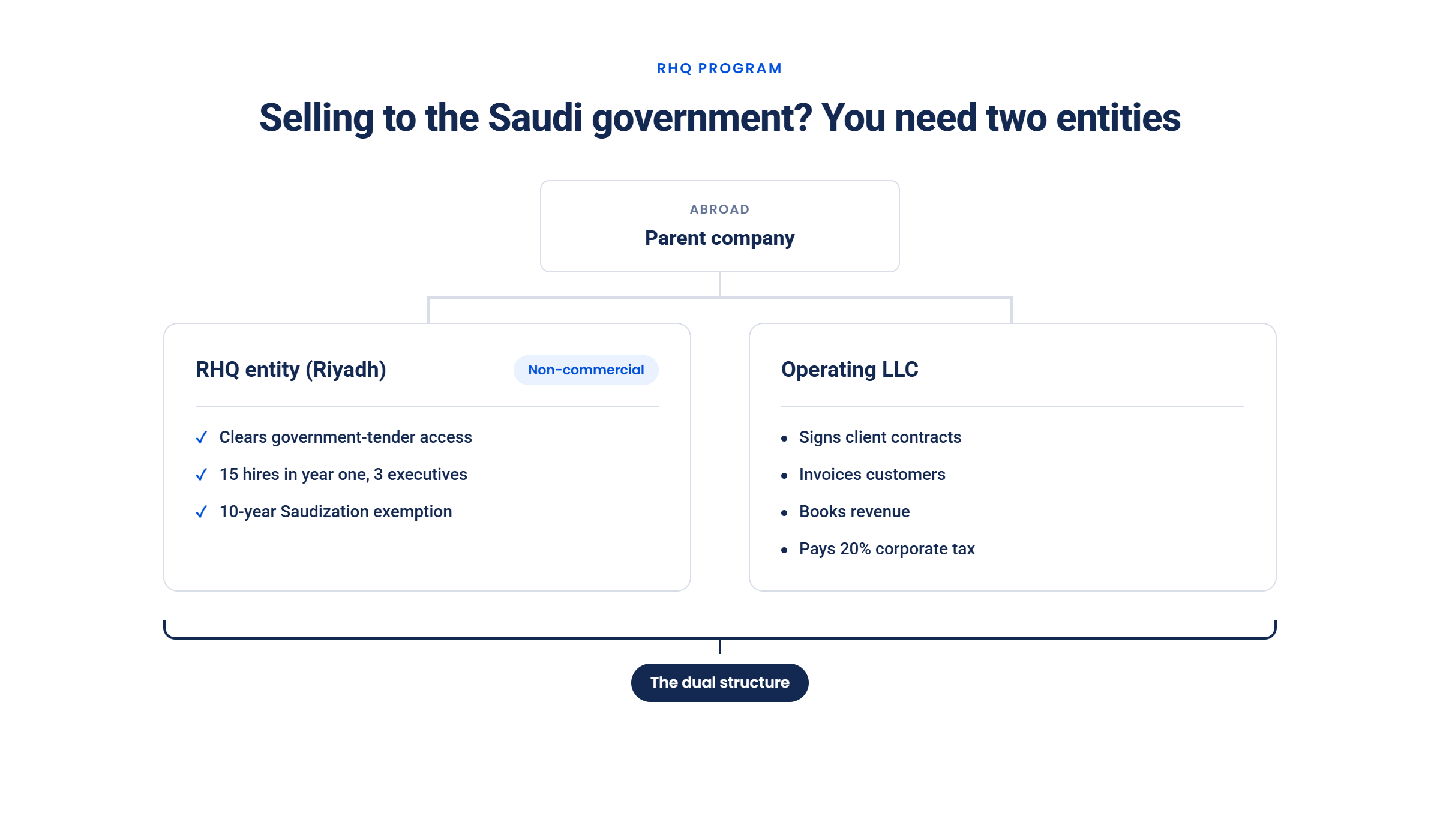
Weeks 1 to 8: Preparation and document legalization
- Determine entity type: LLC (most common), Branch of Foreign Company, or Regional Headquarters (RHQ)
- Engage a Saudi law firm or corporate services provider
- Prepare parent-company documentation, attested and translated into Arabic. This is the real bottleneck of the whole setup: embassy stamps and apostilles in the parent company’s home country routinely take 4 to 8 weeks
- Reserve the entity name through the Ministry of Commerce
Weeks 6 to 9: MISA registration
- Submit the registration application (formerly the MISA foreign investment license) through the Ministry of Investment (MISA) portal
- MISA approval takes 2 to 10 business days for standard service and tech activities once documents are legalized
- Some regulated sectors (media, defense, energy) require additional approvals
Weeks 8 to 14: Commercial Registration (CR)
- Ministry of Commerce issues Commercial Registration once the MISA registration is approved
- Chamber of Commerce membership follows
Weeks 12 to 18: Post-CR compliance registrations (run in parallel)
- MHRSD labor registration
- GOSI social insurance registration
- ZATCA tax registration (VAT if applicable, corporate income tax, Zakat if any Saudi ownership)
- Municipality (Baladiya) license
- Civil defense license (if physical premises)
Weeks 16 to 24: Bank account and physical presence
- Corporate bank account opening: 4 to 8 weeks. This is often the single slowest step in 2025-2026 because Saudi banks (regulated by SAMA) require extensive documentation and physical signatory presence.
- Office lease (Ejar registration) if physical presence is required by your sector
- The resident General Manager (any nationality, holding a valid Iqama) must be in place before payroll can start
Weeks 20 to 36: First hires
- Nitaqat status assessment begins as soon as you hire the first person
- Work permits and Iqamas processed through QIWA
- First payroll cycle runs through Mudad
Realistic total: 3 to 9 months from decision to fully operational entity that can employ people. A straightforward LLC in Riyadh with clean, pre-attested parent-company documents lands closer to 3 to 4 months. Complex structures, regulated sectors, or slow document attestation push you to 9 months or beyond.
Real upfront cost breakdown (line items nobody publishes)
| Line item | Typical cost (USD equivalent) |
|---|---|
| MISA registration (year 1) | 3,200 (SAR 12,000: SAR 10,000 subscription + SAR 2,000 annual fee) |
| Commercial Registration (CR) and Chamber of Commerce | 1,500 to 2,500 |
| Legal fees (Saudi corporate law firm) | 5,000 to 15,000 |
| International document legalization, attestation, and translation | 2,000 to 8,000 |
| Municipality (Baladiya) license | 800 to 2,500 |
| Bank account setup and initial deposit | Variable; SAR 25,000 minimum LLC capital |
| Accounting and tax setup | 2,000 to 5,000 |
| Corporate seal, letterhead, standard docs | 500 to 1,000 |
| Office lease (if required, first-quarter payment) | 8,000 to 25,000 |
| Resident General Manager Iqama, relocation, or hiring (year 1) | 15,000 to 40,000 |
| Total upfront | USD 15,000 to USD 45,000 (or higher with office and a full-time senior General Manager) |
Numbers vary by sector, city, and the parent company’s home jurisdiction. Regulated activities add substantially — see the regulated-sector section below.
Annual overhead you pay before you employ anyone
The number nobody publishes. Your entity generates these costs whether you have zero employees or fifty.
| Ongoing cost | Annual (USD equivalent) |
|---|---|
| MISA registration annual fee | ~550 (SAR 2,000) |
| CR renewal | 300 to 500 |
| Chamber of Commerce | 1,500 to 2,000 |
| Municipality license renewal | 800 to 2,500 |
| Accounting and audit | 5,000 to 20,000 |
| Corporate tax filings (ZATCA) | 2,000 to 5,000 |
| Resident General Manager or corporate services representative (fractional) | 15,000 to 45,000 |
| Office lease (if required) | 8,000 to 25,000 |
| Total annual overhead (before any employee) | USD 25,000 to USD 70,000 |
This is the “keeping the lights on” number. Every year. Whether you employ five people or fifty.
What you get
- Your own Saudi corporate identity
- Ability to bid on government tenders (Aramco, SABIC, PIF) once the required structures are in place
- Direct hiring authority under your own Nitaqat tier
- Full flexibility on employment structure, equity, and leadership positioning
- Regional Headquarters (RHQ) tax incentive eligibility (if you qualify)
- Long-term brand equity as a Saudi-registered company
What you do not get
- Speed (3 to 9 months to first hire)
- Cost efficiency at small scale
- Freedom from Ministry of Labor correspondence (it lands on your desk now)
- Freedom from Nitaqat quota management (you own it directly, not the EOR)
The resident General Manager requirement
Most EOR-vs-entity guides get this wrong in one direction or the other, usually under the label “Saudi resident director requirement.” It is the single most underestimated obligation of the entity path, so here is the accurate version. Saudi corporate law does not require any company director or board member to be a Saudi national or a local resident. A foreign-owned entity can have a board composed entirely of international, non-resident directors. What the Kingdom does strictly mandate is a local General Manager (GM): an individual who legally resides in Saudi Arabia, holds a valid residency permit (Iqama), and acts as the entity’s legal signatory for corporate documents, bank portals, and government platforms. The GM can be an expatriate transferred from your home office or a local hire, Saudi or non-Saudi. In practice, this means one of three arrangements: Option 1: Relocate a trusted executive from headquarters. Cost: their full Saudi package plus Iqama sponsorship and relocation, typically SAR 400,000 to SAR 1,000,000 per year all-in for someone senior enough to credibly represent the entity. Realistic only for larger operations. Option 2: Hire a GM locally. A Saudi or expat hire already in the Kingdom, at market salary for the seniority you need. Option 3: A fractional corporate services representative. Cost: SAR 50,000 to SAR 150,000 per year through a Saudi corporate services firm. Most first-time foreign entities use this route. Whichever route you take, factor SAR 50,000 to SAR 200,000 annually for the resident GM function into your entity budget. This is not a cost that scales with employees. It is a fixed overhead that begins the day your CR is issued.
Vision 2030 and the MISA reforms that changed the math
Two policy shifts in the last decade rewrote the entity path. If you are comparing EOR vs entity in 2026, ignore any guide that does not account for these.
100 percent foreign ownership
Since 2019, foreign investors can own 100 percent of a Saudi LLC for most commercial activities. You no longer need a Saudi partner or agent for a majority of business activities. Regulated sectors (defense, oil exploration, real estate in Mecca and Medina, and a handful of others) still have restrictions. But for tech, marketing, professional services, retail, healthcare, and most other sectors, full foreign ownership is now the default. This alone makes the entity path far more attractive than it was pre-2019. Historically, the “Saudi partner” requirement was a strategic obstacle, not just a legal one.
The Regional Headquarters (RHQ) Program
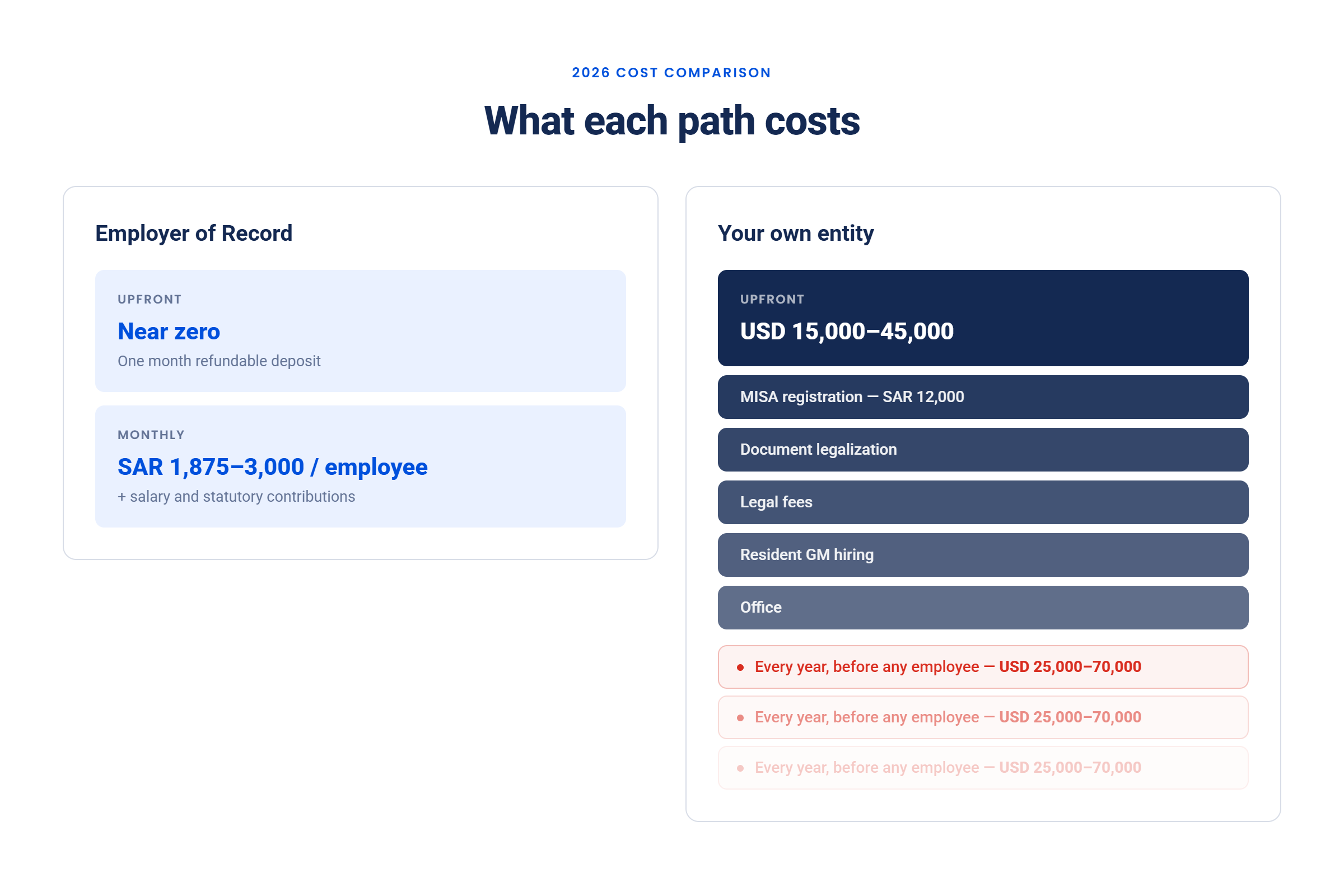
Launched in 2021 and enforced from January 2024, the RHQ Program requires any multinational wanting to do business with the Saudi government (or its subsidiaries) to establish its Regional Headquarters in Saudi Arabia. In exchange, the RHQ receives:
- 30-year exemption from corporate income tax on qualifying RHQ activities
- 30-year exemption from withholding tax on qualifying outbound payments (dividends, royalties, service fees)
- Streamlined MISA licensing
- Priority access to government contracts
Two constraints define the model. First, headcount: the RHQ must employ at least 15 full-time staff within its first year, three of them at senior executive (C-suite) level, and their nationalities are exempt from standard Nitaqat metrics under a 10-year holiday from mandatory Saudization quotas. Second, scope: an RHQ is a strictly non-commercial vehicle. It cannot sign client contracts, invoice local customers, or book trading or service revenue. Local sales run through a separate operating entity, and the 30-year exemptions apply to qualifying intra-group hub management services, not to the operating company’s commercial profits. So the RHQ path is for companies with real regional scale, not for testing. If you are not planning to do significant business with Saudi government entities, the RHQ Program is not the deciding factor. If you are, an EOR will not get you there. You need the entity structure.
What this changes for the EOR vs entity decision
Vision 2030 reforms make the entity path more attractive at the higher end (regional scale, government tenders, tax planning). They do not change the math for smaller-scale hiring. For your first 15 to 25 employees, the EOR path is still cheaper and faster. But if your 3-year plan includes RHQ status, the entity path pays for itself far sooner than the standard break-even suggests.
Tax implications: EOR vs entity in Saudi Arabia
Tax treatment is the axis that most EOR vs entity guides skip entirely. Here is what actually happens to your tax exposure under each path.
Under the EOR path
Your company outside Saudi Arabia has no Saudi tax presence. You are not registered with ZATCA. You do not file Saudi corporate income tax, Zakat, or VAT. The EOR handles those obligations for its own entity, not yours. The EOR invoices you monthly for a services fee. In your home country, that fee is typically a deductible business expense (confirm with your accountant). Saudi VAT at 15% is included on the EOR service fee line, but as the client company you can recover it if you are VAT-registered in a jurisdiction with reciprocal recovery arrangements. Most companies just expense it. There is one caveat worth knowing: permanent establishment risk. If your foreign company has employees performing sales, contract negotiation, or client-facing revenue-generating work in Saudi Arabia, Saudi tax authorities can argue you have a taxable presence even without an entity. Direct EORs manage the contract wording to reduce this risk, but the exposure is not zero. Discuss with a tax advisor.
Under the entity path
Your Saudi entity is a taxpayer in Saudi Arabia. That means:
- Corporate Income Tax (CIT): 20% on the entity’s net profits. Applies to foreign-owned shareholding.
- Zakat: 2.5% on the entity’s Zakat base (roughly, adjusted net worth) for the Saudi-owned portion, if any.
- VAT: 15% output tax on Saudi sales, with input VAT recoverable on eligible expenses. Filing is monthly or quarterly depending on turnover.
- Withholding Tax (WHT): Applies on outbound payments to non-residents. Rates vary by payment type (5% on dividends, 15% on royalties, 5-15% on services).
- RHQ Program exemption: If you qualify as an RHQ, corporate income tax and withholding tax are waived for 30 years on qualifying RHQ activities; the operating subsidiary’s commercial profits remain taxable.
Filing burden: your Saudi entity must maintain audited financial statements, file annual CIT returns, monthly or quarterly VAT returns, and withholding tax returns on relevant payments. Budget USD 5,000 to USD 20,000 per year for accounting and audit compliance. The EOR vs entity tax verdict: for small operations (under 15 employees, no Saudi sales), an EOR keeps you out of Saudi tax registration entirely. For scaled operations with Saudi customers, the entity path is unavoidable. But the RHQ Program can make it dramatically more tax-efficient than most guides assume.
The EOR vs entity break-even math (with real numbers)
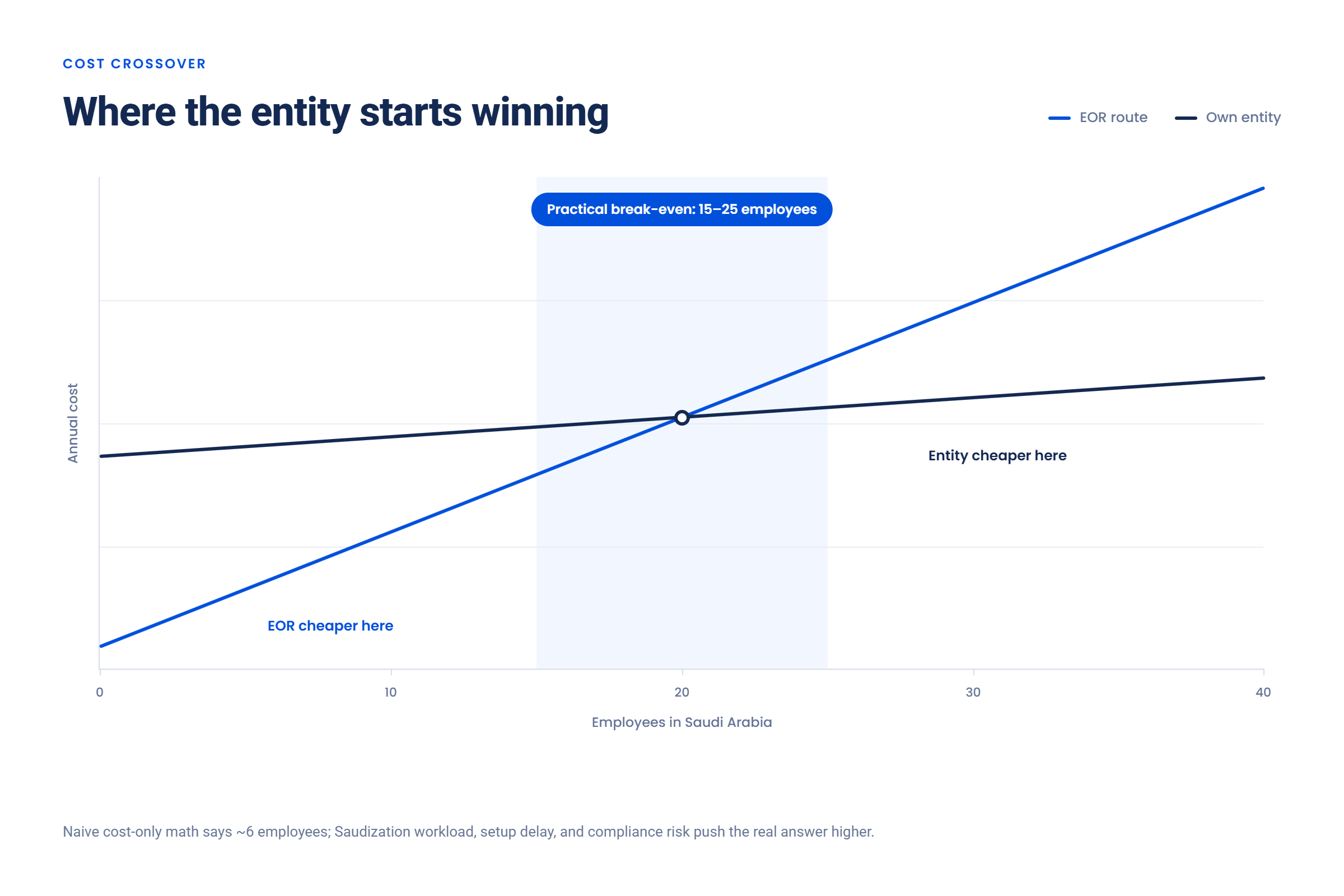
Where does the entity path start paying off in raw cost terms? Here is the math for a company hiring Saudi nationals at SAR 15,000 gross monthly. EOR cost per employee per year:
- Service fee: SAR 30,000 (SAR 2,500 x 12)
- Everything else (salary, GOSI, medical, EOSB) is the same whether you use an EOR or an entity. The EOR does not create those costs. It passes them through.
So in the EOR vs entity comparison, the incremental EOR cost is roughly SAR 30,000 per employee per year. Entity fixed overhead:
- USD 40,000 mid-range x ~3.75 SAR/USD = roughly SAR 150,000 per year fixed
Break-even:
- N x 30,000 = 150,000 + N x 3,000 (per-employee entity admin)
- 27,000N = 150,000
- N ≈ 5.5 employees on pure cost math
But that is the naive number. The practical break-even is higher because:
- Opportunity cost of the setup delay. 3 to 9 months of not hiring is meaningful cost. If each unfilled role costs you SAR 50,000 in delayed revenue per month, that alone is SAR 150,000 to SAR 450,000 in opportunity cost.
- Nitaqat management risk. Managing your own Saudization ratio is a real workload. Get it wrong and you cannot issue new visas at all. EORs absorb this.
- Compliance error cost. GOSI misclassification, WPS filing errors, EOSB miscalculations, and Iqama renewal misses all fall on you with an entity. With an EOR, they fall on the EOR.
- Resident General Manager dependency. If your GM or corporate signatory leaves or fails to file, your entity can be suspended. Ongoing risk.
Factoring these in, the practical break-even is 15 to 25 employees, not 5 to 10. That is why the industry consensus lands there. If you are at 5 to 10 employees and considering an entity, ask yourself: are you making that switch for cost, or for strategic reasons (branding, government contracts, RHQ eligibility)? If it is strategic, entity might be right at 5. If it is cost, wait until 15 to 25. For what it is worth, when companies come to us at 20 or more planned hires, we tell them to model their own entity first. It costs us deals, and it is still the right advice.
EOR vs entity scenarios: which path for which company
Scenario 1: SaaS company hiring 3 to 5 Saudi people over 12 months. Use an EOR. The entity path costs more than the total EOR bill for this team, and it locks you into ongoing overhead. If the market works, transition later. Scenario 2: Global consulting firm bidding on Saudi Aramco contract. Set up the dual structure: an RHQ entity to satisfy the government-procurement requirement, plus an operating LLC to sign the contracts and invoice. An EOR cannot make you eligible for the tender. Scenario 3: Series B startup hiring first Saudi go-to-market team (1 country lead, 3 to 8 hires over 18 months). EOR for months 1 through 12. Reassess entity at month 12 based on actual traction. Scenario 4: Manufacturing company with 40+ Saudi hires planned over 24 months. Entity from day one. The break-even math clearly favors the entity path at this scale. Scenario 5: Enterprise software vendor selling to Saudi banks and government. Set up the RHQ plus an operating LLC: the RHQ clears tender access and houses regional management, while the operating company signs contracts and books the revenue. At enterprise deal sizes, the combined structure pays for itself quickly. Scenario 6: Recruitment agency or professional services with 15 to 30 hires in year one. Fence-sitter. Model both paths against your specific salary bands and growth curve. If growth is certain, entity. If growth is uncertain, start EOR.
The hybrid strategy: start with EOR, transition to entity
The smartest move for most first-time Saudi hirers is not picking one path or the other. It is sequencing. Months 1 to 6: Hire your first 1 to 5 employees through an EOR. Prove the market. Learn what your actual Nitaqat mix looks like. Identify the salary bands that work. Months 6 to 12: If early hires are performing and the pipeline is growing, begin entity setup in parallel. Keep hiring through the EOR while MISA registration and document legalization run. Months 12 to 15: Once your entity is fully operational, transfer employees from the EOR to your own entity. This transfer takes about 19 working days per employee under standard Iqama sponsorship transfer rules. Months 15+: All new hires under your own entity. EOR relationship ended after the last transfer. Total EOR cost during transition (say 5 employees for 12 months): SAR 150,000. Total entity setup cost: USD 25,000. Combined: about USD 65,000 over the first 15 months. And your team is fully hired during that time, not waiting for entity readiness. Compare to going entity-first: USD 25,000 setup + USD 40,000 first-year overhead + 6 months of not hiring = USD 65,000 in explicit cost plus significant opportunity cost. The hybrid strategy is often the cheapest overall, precisely because it removes the “not hiring during setup” penalty. It is also the transition we run most often at Masdar: clients hire through our Saudi entity while their own is in setup, then we transfer the team over on the standard 19-working-day Iqama process when their CR goes live.
How regulated sectors change the math
Not every Saudi entity costs the same to open. If you operate in a regulated sector, add the following on top of the standard USD 15,000 to USD 45,000 upfront.
| Regulated sector | Additional upfront cost (USD) | Timeline addition |
|---|---|---|
| Financial services (payments, lending, fintech) | 25,000 to 100,000 | 3 to 6 months for SAMA approval |
| Healthcare (clinics, pharma, medical devices) | 15,000 to 50,000 | 2 to 4 months for MOH approval |
| Insurance | 30,000 to 100,000 | 3 to 6 months for Insurance Authority (IA) approval |
| Telecom and IT infrastructure | 20,000 to 75,000 | 2 to 5 months for CST approval |
| Defense and security | Case-by-case, often 6-figure | Case-by-case, often 12+ months |
| Media and broadcasting | 10,000 to 40,000 | 2 to 4 months for General Authority of Media Regulation (Gmedia) approval |
| Real estate (outside Mecca/Medina) | 5,000 to 25,000 | 1 to 3 months additional |
If your business is in one of these sectors, factor the extended timeline into your EOR-vs-entity math. Companies that need to be operational in Saudi Arabia within 12 months and are in a regulated sector usually start with an EOR to serve as a legal hiring bridge while the entity’s sector-specific licenses process in parallel.
What if you need to close the entity later?
The unspoken risk in the entity path is that you might change your mind. Business models pivot. Market entries do not work. Founders move on. When you close a Saudi entity, the process takes time and money too. Dissolution timeline: 6 to 12 months from decision to full deregistration. The bank account cannot be closed until CIT, VAT, and Zakat clearances are issued by ZATCA. Employees must be terminated with full EOSB paid out. Iqamas must be cancelled or transferred through QIWA. Property leases must be terminated. Dissolution cost estimate:
- Legal and administrative dissolution: USD 5,000 to USD 15,000
- Final audit and tax clearances: USD 3,000 to USD 8,000
- Employee severance (EOSB accrual): fully payable, per Saudi Labor Law
- Iqama cancellation fees: SAR 100 to SAR 500 per employee
- Bank closure fees: Variable, usually under USD 500
Practical cost: budget USD 15,000 to USD 30,000 for a clean dissolution of a small-to-medium entity, plus 6 to 12 months of time. During that window, you are still responsible for filing tax returns and maintaining minimum compliance until deregistration is final. For an EOR relationship, closure is meaningfully simpler: cancel your service agreement, transition employees (either transfer sponsorship or terminate), pay outstanding EOSB, and the relationship ends. Closure timeline: 2 to 4 months, closure cost: near zero beyond final EOSB payouts. This is not an argument to always pick the EOR. It is an argument to think carefully about the exit before you commit to entity setup, particularly for market-entry scenarios where success is uncertain.
Five things that can go wrong in the EOR vs entity choice
Going EOR when you should go entity
If you are at 30+ Saudi employees, the EOR fee stack is meaningful money. USD 30,000 per employee per year x 30 employees = USD 900,000 annually. At that scale, your own entity almost always wins. If you delay too long, you leave money on the table.
Going entity when you should go EOR
Opening an entity for your first 2 hires ties up USD 40,000 upfront, USD 40,000 in annual overhead, and 6 months of no-hire time. Total cost over 18 months: USD 100,000-plus. Two EOR-employed people for the same period: USD 60,000. Entity-first for small teams is a common expensive mistake.
Underestimating the resident General Manager requirement
Every first-time entity founder does this. “I will find someone cheap.” No, you will not. The entity needs a General Manager who resides in the Kingdom with a valid Iqama to sign for it, and securing that person (relocating an executive, hiring locally, or engaging a corporate-services representative) has real cost and lead time. Budget SAR 50,000 minimum per year for a serviceable fractional arrangement, and meaningfully more for a dedicated GM. Anything less and your entity risks non-compliance filings.
Missing the RHQ eligibility deadline
If your business model depends on Saudi government contracts (Aramco, SABIC, PIF, ministries), you need RHQ status to bid from January 2024 onward. Miss the window and your competitors that got RHQ status early lock you out of tenders.
Not modeling Nitaqat impact
If you are going entity-first, your Saudization ratio is now your problem. Getting stuck outside the compliant bands for a quarter can stall all expat hiring. Model your Saudi-to-expat mix carefully. This is not a problem with the EOR path. You inherit the EOR Nitaqat tier (which is why direct vs aggregator EOR matters so much).
Frequently asked questions
Is an EOR cheaper than setting up an entity in Saudi Arabia?
For your first 15 to 25 employees, yes. Above that, running your own Saudi entity almost always costs less per head. The break-even depends on salary bands, Saudization pressure, and how you value setup speed vs long-term cost.
How long does it take to set up an entity in Saudi Arabia?
3 to 9 months for full operational readiness. The MISA registration itself is approved in 2 to 10 business days; international document attestation, Commercial Registration, ZATCA, GOSI, MHRSD, the municipality license, the corporate bank account, and the resident General Manager stack the rest.
How much does it cost to set up a Saudi entity in 2026?
USD 15,000 to USD 45,000 upfront for a standard LLC, depending on sector and complexity. Ongoing annual overhead (before employees) runs USD 25,000 to USD 70,000 per year. Regulated sectors (financial services, healthcare, telecom, defense) add substantially on top.
Do I need a Saudi partner to open an entity?
For most sectors, no. Since Vision 2030 reforms in 2019, 100 percent foreign ownership is permitted for the majority of commercial activities. Regulated sectors (defense, some real estate, some financial services) still have restrictions.
What is the Regional Headquarters (RHQ) Program?
An initiative under Vision 2030 requiring multinationals doing business with the Saudi government to base their regional HQ in Saudi Arabia. In exchange, RHQ entities receive a 30-year corporate income tax exemption and 30-year withholding tax exemption on qualifying RHQ activities. Enforcement began January 2024. The RHQ itself is a non-commercial management vehicle: local sales run through a separate operating entity. It must hire at least 15 full-time staff in its first year, three at senior executive level, and enjoys a 10-year exemption from mandatory Saudization quotas.
Do I need a resident General Manager?
Saudi law does not require company directors or board members to be Saudi nationals or residents. It does require a General Manager who resides in the Kingdom and holds a valid Iqama to act as the entity’s legal signatory. The GM can be an expatriate. Fractional corporate-services arrangements cost SAR 50,000 to SAR 150,000 per year through a Saudi corporate services firm.
What are the tax implications of hiring through an EOR vs opening an entity?
Under the EOR path, your company outside Saudi Arabia has no Saudi tax presence. No ZATCA registration, no corporate income tax, no VAT filing. The EOR invoice is a deductible business expense in your home country. Under the entity path, your Saudi entity pays 20% corporate income tax (unless RHQ-exempt on qualifying activities), 15% VAT on Saudi sales, and withholding tax on relevant outbound payments. Filing burden is substantial.
Can I use an EOR and then switch to my own entity later?
Yes. This is the hybrid strategy. Employees transfer from the EOR to your entity via standard Iqama sponsorship transfer (about 19 working days per transfer). Most direct EORs support this transition without penalty.
Which is faster to hire the first employee?
EOR by a wide margin. In-country transfer: 19 working days. Outside-country hire: 45 to 68 working days. Entity path: 3 to 9 months before you can hire anyone.
Can I bid on Saudi government contracts through an EOR?
No. Government tenders (Aramco, SABIC, PIF, ministries) require the RHQ structure plus an operating entity. If tender access is your business model, the entity path is mandatory.
What is the minimum capital for an LLC in Saudi Arabia?
SAR 25,000 minimum for most commercial LLCs. Higher for regulated activities (some sectors require SAR 500,000 to SAR 5 million or more). Capital is deposited into your Saudi bank account and remains locked until the entity is dissolved.
How does Vision 2030 affect the EOR vs entity decision?
Vision 2030 makes the entity path more attractive at scale by permitting 100 percent foreign ownership and offering RHQ tax incentives. It does not change the math for small teams (under 15 to 25 hires) where the EOR still wins on cost and speed.
Can I have a Saudi entity without a physical office?
Some entity structures require a registered physical address. For most LLCs, virtual office arrangements are acceptable, though the address must satisfy Ejar (rental registration) requirements. Confirm with your Saudi law firm before assuming.
What happens to my employees if I switch from EOR to entity?
Standard Iqama sponsorship transfers move employees from the EOR to your entity. Employees keep their EOSB accrual (transferred), continue on the same salary structure, and receive updated contracts under your entity name. The process takes about 19 working days per employee.
What does it cost to close a Saudi entity if my market entry does not work?
USD 15,000 to USD 30,000 for a clean dissolution of a small-to-medium entity, plus 6 to 12 months of time. The bank account cannot close until ZATCA issues final tax clearances. Employees must be terminated with full EOSB paid out. This is why market-entry scenarios often start with an EOR.
What to do next
If you are weighing EOR vs entity for a specific Saudi hiring plan, the honest answer depends on numbers we can calculate together: how many employees, at what salaries, over what timeline, in which industry. Send us a specific scenario and we will run both paths for you. If the entity path wins for your situation, we will say so and connect you to a Saudi corporate law firm we work with regularly. Also worth reading:
- How Much Does an EOR Cost in Saudi Arabia? — full pricing breakdown
- Best EOR Companies in Saudi Arabia 2026 — 7 providers compared
- How to Hire Employees in Saudi Arabia Without a Local Company — full onboarding walkthrough
- Direct EOR vs Aggregator EOR in Saudi Arabia — the Nitaqat compliance angle
Authoritative references
- Ministry of Investment (MISA) — investment registration
- Ministry of Commerce — Commercial Registration
- MHRSD — labor regulations
- ZATCA — tax and customs
- GOSI — social insurance
- QIWA — labor platform
- Mudad — WPS payroll
- SAMA — Saudi Central Bank
- Saudi Vision 2030 — official portal
- Public Investment Fund (PIF) — government tender reference
- Aramco and SABIC — government tender references
Prosenjit Biswas is Head of Marketing at Masdar EOR (masdareor.com), a direct Employer of Record with our own licensed entities in all six GCC countries. Masdar holds Green Nitaqat status in Saudi Arabia through ISTIQDAM. To discuss a specific Saudi hire, contact Georgia Holland at gholland@masdareor.com. Last updated: July 22, 2026. Cost ranges and regulations update over time. Verify current MISA fees and RHQ criteria against official sources before decisions.
More guides in: EOR & PEO