

The new three-year Nitaqat cycle, the raised sector quotas, the Qiwa contract rule, and exactly what your tier (or your EOR’s tier) means for your next hire.
Nitaqat is Saudi Arabia’s Saudization program, administered by the Ministry of Human Resources and Social Development (MHRSD). It classifies every private-sector employer into one of five bands based on the ratio of Saudi nationals to expats in its workforce: Platinum, High Green, Mid Green, Low Green, and Red. Your band decides whether you can issue new work visas, transfer sponsorships, and renew Iqamas.
The 2026 cycle brought the biggest overhaul since 2021: assessment moved to the entity level, fixed quotas gave way to thresholds that scale with headcount, sector targets rose, and Saudization credit is now tied to digitally documented contracts on Qiwa. One thing the 2026 cycle did not do is remove the Yellow band. That happened back in January 2021, and the companies sitting in it went straight to Red. If your mental model of Nitaqat still has a Yellow buffer in it, this guide will bring you current.
I run marketing at Masdar EOR, a direct Employer of Record whose Saudi operations run on a Green Nitaqat entity. The tier system is not an abstraction for us: it is the thing our clients’ onboarding depends on every month. This guide explains how the 2026 system works, how the ratio is calculated, what each band can and cannot do, and the one inheritance rule most foreign employers discover too late.
Quick answers
- What Nitaqat is: Saudi Arabia’s workforce nationalization program, classifying employers by their Saudi-to-expat ratio
- The 2026 bands: Platinum, High Green, Mid Green, Low Green, Red (five bands, no Yellow)
- What happened to Yellow: abolished in January 2021, when the program was overhauled into today’s five-band structure; former Yellow establishments were reclassified as Red
- What your band controls: new work visas, sponsorship transfers, Iqama renewals, access to government services
- Red band consequences: new visas blocked, work permit renewals blocked, expat staff can leave for higher-band employers without your approval
- The new cycle: a three-year Developed Nitaqat phase effective 26 April 2026, running to 2028, with quotas stepping up within it
- New in 2026: entity-level assessment (same-activity branches counted together) and dynamic thresholds that rise smoothly with headcount
- The Qiwa rule: Saudi employees only count toward your ratio if their contracts are digitally documented on Qiwa
- If you hire through an EOR: you inherit the EOR’s band, not your own
- Where to verify: Qiwa shows an entity’s current band; rules are published by MHRSD
What Saudization actually is (and why it exists)
Saudization, formally the Nitaqat program, is the centerpiece of Saudi Arabia’s labor-market policy under Vision 2030. The goal is straightforward: increase the share of Saudi nationals employed in the private sector.
The mechanism is what makes it different from nationalization programs elsewhere in the Gulf. Rather than a flat quota, Nitaqat is a graded incentive system. Employers who exceed their sector’s Saudization target get faster government services and hiring privileges. Employers who fall short lose, step by step, the ability to bring in and keep expat workers at all.
That design has one consequence every foreign employer needs to internalize: Nitaqat is not a fine you pay. It is a switch that turns your hiring on or off. A company in a high band operates freely. A company in Red cannot issue a single new work visa, no matter how much it is willing to spend.
A brief history of Nitaqat (why the 2026 change fits a pattern)
Nitaqat has tightened on a roughly five-year rhythm since it began. Knowing the pattern helps you plan past the current cycle.
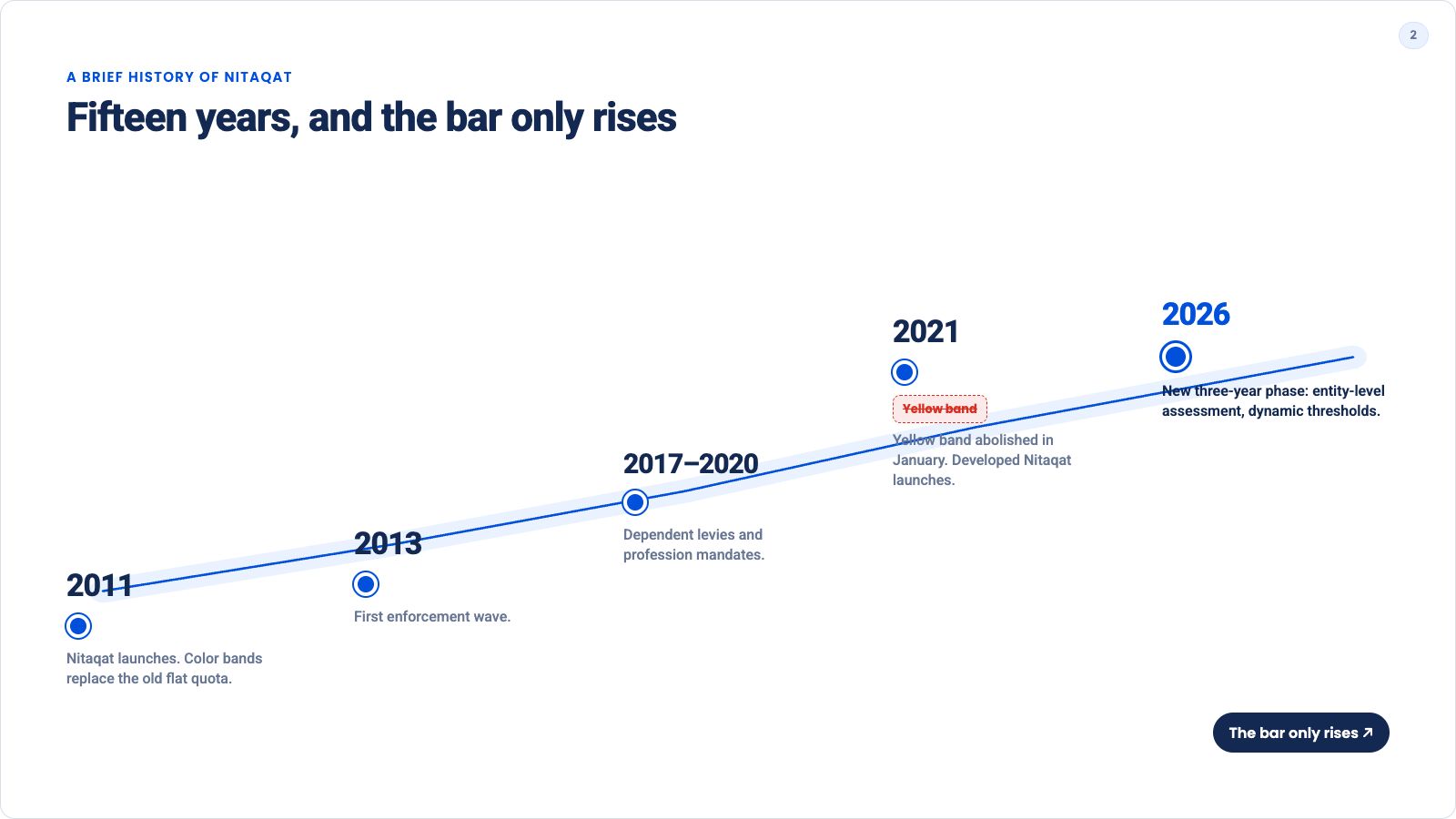
- 2011: Nitaqat launches, replacing the old flat quota (a roughly 30% Saudization requirement dating from the 1990s that was widely ignored in practice) with the color-band system
- 2013: first major enforcement wave; mass correction campaigns against non-compliant establishments
- 2017 to 2020: expat dependent levies and profession-specific mandates layer on top of the band system
- 2021: the Yellow band is abolished in January, with former Yellow establishments reclassified as Red; later that year “Nitaqat Mutawar” (developed Nitaqat) introduces a smoother quota curve and published targets through 2024
- 2026: the current three-year phase takes effect in April: entity-level assessment, dynamic thresholds, raised professional quotas, and Saudization credit tied to Qiwa digital contracts
The direction has never reversed. Every cycle raises the bar and removes a cushion. If your Saudi plan assumes today’s quota is the permanent one, the history says otherwise: build to the year-three target, not the year-one target.
The 2026 overhaul: what changed
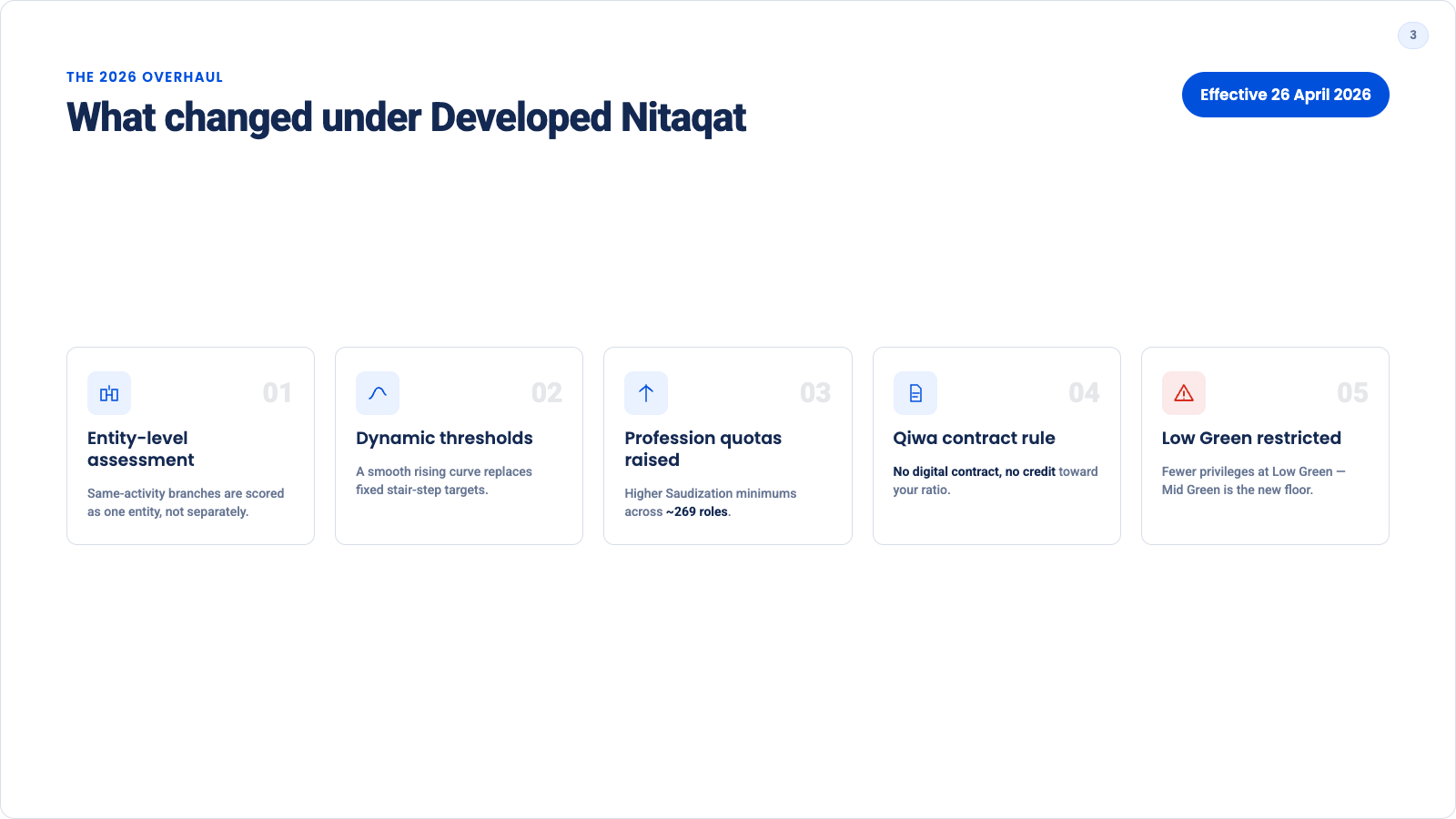
On 26 April 2026, MHRSD’s new Developed Nitaqat procedural guide took effect, opening a three-year phase that runs to 2028 and targets the localization of more than 340,000 additional private-sector jobs. Five changes matter for employers.
- Assessment moved to the entity level. Saudization is now assessed across all branches that carry the same economic activity under an entity, rather than establishment by establishment. If your Saudi structure has multiple branches or registrations, how they group under the new model is the first thing to check on Qiwa, because a ratio problem in one branch is now a ratio problem for all of them.
- Fixed size bands gave way to dynamic thresholds. The old fixed size brackets, with quota cliffs at set headcounts, were replaced by a published formula under which the required percentage rises smoothly as headcount grows. Your target is now specific to your actual workforce size, and growth raises the bar gradually with every hire instead of jumping at magic numbers.
- Sector and profession quotas were raised. The increases concentrate in professional categories: healthcare, engineering, accounting, procurement, and marketing and sales roles. MHRSD’s profession-level mandates now cover roughly 269 roles. If your Saudi team sits in one of these functions, your target is higher in this cycle than the last one.
- Saudization credit now requires digital contracts on Qiwa. A Saudi employee only counts toward your ratio if their employment contract is digitally documented and authenticated on the Qiwa platform. An undocumented Saudi employee is invisible to your Nitaqat calculation. This closed a long-standing gap and caught out employers whose paperwork lagged their payroll.
- Low Green now carries real restrictions. The guide tightens the link between band and services. Low Green entities face limits on new visa issuance and profession changes, and the full privilege set effectively starts at Mid Green. Scraping past the minimum no longer buys full operational freedom.
What the 2026 overhaul did not change is the band structure itself. The five bands date from the 2021 overhaul, which is also when Yellow disappeared. There is still no buffer band, and that absence does more work in this system than any single quota number.
One honest caveat: quota percentages and band thresholds are sector- and headcount-specific, and MHRSD adjusts them within the cycle. Every number in this guide should be verified against your entity’s actual classification on Qiwa before you make hiring decisions. We re-verify this article against MHRSD sources quarterly; the last verification date is in the footer.
The five Nitaqat tiers in 2026, and what each one can do
Every private-sector establishment with employees sits in one of these bands. Since the 2026 procedural guide, the band is assessed at the entity level, with branches sharing one economic activity counted together; separate entities and activities still carry separate bands.
| Band | What it means | Visa and hiring privileges |
|---|---|---|
| Platinum | Exceeds the sector’s top Saudization threshold | Priority visa processing, unrestricted sponsorship transfers in, can recruit expats away from Red entities without the current employer’s approval, preferred access to government services and tenders |
| High Green | Comfortably above target | Full visa issuance, transfers, and renewals, with the deepest compliance buffer and the widest visa allocations within Green |
| Mid Green | Solidly compliant | Full visa issuance, transfers, and renewals |
| Low Green | Meets the minimum target | Work permit renewals intact, but the 2026 guide limits new visa issuance, profession changes, and inbound transfers at this level; and there is no buffer: one bad quarter of hiring mix can drop the entity out of Green |
| Red | Below target | New work visas blocked, work permit renewals blocked, sponsorship transfers in blocked, expat employees may transfer out to Green/Platinum employers without consent, restricted government services |
Two details about this table that competitors usually skip:
- The Green sub-bands matter for privilege scope, not processing speed. Qiwa does not process a High Green entity’s transactions faster than a Low Green one’s. What differs is what each sub-band is allowed to do: High Green holds a bigger compliance buffer and wider visa allocations, while Low Green loses access to expansion services under the 2026 guide. If your provider quotes onboarding capacity, ask which Green sub-band it holds.
- Red is not just a hiring freeze. It is a retention risk. In Red, your existing expat employees gain the right to transfer their sponsorship to a higher-band employer without your release. Competitors can legally recruit your team while you are locked out of replacing them. This is the mechanism that turns a compliance slip into a workforce exodus.
What happened to the Yellow band (and why it still matters)
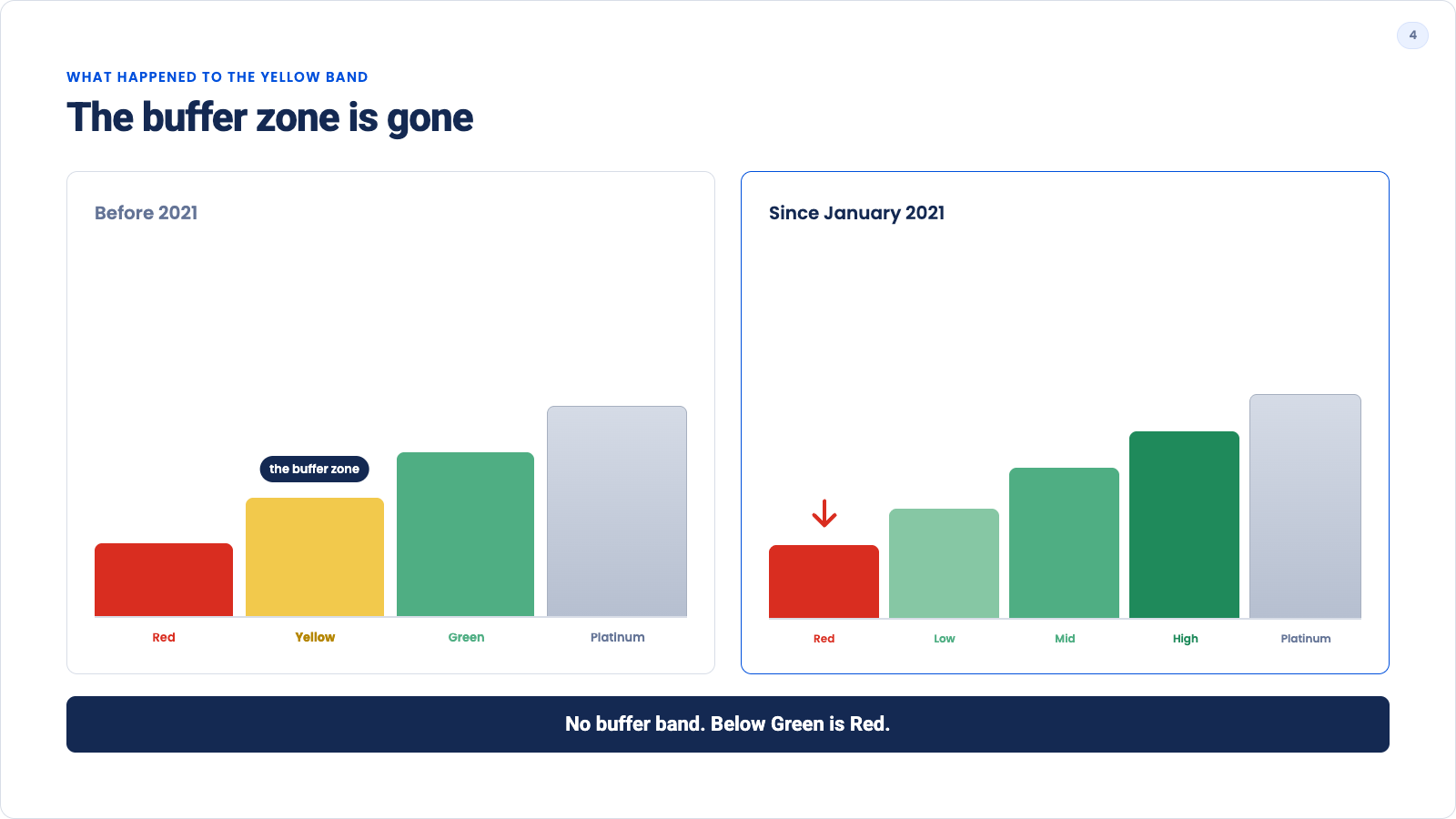
If you last worked with Saudi entities before 2021, you knew Yellow as the warning zone: restricted, uncomfortable, but survivable. It was abolished in January 2021, in the overhaul that produced today’s five-band structure, and the establishments sitting in it were reclassified as Red. For them, that meant:
- Pending visa applications stopped processing
- Work permit renewals for existing expat staff were blocked at their next renewal date
- Expat employees became eligible to transfer out without employer consent
- Government service access tightened
The reason a change from 2021 still earns its own section is what it removed: the cushion. Under the old system, a company that slipped below Green landed in Yellow and kept limping along with partial privileges. Under the current system, the same slip lands in Red, with the full set of blocks, immediately. Compliance in Saudi Arabia is binary in practice: you are Green or better, or you are in trouble.
The recovery path from Red is the same today as it was for Yellow’s former occupants: raise the Saudi ratio above the sector’s Green threshold, get reassessed, and restore privileges. The transition period is the dangerous part, because renewal blocks bite on a rolling basis as each employee’s permit comes up.
Why this matters even if your own history has no Yellow in it: if you hire through an aggregator EOR, your employees sit on a local Saudi partner’s books, and that partner’s ratio is outside your control. If it slips below Green, there is no buffer band to absorb the fall; your workers’ renewals are exposed at once, without any change in your own behavior. That risk is structural to the aggregator model, and it is exactly the concentration risk we documented in the direct-vs-aggregator comparison.
How the Nitaqat ratio is calculated (with a worked example)
The band assessment is a weighted ratio, not a raw headcount. The mechanics that matter:
The basis is GOSI registration. Your Saudi headcount is what is registered with GOSI, averaged on a 26-week weighted window. You cannot fix a bad ratio by hiring five Saudis the week before assessment; the average moves slowly by design. Qiwa recalculates continuously as the underlying data changes, and formal classification reviews run roughly every six months.
Not every Saudi counts as one full point. MHRSD applies weightings to reward quality of employment, not just quantity. The long-standing rules, which you should verify for the current cycle:
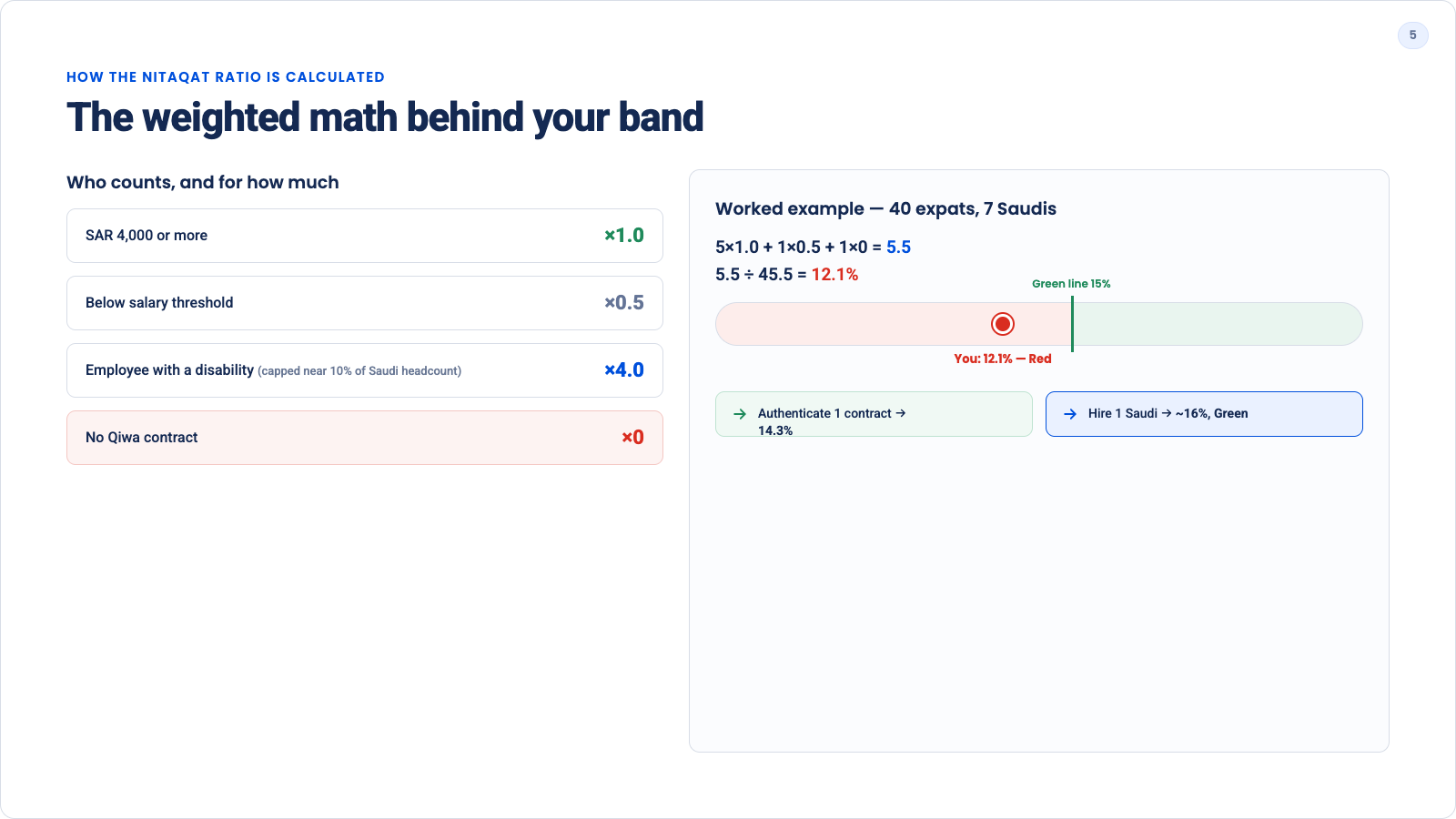
- A Saudi employee paid at or above the SAR 4,000 private-sector minimum wage counts as 1.0
- A Saudi employee paid below the full minimum-wage threshold counts as 0.5
- A Saudi employee with a disability, employed under compliant conditions, counts as 4.0, capped at roughly 10% of the Saudi workforce
- Saudi students and certain part-time categories carry fractional weights
- Since the 2026 cycle: any Saudi without a Qiwa-documented digital contract counts as 0, regardless of salary
The target you are measured against depends on your sector and your headcount. This is where the 2026 guide changed the mechanics. The old fixed size bands (Micro, Small, Medium, Large, Giant) were replaced by a dynamic model in which the required percentage rises smoothly as headcount grows, published as a formula rather than a bracket table.
Two practical consequences: your target is specific to your actual workforce size, not a bracket average; and growth raises the target gradually with every hire rather than jumping when you cross a fixed boundary. Very small establishments (up to five employees) have historically sat largely outside the color system; verify current treatment on Qiwa rather than assuming. Either way, model the target trajectory before you scale, not after.
Worked example
A foreign-owned commercial services entity in Riyadh has 47 employees on its GOSI registration: 40 expats and 7 Saudis. Of the 7 Saudis:
- 5 are full-time at SAR 6,000+ with Qiwa-documented contracts: 5 x 1.0 = 5.0 points
- 1 is part-time at SAR 3,200: 1 x 0.5 = 0.5 points
- 1 is full-time at SAR 5,000 but the contract was never authenticated on Qiwa: 1 x 0 = 0 points
Weighted Saudi count: 5.5. Weighted total workforce: 40 expats + 5.5 = 45.5. Saudization ratio: 5.5 / 45.5 = 12.1%.
If this entity’s sector-and-headcount target for Green is, say, 15% (illustrative; check your own on Qiwa), it is Red. Notice two things. First, the undocumented contract cost the company a full point: authenticating that one contract on Qiwa lifts the ratio to 14.3% at zero hiring cost. Second, one additional full-salary Saudi hire takes it to roughly 16%, into Green. The gap between “locked out of hiring” and “fully operational” was two administrative moves.
This is why Nitaqat management is an operations discipline, not a legal abstraction.
The 2026 sector quota picture
The new cycle raised targets in professional categories. Two different mechanisms are in play, and most guides conflate them:
- Entity-level Nitaqat quotas. Your establishment’s overall Saudi ratio target, set by sector and headcount. This is what determines your color.
- Profession-specific Saudization mandates. Separate MHRSD decisions that require specific percentages of certain roles to be held by Saudis, regardless of your overall color. These mandates now cover roughly 269 professions, and the 2026 cycle raised or introduced targets in:
| Profession category | What changed in the current cycle |
|---|---|
| Healthcare roles | Raised phased targets across clinical professions |
| Engineering roles | Raised phased target for accredited engineering positions |
| Accounting and finance roles | Raised phased targets, stepping up within the cycle |
| Procurement roles | Raised targets |
| Marketing and sales roles | Raised targets |
Exact percentages vary by profession, phase date, and entity size, and MHRSD publishes them as ministerial decisions. Do not budget against a blog’s number, including ours: pull the current figure for your specific activity from Qiwa or MHRSD before committing to a hiring plan. What you should take from this table is directional: if you are building a Saudi team in professional functions, assume the required Saudi share of those specific roles is higher this cycle and will step up again within it.
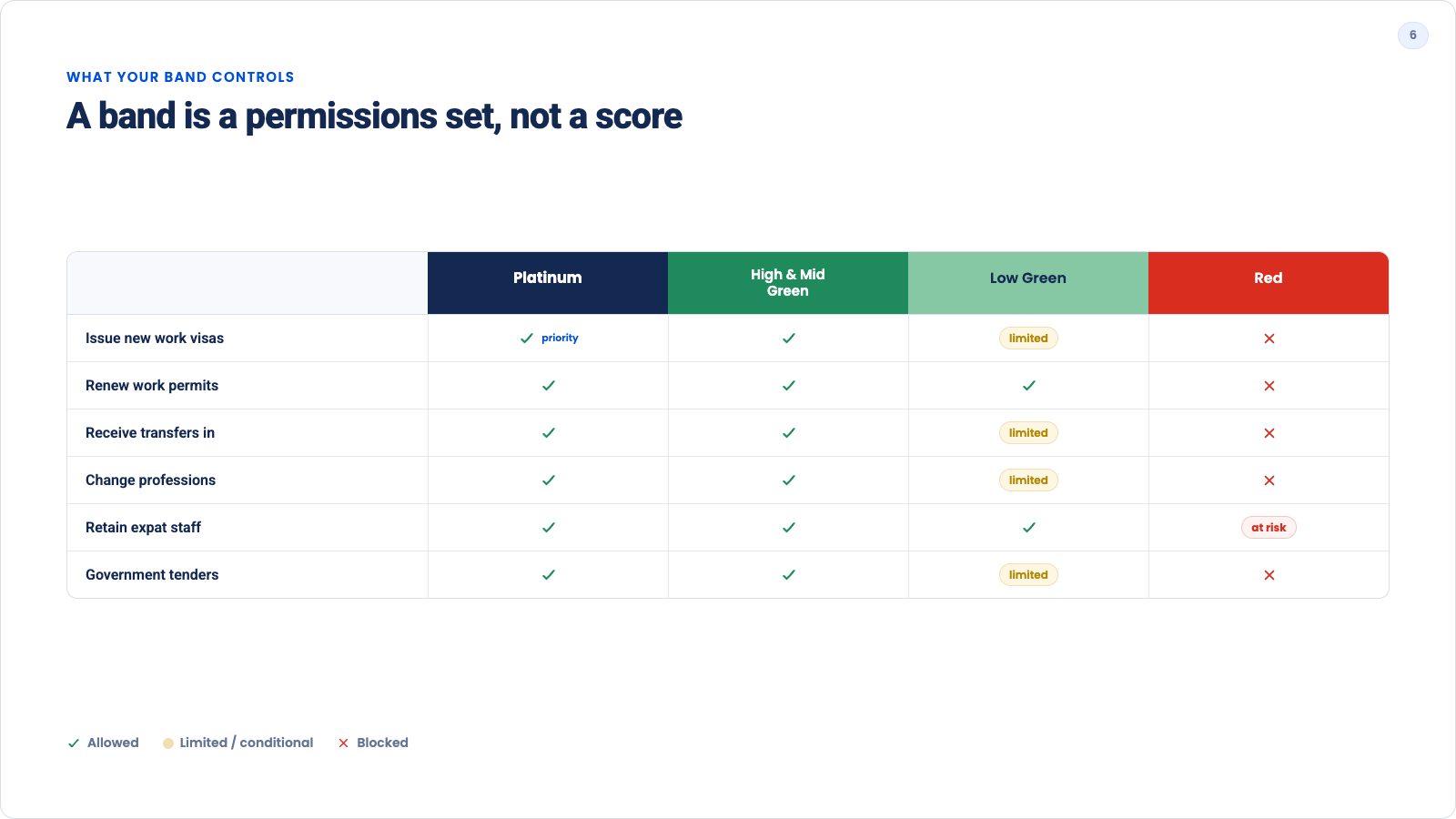
What your band controls, consequence by consequence
The band is often described as a “score.” It is better understood as a permissions set.
| Operation | Platinum | High / Mid Green | Low Green | Red |
|---|---|---|---|---|
| Issue new expat work visas | Yes, priority | Yes | Limited under the 2026 guide | No |
| Renew existing work permits | Yes | Yes | Yes | No |
| Receive sponsorship transfers in | Yes, without current-employer approval from Red entities | Yes, standard process | Restricted | No |
| Change employee professions | Yes | Yes | Restricted | No |
| Retain expat staff | Yes | Yes | Yes | At risk: staff may transfer out without consent |
| Government services (Qiwa transactions, certificates) | Priority | Standard | Standard, some services limited | Restricted |
| Government tenders | Preferred | Eligible | Eligible | Restricted |
The exact benefit matrix is published in the MHRSD procedural guide and can shift within the cycle; treat this table as the shape, and Qiwa as the source. For a foreign employer, the practical reading is: Platinum is a luxury, Mid Green or better is the requirement, Low Green is a warning light, and Red is an operational emergency.
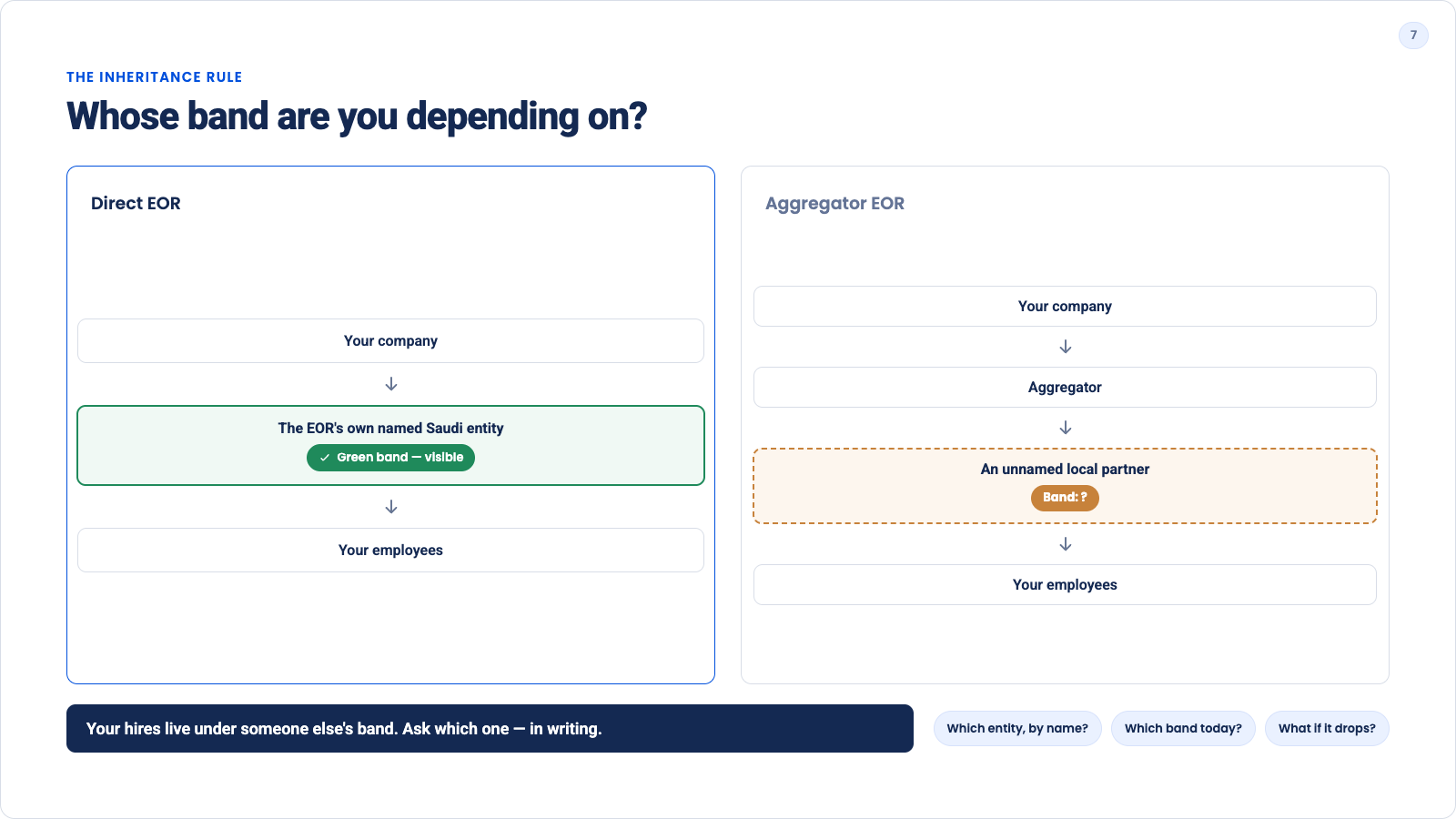
The inheritance rule: whose tier are you depending on?
Here is the part that matters most if you do not have your own Saudi entity.
When you hire in Saudi Arabia through an Employer of Record, your workers sit on the EOR’s entity, and every permission in the table above is governed by the EOR’s band, not yours. You inherit it. The same applies one layer deeper with aggregator EORs: the band that governs your hires belongs to the local Saudi partner who is the legal employer on paper, an entity you may never have heard of.
Three questions follow from this, and they are worth asking any provider in writing:
- Which specific Saudi entity will employ my workers, by name?
- What is that entity’s current Nitaqat band? (Green or Platinum onboards; Red cannot.)
- What is your contractual commitment if that band drops during my contract?
Masdar operates on our own Green Nitaqat entity, and we put the band in writing because our onboarding commitments depend on it. That is not unique virtue; any direct EOR managing its own entity can do the same. What the aggregator model structurally cannot do is commit to a band its partner controls. If Nitaqat certainty matters to your Saudi plans, this is the fault line to probe, and the full direct-vs-aggregator breakdown covers it in depth.
One cost note while we are here: the annual work permit fee is not a Nitaqat penalty. It runs SAR 9,600 per employee per year (SAR 800 per month) when expats outnumber Saudis on the entity, and drops to SAR 8,400 (SAR 700 per month) when Saudis match or outnumber expats. Your band decides whether the permit can be issued or renewed at all; the fee level tracks the workforce balance. The visa sponsorship cost breakdown has the full fee stack.
How to check any entity’s Nitaqat band
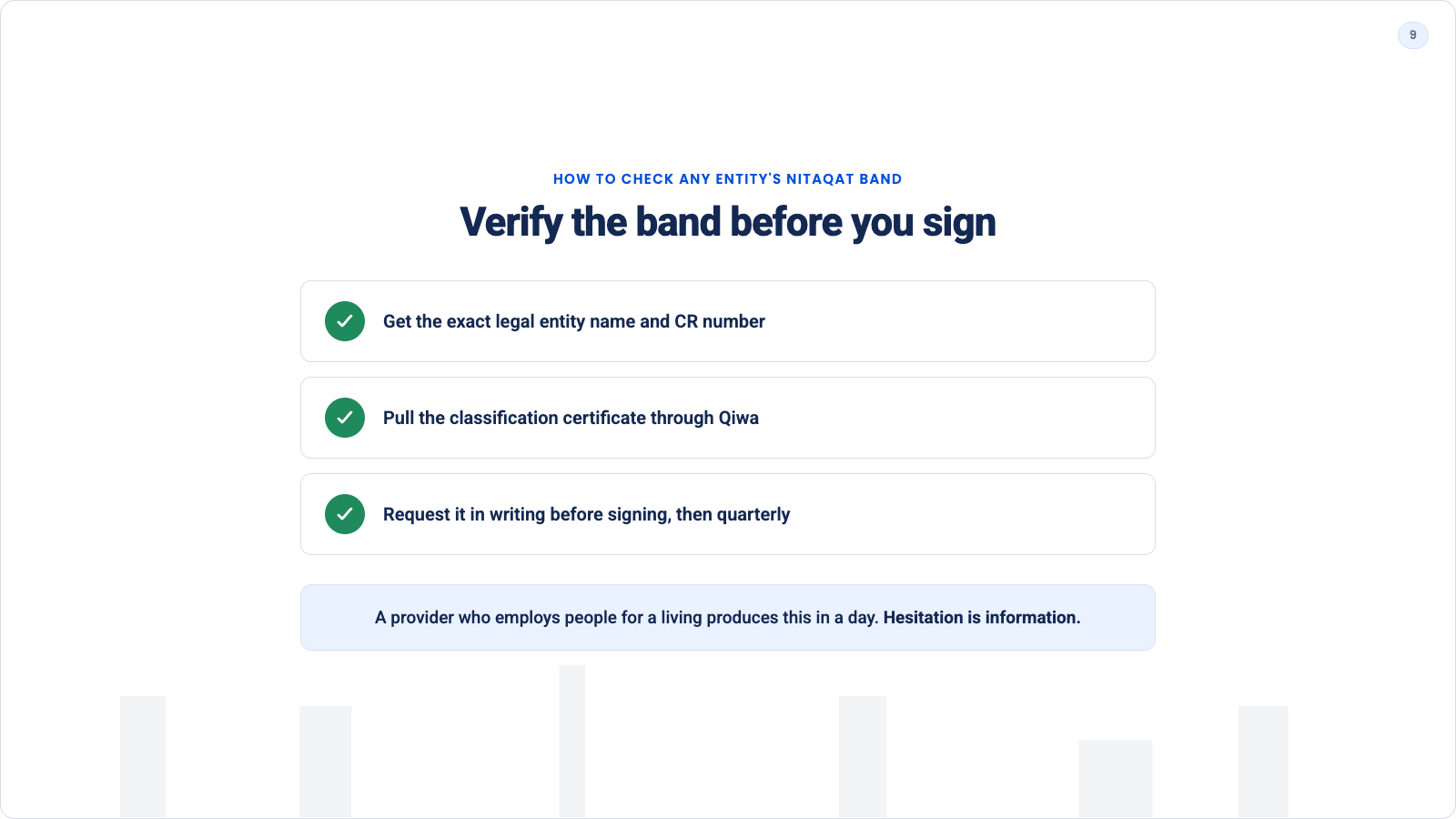
You do not have to take anyone’s word for their band. Verification takes minutes:
Get the exact legal entity name and Commercial Registration (CR) number of the employer in question (your own entity, your EOR, or an aggregator’s named partner).
The entity’s band is visible through the Qiwa platform, which publishes establishment classification as part of its employer services. An entity’s authorized user can pull its own certificate directly; counterparties can request the current classification certificate as a condition of contracting.
Ask for the Nitaqat classification certificate in writing before signing, and quarterly after. A provider who employs people for a living produces this document in a day. Hesitation is information.
If a provider cannot or will not name the employing entity, you cannot verify the band, and you are carrying a risk you cannot see.
How to climb a band (and how fast it moves)
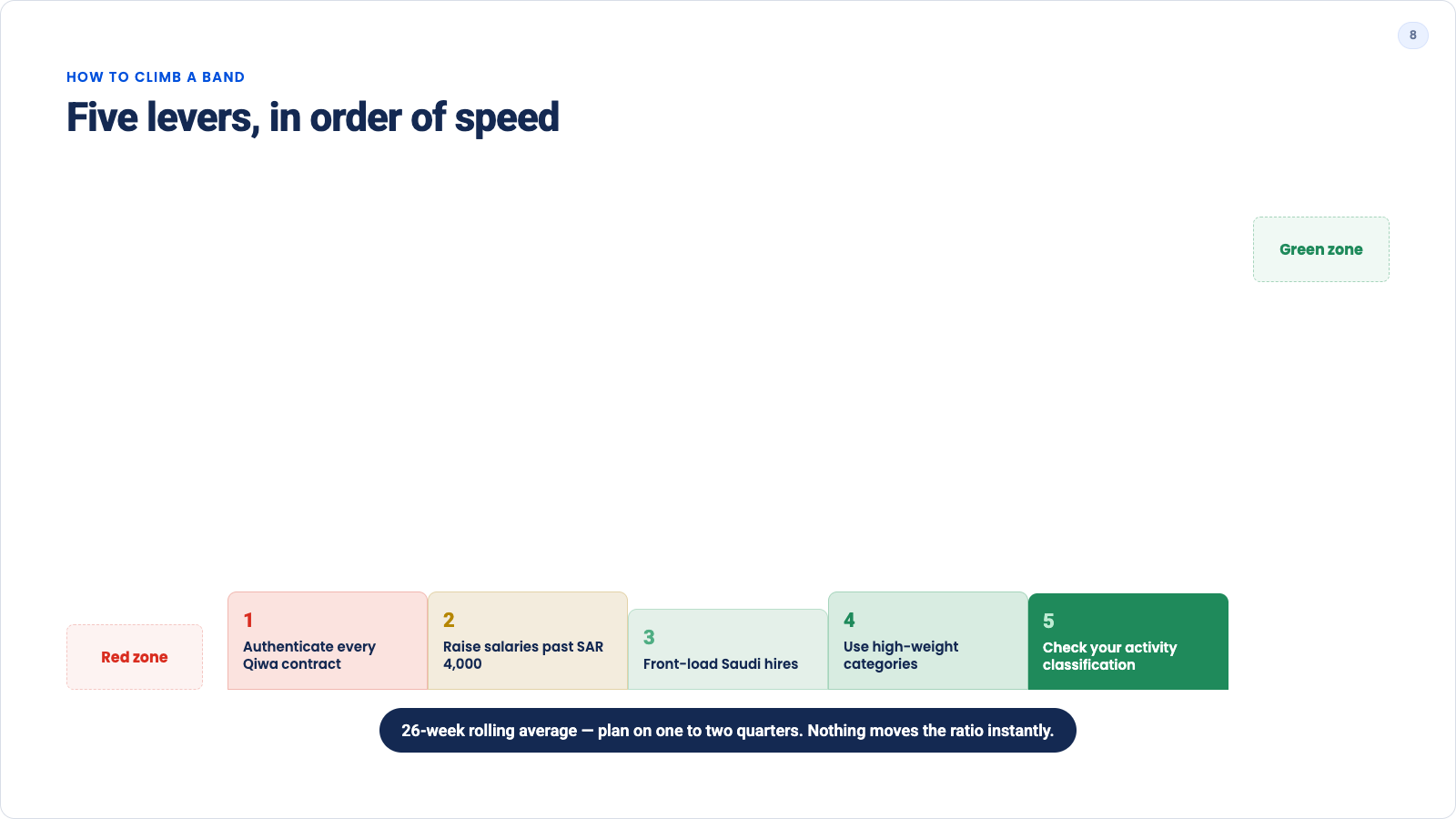
For companies managing their own entity, the levers are known. In rough order of speed:
- Authenticate every Saudi contract on Qiwa. Zero hiring cost. Any Saudi employee without a documented digital contract is a wasted point. This is the first audit to run, and the fastest fix in the system.
- Raise below-threshold salaries past the minimum-wage line. A Saudi employee at SAR 3,500 counts as 0.5; at SAR 4,000+ they count as 1.0. The marginal cost of the raise is often far below the cost of the extra expat capacity it unlocks.
- Hire Saudis into roles you were going to fill anyway. The obvious lever, but sequencing matters: because the ratio is a rolling average, a Saudi hired in January moves your assessed ratio for months afterward. Front-load Saudi hires in your plan; back-load expat hires.
- Use the high-weight categories deliberately. Employing Saudis with disabilities under compliant conditions carries a multiplied weight (4.0, capped at roughly 10% of the Saudi workforce). Done properly, with the role, accommodation, and documentation done right, this is both good employment practice and efficient compliance.
- Check your activity classification. Entities are sometimes classified into a stricter sector than their real activity warrants. If your CR activity code does not match what you do, your quota may be wrong, and reclassification through the Ministry of Commerce and MHRSD can change your target. Under the 2026 entity-level model, also check how your branches are grouped: same-activity branches are now assessed together.
Because the assessment uses a rolling average, movement is measured in months, not days. A Red entity executing well typically needs one to two quarters to re-enter Green. Plan around that lag: the time to fix a ratio is before you need the visas, not after.
Three scenarios
The company that slipped out of Green. A 60-person trading entity sat in Low Green through 2025. Two Saudi resignations in one quarter pulled its weighted ratio below the Green threshold, and with no buffer band below Green, it went straight to Red: renewals began failing as they came due.
The recovery plan was the levers above, executed in order: a Qiwa contract audit recovered two uncounted Saudis in week one, two salary adjustments crossed the minimum-wage line in month one, and three Saudi hires over the following quarter lifted the weighted ratio back into Low Green. Total time locked out: about four months. Permits that lapsed during the window came back with late-renewal fines and the accrued levy for the lapsed period, a bill that grew with every week of delay.
The first-time hirer. A UK software company wants three salespeople in Riyadh and has no entity. Its Nitaqat exposure is entirely inherited: the deciding question is the band of whichever entity will employ those three people.
It asks the three questions from the inheritance section, gets a Green classification certificate in writing from a direct EOR, and its hires, already in the Kingdom on transferable Iqamas, onboard in under a month. Its own Saudization obligation is zero because it owns no Saudi entity; the obligation lives with the employer of record. If it later opens its own entity, the quota becomes its own problem from the day the CR is issued. This is the trade-off we cover in EOR vs setting up a legal entity in Saudi Arabia.
The scaling company. A 20-person entity plans to double headcount in a year. Its mistake would be hiring 15 expats first and “fixing Saudization later”: the rolling average means the ratio degrades immediately and recovers slowly, and under the dynamic threshold model the target itself also creeps up with every hire. The entity can hit Red mid-plan, freezing the remaining visas. The right sequence is interleaved: Saudi hires early and throughout, expat visa applications timed against the projected ratio, tracked monthly on Qiwa. Growth plans in Saudi Arabia are Nitaqat plans, whether or not anyone writes that down.
Frequently asked questions
What is Nitaqat?
Nitaqat is Saudi Arabia’s workforce nationalization (Saudization) program, run by MHRSD. It classifies every private-sector establishment into a band (Platinum, High/Mid/Low Green, or Red) based on the weighted ratio of Saudi nationals in its workforce, and ties visa and work permit privileges to that band.
What is the difference between Saudization and Nitaqat?
Saudization is the policy goal: increasing the share of Saudi nationals in private-sector jobs. Nitaqat is the program that measures and enforces it, through the band system, the weighted ratio calculation, and the visa privileges tied to each band. In practice the terms are used interchangeably, but Saudization is the “what” and Nitaqat is the “how.”
What are the Nitaqat tiers in 2026?
Five bands: Platinum, High Green, Mid Green, Low Green, and Red. This structure dates from the 2021 overhaul, which also abolished the Yellow band; the 2026 cycle kept the structure and changed how targets are set and assessed.
What happened to the Yellow tier?
It was abolished in January 2021, when MHRSD overhauled the program into today’s five-band structure, and the establishments sitting in it were reclassified as Red. There has been no buffer band between Green and Red since: entities that fall below the Green threshold face Red-band restrictions directly.
What is the difference between Green and Platinum?
Both are operational: visas, renewals, and transfers all work. Platinum adds priority processing, preferred access to government tenders, and the right to recruit expats away from Red entities without the current employer’s consent. Within Green, the sub-bands differ in privilege scope and buffer rather than processing speed: Mid Green and above hold the full set of visa and transfer privileges, while the 2026 procedural guide attaches limits to Low Green, including on new visas and profession changes.
What happens if my company falls into Red?
New work visas are blocked, existing work permits cannot be renewed as they come due, inbound sponsorship transfers are blocked, and your expat employees become eligible to transfer to Green or Platinum employers without your consent. Recovery requires raising your weighted Saudi ratio above your sector’s Green threshold and being reassessed, which typically takes one to two quarters.
How is the Nitaqat ratio calculated?
As a weighted rolling average based on GOSI registration. Saudis at or above the SAR 4,000 minimum wage generally count as 1.0; below-threshold salaries count as 0.5; Saudis with disabilities can count as 4.0 under compliant conditions, capped at roughly 10% of the Saudi workforce; and since the 2026 cycle, a Saudi without a Qiwa-authenticated digital contract counts as zero. The target percentage depends on your sector and scales with your headcount under the 2026 dynamic threshold model.
Does Nitaqat apply to foreign companies?
It applies to every private-sector establishment registered in Saudi Arabia, regardless of ownership. A foreign company without a Saudi entity has no direct Nitaqat obligation, but inherits the band of whichever entity employs its workers (an EOR or an aggregator’s local partner).
Do I inherit my EOR’s Nitaqat tier?
Yes. Your workers sit on the EOR’s entity, so its band governs their visas, renewals, and transfers. With aggregator EORs, the governing band belongs to the local partner who is the legal employer. Ask for the employing entity’s name and current classification certificate in writing.
How do I check a company’s Nitaqat tier?
Through the Qiwa platform, using the entity’s exact legal name and CR number. An entity can pull its own classification certificate directly; if you are contracting with a provider, request the certificate as a condition of signing.
How often is the band reassessed?
The ratio is computed as a 26-week weighted average of GOSI data, and Qiwa recalculates continuously as the underlying data changes; formal classification reviews run roughly every six months. Because the calculation averages over months, both improvement and deterioration show up gradually rather than overnight.
Can a Red company keep its existing employees?
Its existing expat employees keep working until their permits expire, but renewals are blocked while the entity is Red, and employees gain the right to transfer to higher-band employers without the Red employer’s consent. Retention risk starts immediately; the hard wall arrives at each permit’s renewal date.
Do part-time or low-paid Saudi employees count toward Saudization?
Partially. Saudis paid below the full minimum-wage threshold have historically counted as half a point, and certain part-time and student categories carry fractional weights. Exact weightings are set by MHRSD and should be verified for the current cycle.
What is the Qiwa digital contract rule?
Since the 2026 cycle, a Saudi employee counts toward your Saudization ratio only if their employment contract is digitally documented and authenticated on Qiwa. Payroll alone is not enough; the contract record is what MHRSD counts.
Are there profession-specific Saudization quotas on top of Nitaqat?
Yes. Separate ministerial decisions mandate minimum Saudi percentages in specific professions (including healthcare, engineering, accounting, procurement, and marketing roles), independent of your overall band. These mandates now cover roughly 269 professions, and the current cycle raised several of them. Verify the figure for your specific roles through MHRSD or Qiwa.
How does the tier affect work permit fees?
It does not set the price. The annual work permit fee is SAR 9,600 per employee (SAR 800 per month) when expats outnumber Saudis on the entity, and SAR 8,400 (SAR 700 per month) when Saudis match or outnumber expats; the split follows the workforce balance, not the Nitaqat color. What the band controls is whether permits can be issued or renewed at all. The full fee stack is in our visa sponsorship cost guide.
How fast can a company move from Red to Green?
With disciplined execution (Qiwa contract audit, salary threshold fixes, front-loaded Saudi hiring), one to two quarters is realistic. The rolling average is the constraint: nothing moves the assessed ratio instantly.
What size of company does Nitaqat apply to?
All private-sector establishments with employees are classified. Very small establishments (up to five employees) have historically sat largely outside the color system. Above that, the 2026 guide sets targets through a dynamic model that scales with headcount rather than fixed size brackets, so the requirement rises gradually as you grow. Verify your entity’s current target on Qiwa.
Does Nitaqat apply per company or per entity?
At the entity level. Since the 2026 procedural guide, branches carrying the same economic activity under an entity are assessed together, rather than branch by branch. Separate entities and separate activities still carry separate classifications, and a strong band on one does not offset a weak band on another. Check how your structure is grouped on Qiwa.
What to do next
If you are hiring in Saudi Arabia and the deciding question is “whose Nitaqat band will my hires depend on,” ask it in writing, of us or of any provider you are evaluating. We will send our Green classification in writing, and if your situation is better served by your own entity carrying its own quota, we will tell you that too.
Also worth reading:
- Direct EOR vs Aggregator EOR in Saudi Arabia: the tier inheritance problem in full
- How Much Does It Cost to Sponsor an Employee in Saudi Arabia?: the tier-dependent process and the full fee stack
- How Much Does an EOR Cost in Saudi Arabia?: full pricing model
- How to Hire Employees in Saudi Arabia Without a Local Company: the process the tier gates
- EOR vs Setting Up a Legal Entity in Saudi Arabia: when the quota becomes yours
Authoritative references
- Ministry of Human Resources and Social Development (MHRSD): Nitaqat administration, quota decisions, and the 2026 Developed Nitaqat Procedural Guide
- Qiwa: establishment classification, digital contracts, tier verification
- GOSI: headcount registration basis
- Mudad: WPS payroll linkage
- Ministry of Commerce: Commercial Registration and activity classification
- Saudi Vision 2030: policy context
Last updated: 23 July 2026. Last verified against MHRSD and Qiwa sources: 23 July 2026. Band thresholds, weightings, and profession quotas change within the Nitaqat cycle; verify your entity’s specific figures on Qiwa before acting.
More guides in: Workforce Nationalization