
GCC Payroll 2026: Country-by-Country Compliance Guide
Running GCC payroll isn’t what it was three years ago. Back then, you could wire salaries a week late, miss a GOSI filing, or fudge a Saudization number and probably get away with it. Not anymore. By 2026, every major Gulf regulator has moved to real-time monitoring. The platforms talk to each other. The fines stack up faster than they used to.
This guide walks through what you actually need to know to run compliant payroll across all six GCC countries this year. We’ll cover the working hours, social insurance rates, end-of-service formulas, and the compliance traps that catch foreign employers most often. Everything in the country sections comes from how we run payroll on the ground at Masdar EOR — through our own locally-registered entities in every single Gulf country.
One quick note before we start. When we say “GCC payroll” here, we mean the Gulf Cooperation Council — Saudi Arabia, the UAE, Qatar, Kuwait, Oman, and Bahrain. Not Global Capability Centers.
💼 Need help running GCC payroll across multiple countries? Masdar EOR holds direct labour licences in all six GCC countries. One quote. One compliance team. Get a payroll quote →
What “GCC Payroll” Actually Means in 2026
GCC payroll isn’t just cutting cheques and sending them to a bank. It’s running five interlocking systems every month. Miss any one of them, and the others start to fail.
Here’s the stack:
- Employment contract platform. Qiwa in Saudi, MOHRE in the UAE, MOL in Qatar, PAM in Kuwait, MOL in Oman, LMRA in Bahrain. Your contract has to be registered and authenticated on the right platform before payroll even runs.
- Wage Protection System. The official salary-payment rail for expat workers. Every GCC country runs one. Salaries paid outside the WPS don’t count for compliance purposes — full stop.
- Social insurance. GPSSA and ADPF in the UAE, GOSI in Saudi, GRSIA in Qatar, PIFSS in Kuwait, PASI transitioning to SPF in Oman, SIO in Bahrain. Each takes a slice. Most apply only to national employees — expats are mostly exempt.
- End-of-service accrual. Tracked monthly, paid out when the employee leaves. Bahrain switched this to monthly SIO contributions in March 2024 — a quiet but significant change.
- Nationalization quota. Saudization, Emiratisation, Qatarization, Bahrainization, Omanization, Kuwaitization. Counted in real time these days, not annually like before.

This is why Masdar EOR runs operations through six separate locally-registered entities — one per country. There’s no single regional “license” that covers all six. Anyone claiming otherwise is operating through partners. We’ve held our own commercial registrations in each Gulf jurisdiction since day one.
Country-by-Country: What GCC Payroll Looks Like in 2026
Every Gulf country runs its own labour code and its own payroll system. Here’s what each one actually looks like in 2026.
🇦🇪 United Arab Emirates
The UAE is usually the cleanest place to run payroll. MOHRE is well organised. The WPS is digital end-to-end. And expats don’t contribute to social security at all — only Emirati employees do.
- Regulators: GDRFA (immigration), MOHRE (labour), GPSSA for Dubai-based Emiratis, ADPF for Abu Dhabi-based Emiratis
- Working hours: 48 per week or 8 per day. Weekends Saturday and Sunday. Ramadan working hours reduced by 2 hours daily
- Salary structure: No statutory components. Basic-vs-allowance split is by agreement. But basic salary is the EOSB calculation base, so it matters
- Social insurance — Emiratis only. Expats exempt entirely.
- GPSSA (Dubai) — new hires from October 2023 onwards: Employee 11%, Employer 15%
- GPSSA (Dubai) — existing members from before that date: Employee 5%, Employer 12.5% (plus 2.5% covered by the government to bring the total fund injection to 20%)
- ADPF (Abu Dhabi) — new members from 1 December 2023: Employee 11%, Employer 15%
- ADPF — existing members from before that date: Employee 5%, Employer 15%
- ILOE: Mandatory unemployment insurance for both public and private sector. Eligible employees with at least 12 months of subscription can receive up to 60% of average basic salary as a monthly cash benefit if they lose their job
- Medical insurance: Mandatory. Abu Dhabi requires coverage for employee + spouse + 3 children under 18. Dubai requires only the employee; family by agreement
- End-of-service (Federal Decree-Law No. 33 of 2021):
- Under 1 year: nothing
- 1–5 years: 21 days basic salary per year
- 5+ years: 30 days basic salary per year beyond five
- Total cap: 2 years of basic salary
- Annual leave: 30 calendar days after one year of service. Two days per month for service of 6–12 months
- Sick leave: 90 days — 15 days full pay, 30 half pay, 45 unpaid
- Maternity: 60 days (45 full + 15 half). Plus 5 days parental leave for both parents
💼 Running payroll in 2 or more GCC countries? Masdar EOR handles all six in one invoice. Talk to us →
🇸🇦 Saudi Arabia
Saudi is the most complex GCC payroll market. The reason: three platforms — Qiwa, Mudad, and GOSI — work together. If the salary you put in the Qiwa contract drifts from the one you upload to Mudad, or from the wage GOSI is calculating contributions on, the system flags you for inconsistency.
- Regulators: MOFA (immigration), MHRSD (Ministry of Human Resources and Social Development — the renamed and merged labour authority), GOSI (social insurance). Qiwa and Mudad are the operating platforms
- Working hours: 8 per day, 48 per week. Friday is the legally mandated weekly rest day; many private employers also observe Saturday, though the law permits a six-day workweek. Ramadan reduction of 2 hours daily
- Salary structure: Statutory obligation — housing and transportation must be provided in kind or paid as allowances. Typical split: 60% basic / 25% housing / 15% transport
- Minimum wage: SAR 4,000 per month for Saudi nationals in the private sector. No statutory minimum for expats
- Social insurance — GOSI for Saudi nationals (two cohorts):
- Existing cohort (registered before 3 July 2024): Employee 9.75%, Employer 11.75%. Total 21.5%
- New cohort (registered on or after 3 July 2024): Annuity rates rise 0.5% per side per year under Royal Decree M/273. For 2026: Employee 10.25%, Employer 12.25%. Total 22.5%. Steps up again on 3 July 2026 to 10.75% / 12.75%
- Social insurance — expats: Employer 2% only (occupational hazard). Employees pay nothing
- Medical insurance: Mandatory. Family status contracts cover spouse, unmarried daughters, and male children under 25
- End-of-service — resignation:
- Under 2 years: no gratuity
- 2–5 years: one-third
- 5–10 years: two-thirds
- 10+ years: full gratuity
- End-of-service — termination by employer (Article 84):
- Calculation is cumulative tiered: half-month salary per year for the first 5 years, plus one full month per year from year 6 onwards
- Pro-rata award for fractions of a year served, even if total service is under 1 year
- Example: 7-year service = 2.5 months (years 1–5) + 2 months (years 6–7) = 4.5 months
- Annual leave: 21 days for 1–5 years of service. 30 days from year 6 onwards
- Sick leave: 120 days per year — first 30 at 100%, next 60 at 75%, last 30 unpaid
- Maternity (Article 151): 12 weeks total, with pay tiered by service:
- 3+ years of service: fully paid
- 1–3 years of service: half pay
- Under 1 year: unpaid leave
- Paternity: 3 days within 7 days of birth
🇶🇦 Qatar
Qatar runs cleanly when you understand the rhythm. The catch is the notice-period structure — it’s tied to length of service rather than contract type. And there’s no statutory paternity leave at all, which surprises a lot of foreign employers.
- Regulators: Ministry of Interior (immigration), MOL (Ministry of Labour — the standalone authority after MADLSA was restructured), GRSIA (social insurance — Qatari nationals only)
- Working hours: 8 per day, 48 per week. Weekends Friday and Saturday
- Minimum wage structure — non-discriminatory statutory minimum that requires three components if not provided in kind:
- Basic Wage: QAR 1,000 minimum
- Housing Allowance: QAR 500 minimum
- Food Allowance: QAR 300 minimum
- Total statutory cash floor: QAR 1,800 per month if neither food nor accommodation is provided directly
- Social insurance — GRSIA: Applies only to Qatari nationals. Expats are not part of the scheme and don’t contribute
- Medical insurance: Mandatory. Choice between a Government Medical Card or Private Medical Insurance
- End-of-service: Statutory minimum of 21 days of basic salary per year, after one year of service. Same treatment whether the employee resigns or is terminated, except for Article 61 misconduct dismissal which forfeits gratuity. (Contracts can negotiate higher rates or caps above the statutory floor)
- Annual leave: 3 weeks for 1–5 years of service. 4 weeks beyond 5 years
- Sick leave: After 3 months of continuous service — first 2 weeks at full wage, next 4 weeks at half, next 6 weeks unpaid
- Maternity: 50 days, with at least 35 mandatory after delivery
- Paternity: None. Qatar has no statutory paternity leave
- Notice during probation (post-2020 reforms):
- Employer dismissing for unsuitability: minimum 1 month
- Employee resigning to change employers in-country: 1 month (new employer compensates old employer for recruitment fees)
- Employee resigning to exit the country: subject to agreement, capped at 2 months
- Notice after probation: 1 month if the employee has under 2 years of service. 2 months if 2 years or more
💼 Worried any of these rules might catch your team out? Book a free 20-minute compliance review with Masdar EOR. Schedule your call →
🇰🇼 Kuwait
Kuwait has the heaviest paperwork burden in the region. Visa lead times are long. The notice period is 3 months — much longer than most GCC countries. And the social insurance cap means high-earning Kuwaitis hit it quickly.
- Regulators: General Directorate of Residency – Ministry of Interior (immigration), PAM (Public Authority for Manpower — the labour authority for private-sector compliance), PIFSS (social insurance)
- Working hours: 8 per day, 48 per week. Weekends Friday and Saturday
- Probation: Up to 100 days. Once per employer. Under Article 24, employers must provide at least 5 working days’ notice to terminate during probation. Instant termination without notice is not legally supported. If the client terminates, the EOR still pays end-of-service for the period worked
- Notice after probation: 3 months. Can only be shortened with written agreement from both sides
- Social insurance — PIFSS: Applies only to Kuwaiti nationals
- Employee 8%, Employer 11.5%
- Cap: KWD 2,750 per month
- Expats are exempt entirely
- Medical insurance: Not mandatory under Kuwaiti law. Most clients still provide it as standard practice
- End-of-service:
- Year 1 through year 5: 15 days of wages per year
- Year 6 onwards: 30 days of wages per year (one month)
- Based on the last remuneration received
- Annual leave (Article 70): Employees accrue 30 days of paid annual leave per year, but cannot legally take it until completing at least 9 months of continuous service. The 30-day allotment is calculated in working days, so weekends and public holidays already sit outside the entitlement
- Sick leave (Article 69): 75 days per year — 15 at full pay, 10 at 75%, 10 at 50%, 10 at 25%, and 30 unpaid
- Maternity: 70 days fully paid, with up to 4 months unpaid extension on request. Termination during maternity leave is prohibited
- Paternity: None. Kuwait has no statutory paternity leave
🇴🇲 Oman
Oman did the biggest reset of any GCC country in 2023–2024. The new Labor Law (Royal Decree 53/2023) reshaped working time, leave, and termination. PASI is being replaced by the Social Protection Fund under Royal Decree 52/2023. Several phases of the SPF rollout were postponed by Royal Decree 60/2025.
- Regulators: Royal Oman Police (immigration / residency, under the Ministry of Interior), MOL (Ministry of Labour — labour inspection and work permits), PASI transitioning to the Social Protection Fund
- Working hours: 45 per week or 9 per day, per Article 56 of the new Oman Labor Law. Weekends Friday and Saturday
- Minimum wage: Omani nationals OMR 325 per month (OMR 225 basic + OMR 100 allowances). No statutory minimum for expats
- Probation: Up to 3 months for monthly-paid employees. Either party can terminate with 7 days’ notice during probation
- Notice after probation: 30 days minimum (Article 37, Oman Labor Law) unless the contract specifies longer
- Social insurance — Omanis:
- Old age, disability, death: Employee 7.5%, Employer 11%
- Work injuries: Employer 1% only
- Employment security: Employee 0.5%, Employer 0.5%
- Maternity: Employer 1% only (effective 1 July 2024)
- Sick and extraordinary leave: Employer 1% (postponed to 19 July 2026 via RD 60/2025)
- Total combined baseline once all phases activate: Employee 8%, Employer 13.5%
- Social insurance — expats. Currently active:
- Maternity: Employer 1% only (since 1 July 2024)
- Postponed under RD 60/2025:
- Sick and extraordinary leave (1% employer) — now 19 July 2026
- Work injuries (1% employer) — now 19 July 2028
- Compulsory savings scheme (9% employee, expected) — 19 July 2027
- Medical insurance: Not mandatory under Oman Labor Law
- End-of-service: 30 days of basic salary per year of service for service after July 2023, after one year of accrual. Legacy service before that date follows the older 15-days-then-30-days formula. Pro-rata for partial years. To be replaced by the Compulsory Savings Scheme once that rolls out
- Annual leave: 30 days of paid annual leave per year, accruing from 6 months of service but only legally claimable after completing one full year of continuous service
- Sick leave: Up to 182 days per year — first 21 at 100%, then descending brackets ending at 35%
- Maternity: 98 days. Up to 14 days can be taken before childbirth with medical approval
- Paternity: 7 working days, taken within 98 days of the child’s birth
🇧🇭 Bahrain
Bahrain is the cheapest and fastest Gulf entry, which is why a lot of regional HQs sit there. But it has two big payroll changes that caught employers off guard recently — the new monthly EOSB scheme via SIO from 2024, and the rising employer social insurance contribution that’s running until 2028.
- Regulators: NPRA (immigration), LMRA (labour), SIO (social insurance)
- Working hours: Article 51 caps standard working hours at 8 per day or 48 per week. Anything beyond requires mandatory overtime compensation. Weekends Friday and Saturday
- Probation: 3 months in common practice. Up to 6 months for certain occupations by ministerial decision. Article 21 requires at least 3 days’ written notice during probation from either side
- Notice after probation: 30 days minimum, or more if agreed when the employer terminates. (Note: Bahrain Labour Law does not include a statutory job-search day during the notice period — that provision is specific to UAE and Saudi law)
- Social insurance — SIO (Bahraini nationals, under Law No. 14 of 2022):
- Employee 8% (7% pension + 1% unemployment)
- Employer 18% in 2026 (15% old age/disability/death + 3% employment injuries)
- Total combined rate: 26%
- Employer share continues rising 1% per year until reaching 20% by January 2028
- Social insurance — expats: Employer 4%. No employee contribution
- Cap: BHD 4,000 per month for both Bahrainis and expats
- Medical insurance: Not mandatory under Bahraini law
- End-of-service (expats only): Now collected monthly by SIO since March 2024
- Years 1–3: 4.2% of gross monthly salary (equivalent to 15 days / 360)
- Year 4 onwards: 8.4% of gross monthly salary (equivalent to 30 days / 360)
- These are concurrent tiered rates by tenure, not a gradual ramp
- Bahraini nationals: EOSB is covered under SIO insurance itself
- Annual leave: 30 days of paid annual leave after one year of service. 2.5 days per month proportional
- Sick leave: 55 days per year — 15 at full pay, 20 at half pay, 20 unpaid
- Maternity: 60 days paid + 15 unpaid additional days on request
💼 Hiring across multiple GCC countries? Masdar EOR is one of the only providers with direct labour licences in all six. Talk to a Masdar specialist →
Social Insurance at a Glance — All Six Countries
For quick reference:
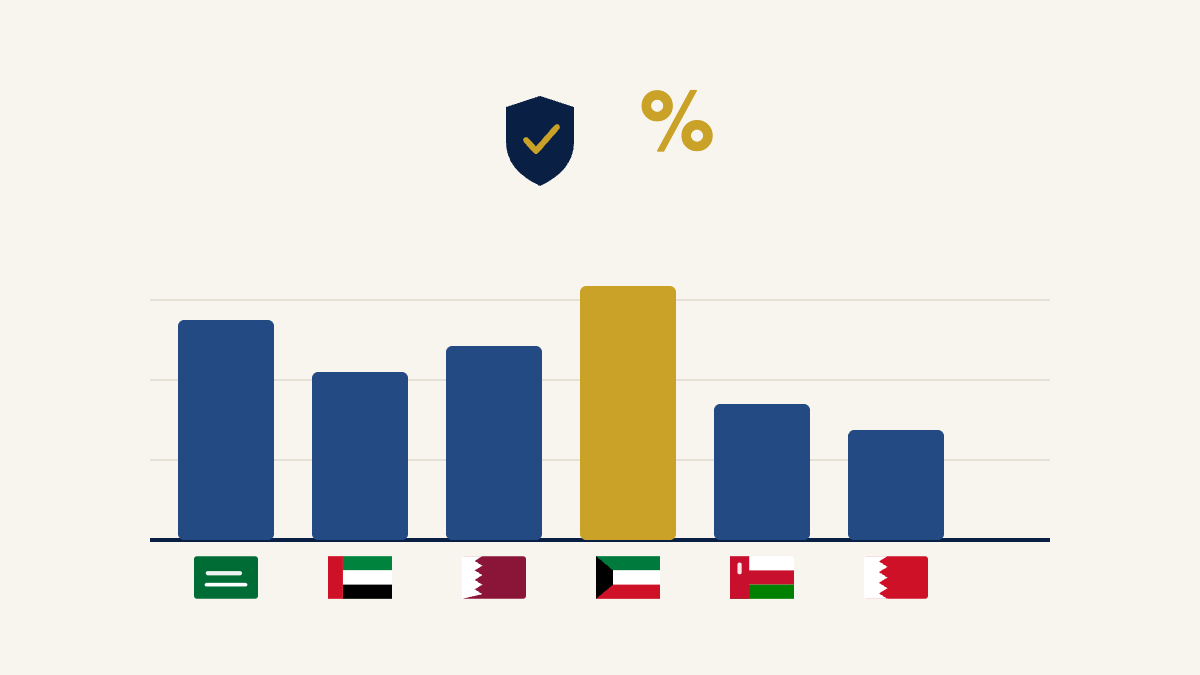
| Country | Scheme | Employees | Nationals — Employee | Nationals — Employer | Expat Contribution |
|---|---|---|---|---|---|
| UAE | GPSSA / ADPF | Nationals only | 5–11% | 12.5–15% | None |
| KSA | GOSI | Nationals + expats (limited) | 9.75–10.25% | 11.75–12.25% | Employer 2% only |
| Qatar | GRSIA | Nationals only | — | — | None |
| Kuwait | PIFSS | Nationals only | 8% | 11.5% | None |
| Oman | SPF (transitioning from PASI) | Nationals + expats (limited) | 8% | 13.5% | Employer 1–11% (phased through 2028) |
| Bahrain | SIO | Nationals + expats | 8% | 18% (rising to 20% by 2028) | Employer 4% + EOSB scheme |
Rates reflect 2026 figures. New cohorts in KSA pay higher rates under Royal Decree M/273.
The 2026 Compliance Picture — Confirmed vs Reported

A few changes have rolled through the Gulf payroll landscape recently. Some are confirmed in our operational data. Others come from regulatory bulletins and industry sources — verifiable, but worth confirming with your regulator before acting on them.
From Masdar EOR’s operational data (confirmed):
- Oman’s Royal Decree 53/2023 introduced the new Labor Law, and RD 52/2023 created the Social Protection Fund. RD 60/2025 postponed several SPF rollout phases — sick leave to 2026, work injuries to 2028, expat compulsory savings to 2027.
- Bahrain’s SIO employer contribution started ramping in 2024 under Law No. 14 of 2022. Currently 18% for 2026, rising 1% per year until it reaches 20% by January 2028.
- Bahrain’s monthly EOSB scheme via SIO replaced the lump-sum gratuity model for expats from March 2024.
- Saudi Arabia introduced a new GOSI cohort for hires from 3 July 2024 onwards under Royal Decree M/273. New cohort rates step up annually.
Industry-reported (verify with your regulator):
- Saudi Arabia’s Mudad payroll window is widely reported as tightening to a 30-day enforcement threshold.
- Bahrain’s Enhanced WPS is reported as becoming mandatory in February 2026 with a Wages Responsible Person requirement.
- Qatarization fines under recent law amendments are reported in the QAR 10,000–100,000 range for quota breaches.
We’ve separated those two buckets honestly. Compliance landscape moves quickly, but saying “we read it in the news” isn’t the same as saying “this is what our team enforces every month for clients.”
The Risk Patterns We See Most

These are the compliance failures that catch foreign employers most often.
WPS salary mismatch. Your accounting team pays AED 25,000 basic for an expat. Your WPS file says AED 22,000. The mismatch shows up the moment MOHRE pulls the file. Now you’re under inspection. (Note: WPS applies primarily to expat employees. Emiratis are processed through GPSSA directly.)
Contract drift. The employee signed for SAR 18,000. You quietly bumped them to SAR 22,000 last year. You never updated Qiwa. Now Mudad and GOSI numbers don’t match Qiwa. Cue the audit.
Misclassified contractors. Saudi authorities now reclassify “freelancers” as employees based on WPS pattern analysis — regular monthly payments of fixed amounts give it away. Fines can be material.
Nationalisation drift. You hire a Saudi national but never authenticate the contract on Qiwa. They don’t count toward your quota. Your Nitaqat band slips.
Late EOSB payouts. Under Article 53 of the UAE Labor Law, employers must pay all wages and end-of-service entitlements within 14 days of contract termination. Missing this triggers a labour complaint and potential MoHRE fines of AED 5,000 to AED 50,000. (Back interest is only awarded if a court explicitly orders it after a formal legal judgment.)
💼 Worried any of these apply to you? Book a free 20-minute compliance review with Masdar EOR. Schedule your call →
EOR or In-House? The Honest Answer
Below about 25 employees per country, an Employer of Record handling payroll usually beats in-house. Above that, the maths starts to flip toward setting up your own entity.
EOR makes sense when:
- You’re testing a new GCC market
- You have 1 to 25 employees per country
- Compliance risk sits outside your team’s expertise
- You want one invoice and one payroll team across all six countries
- Monthly fees run $400–$700 per employee, all-in
In-house or local payroll vendor makes sense when:
- Headcount above 25 to 50 per country
- You already have a local entity and HR team
- Your operations are capital-intensive
- You’re pursuing government contracts
For a deeper read on the model choice, our EOR vs PEO in the GCC breakdown digs into the trade-offs.
💼 Not sure which model fits? Send us your headcount by country and we’ll run the maths. Get your free comparison →
How to Choose a GCC Payroll Partner
A few markers tell you whether a payroll provider can actually handle Gulf compliance.
Six locally-registered entities — not partner licences. To clear local WPS portals, process national pension schemes, and register headcount for Saudization or Emiratisation, a provider must legally establish six individual, locally-registered commercial entities across the GCC nations. There’s no such thing as a single blanket cross-border licence. Masdar EOR operates a wholly-owned network of separate, localised entities in each of the six countries — not partner licences resold under one umbrella.
Native WPS plus non-WPS channels. Expat salaries flow through the country’s official WPS. But local nationals, free-zone executives, and certain cohorts are processed outside mainstream WPS via direct bank networks, GPSSA, or specialised social security portals. Your provider must support both.
Named in-house counsel. Not a vague “compliance team.” A lawyer with an actual name and licence.
Real-time nationalisation tracking. Monthly, ideally weekly. Not at quarter-end. Not when there’s an audit.
Single invoice across all six countries. Multi-country payroll falls apart fast when you’re chasing six different bills with six different VAT treatments.
Monthly EOSB accrual reporting. You want a clear statement showing exactly how much you owe each employee if they leave tomorrow.
FAQ
Is GCC payroll the same across all six countries?
No. Every country runs its own WPS, social insurance, and nationalisation scheme. Saudi, UAE, and Bahrain are the tightest. Oman just rebuilt its system under RD 52/2023, RD 53/2023, and RD 60/2025. Kuwait is the slowest to set up. Qatar sits in the middle.
What does WPS stand for and which countries use it?
Wage Protection System. The UAE, Saudi Arabia (called Mudad), Qatar, Kuwait, and Oman all run dedicated WPS platforms. Bahrain’s wage protection rules are embedded directly into the LMRA and SIO systems rather than running as a separate standalone platform — its compliance requires a designated Wages Responsible Person to authenticate the data.
Do expatriates contribute to social insurance in the GCC?
Mostly no. Saudi Arabia takes a 2% employer-only contribution for expats (occupational hazard). Bahrain runs a separate SIO-administered EOSB scheme for expats — 4.2% for the first 3 years of service, stepping up to 8.4% from year 4 onwards (concurrent tiered rates, not a gradual ramp). Oman now has small employer-only schemes for expats with several phases still postponed. UAE GPSSA/ADPF, Qatar GRSIA, and Kuwait PIFSS apply only to nationals.
What’s the penalty for missing a WPS salary?
Penalties vary by country. The UAE imposes fines per affected employee plus potential work-permit suspensions. In Saudi Arabia, missing a Mudad WPS file results in financial penalties per employee, suspension of new visa issuance, and a block on Qiwa portal services until the salary data is reconciled — though it does not directly downgrade your Nitaqat band, since that’s tied to nationalisation headcount percentages. Bahrain uses LMRA fines.
Can one provider handle payroll across all 6 GCC countries?
Only if they hold six separate locally-registered entities — one per country. There’s no single cross-border umbrella licence under Gulf labour law. Masdar EOR does exactly this: six wholly-owned entities, each with its own commercial registration and labour licence.
How often do GCC payroll rules change?
Not on a fixed schedule. Regulatory shifts happen via Ministerial Decisions, Royal Decrees, or scheduled annual escalations (like Bahrain’s January pension adjustments). Some rules sit static for a year; others move within a single week. Stay subscribed to your country regulator’s bulletins, or work with an EOR that monitors them for you.
💼 Got a payroll question we didn’t cover? Email Masdar EOR’s compliance team. Reach out →
Get GCC Payroll Right Before the Regulators Catch Up
Look, GCC payroll compliance used to be a tick-box. It isn’t anymore. The platforms talk. The fines stack. The cost of being wrong has climbed past the cost of doing it properly.
If you’re running payroll in two or more GCC countries right now, the safest move is to consolidate with a provider that holds locally-registered entities in every market — not partner licences resold under one umbrella. That’s how compliance actions get handled inside Qiwa, Mudad, GOSI, MOHRE, GPSSA, and SIO directly, by people who hold the credentials and the local company registrations to operate inside them.
💼 🚀 Ready to fix your GCC payroll?
Masdar EOR runs payroll, social insurance, Saudization, Emiratisation, and end-of-service across all six GCC countries through six locally-registered entities — UAE, Saudi Arabia, Qatar, Kuwait, Oman, and Bahrain. One invoice. One compliance team. Zero hidden fees.
More guides in: Payroll & Salary