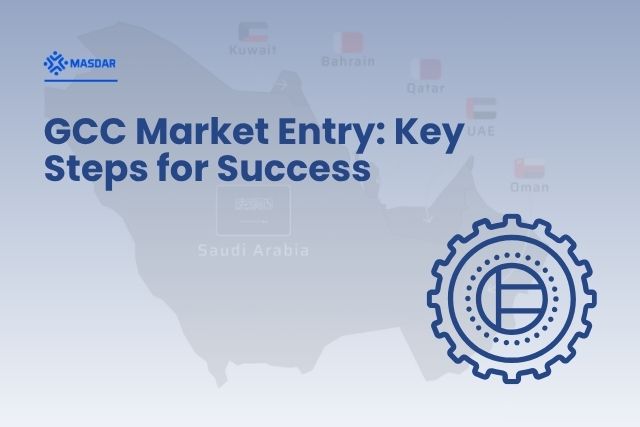
Entering the GCC Market: Key Steps for a Successful Launch

1.Introduction

Expanding into the Gulf Cooperation Council (GCC) region—comprising Saudi Arabia, the UAE, Qatar, Oman, Kuwait, and Bahrain—offers incredible opportunities for global companies. With a rapidly diversifying economic landscape and ambitious government initiatives (like Saudi Arabia’s Vision 2030 and the UAE’s Centennial 2071), the GCC continues to attract foreign investors from around the world. Despite this potential, navigating local regulations, cultural norms, licensing, and employment laws can be a major stumbling block for new entrants.

That’s where Masdar comes in. We specialize in Employer of Record (EOR), Professional Employer Organization (PEO), payroll, and HR services throughout the GCC. Our team ensures global companies can enter these dynamic markets without the burden of complex local compliance. This article outlines the key steps to successfully launch in the GCC, discusses common challenges, and shows how Masdar’s expertise can save you time, money, and headaches—allowing you to focus on securing new clients, growing revenue, and building your brand in one of the fastest-growing regions in the world.

Looking to expand into the GCC but unsure whether EOR or PEO is right for your business?

2. Why the GCC Is an Attractive Market for Foreign Businesses

The GCC’s appeal rests on solid economic fundamentals, a strategic geographic location, and ongoing policy reforms that make it easier for foreign investors to set up shop. Collectively, the GCC’s GDP exceeds two trillion USD, backed by substantial oil revenues and a strong push to diversify into technology, logistics, renewable energy, tourism, and more. High per-capita income, robust consumer spending, and supportive government incentives (like tax exemptions and full foreign ownership in many sectors) create a stable, profitable environment for businesses.

Rapid Diversification: Countries like Saudi Arabia (Vision 2030) and the UAE (Centennial 2071) are investing heavily in non-oil industries. As a result, infrastructure,

healthcare, tourism, e-commerce, and fintech are growing, offering new market opportunities.

  • Investor-Friendly Policies: Most GCC countries have introduced laws permitting 100% foreign ownership, streamlined their licensing processes, and reduced bureaucratic barriers. For instance, the UAE removed the 49% local ownership cap in most sectors, Saudi Arabia established a one-stop shop through MISA (Ministry of Investment), and Bahrain has long offered liberal rules for foreigners.
  • Tax Advantages: Personal income tax is virtually zero across the GCC for expatriates. Corporate tax rates are also low (or nonexistent in certain free zones), though the UAE introduced a 9% corporate tax from 2023 onward for onshore companies above a profit threshold. For many small and medium enterprises, these taxes remain minimal, leading to higher profitability.
  • Robust Infrastructure: The GCC invests billions in transportation, logistics, and tech infrastructure—like the Etihad Rail in the UAE, Qatar’s advanced metro system, and Saudi Arabia’s futuristic megaprojects (e.g., NEOM). Businesses benefit from sophisticated ports, airports, and telecom networks that enable them to scale rapidly.

In short, if you can navigate regulatory compliance and tailor your approach to local consumer preferences, the GCC is a prime location to expand your international footprint.

3. Market Research and Industry Trends in the GCC

Even though the GCC shares cultural and linguistic ties, each country still maintains unique regulatory and consumer nuances. To succeed in GCC business expansion, you need focused market research:

1. Sector-Specific Analysis

  • Identify which industry segments are booming in each country (e.g., Saudi Arabia’s entertainment and renewable energy initiatives, the UAE’s focus on tech startups and fintech, Bahrain’s push for financial services, Qatar’s development post-World Cup, etc.).
  • Study consumption habits, competition, pricing, and distribution channels that are prevalent locally.

2. Competitive Landscape

  • Evaluate who your direct competitors are and how they operate. Some industries—like e-commerce—are dominated by global giants who localize (e.g., Amazon in Saudi Arabia and the UAE). If you’re entering a niche sector, look for local partners or potential acquisition targets to jump-start your market share. 3. Free Zone vs. Mainland
  • In the UAE and Qatar, deciding whether to set up in a free zone or incorporate on the mainland can shape your business strategy. Free zones often offer tax exemptions and streamlined administrative processes, but might limit direct sales in the domestic market unless you partner with a local distributor or pay additional fees.

3. Regulatory Shifts

  • Monitor foreign investment laws, labor policies, and upcoming changes (e.g., new tax regulations, updated visa rules). For instance, Oman’s new laws allow 100% foreign ownership in most sectors, but also mandate Omanization—the hiring of local nationals at a certain ratio.

4. Cultural and Consumer Preferences

  • Simple localizations—like offering an Arabic-language website, halal product certifications, or locally preferred payment methods—can dramatically boost acceptance. In countries like Saudi Arabia, cash on delivery remains popular in e-commerce, though digital payments are rising fast.

By basing your decisions on detailed, country-specific insights, you’ll avoid assumptions that all GCC states operate identically. Masdar can help you gather on-the-ground intelligence from our network across Saudi Arabia, the UAE, Qatar, Oman, Kuwait, and Bahrain, ensuring that your EOR, PEO, payroll, and HR operations align with local norms from day one.

4. Business Setup and Licensing Requirements Across the GCC

One of the most critical—and potentially time-consuming—aspects of GCC market entry is business formation. The good news is that Masdar supports the entire process by offering localized guidance or even an Employer of Record arrangement that eliminates the need for you to set up a full legal entity before starting operations.

Below is a snapshot of key company registration routes in each GCC country.

4.1 Saudi Arabia

  • Licensing Through MISA: Saudi Arabia, the region’s largest economy, enables 100% foreign ownership for most sectors when you obtain an investment license from the Ministry of Investment (MISA). Once approved, you can register a foreign-owned LLC (also known as an SRL) that can sign local contracts, issue invoices, and sponsor work visas.
  • Capital Requirements: Historically, Saudi Arabia required substantial paid-up capital (e.g., SAR 500,000 for certain sectors). Some of these have been relaxed, but you’ll still want to budget for higher upfront costs than in other GCC nations.
  • Saudization (Nitaqat): As part of Nitaqat, you must meet quotas for Saudi national employment. Noncompliance could limit your ability to hire additional foreign staff.
  • Why Masdar Helps: Masdar can act as your Employer of Record in Saudi Arabia, handling your workforce’s legal employment while you confirm your local incorporation details. Our EOR solution lets you hire and operate quickly without navigating all the red tape alone.

4.2 United Arab Emirates (UAE)

  • Mainland vs. Free Zone: You can form a mainland (onshore) LLC under each emirate’s Department of Economic Development (DED), and as of 2021, 100% foreign ownership is allowed in most sectors. Alternatively, choose from 40+ free zones, each offering 100% foreign ownership, zero corporate tax (for free zone activities), and simplified setup.
  • Corporate Tax Updates: From 2023 onward, the UAE introduced a 9% federal corporate tax for mainland entities above a profit threshold. Many free zone companies remain exempt, provided they don’t conduct extensive mainland business.
  • Why Masdar Helps: Masdar is licensed in the UAE to sponsor foreign employees, manage visas, and handle payroll. Whether you prefer a free zone or mainland entity, we ensure full compliance with local labor and business laws.

4.3 Qatar

  • Foreign Investment Law (2019): Qatar allows 100% foreign ownership in most sectors, requiring approval from the Ministry of Commerce and Industry or via the Investment Promotion Agency (IPA). Some industries (like banking and insurance) may still need local partnerships.
  • Qatar Financial Centre (QFC): A specialized jurisdiction where you can register companies under English common law for finance, consulting, or media services. Also has a flat 10% corporate tax on local-source profits.
  • Why Masdar Helps: If your main objective is hiring quickly—before finalizing your QFC or mainland setup—our EOR service covers work permits, payroll, and HR compliance so you can test the market or start servicing clients faster.

4.4 Oman

  • New Investment Law: Oman’s 2019 law allows 100% foreign ownership in most sectors, significantly reducing previous capital requirements.
  • Omanization: Companies must hire Omani nationals in certain job categories and maintain a prescribed ratio of local to foreign employees.
  • Why Masdar Helps : Through PEO or EOR solutions, Masdar simplifies the onboarding of expatriates, ensures your hiring meets Omanization targets, and helps you remain compliant with evolving regulations.

4.5 Kuwait

  • Kuwait Direct Investment Promotion Authority (KDIPA): KDIPA can approve 100% foreign-owned ventures in qualifying sectors, granting incentives like tax holidays. If you don’t go through KDIPA, you typically need a 51% Kuwaiti partner for a standard LLC.
  • High Spending Power: Kuwait’s economy boasts one of the world’s highest GDP per capita, making it lucrative for consumer goods and high-end services.
  • Why Masdar Helps: We guide you in deciding whether KDIPA approval or a local partnership is optimal. Meanwhile, our EOR solutions let you staff operations quickly while you establish a legal presence.

4.6 Bahrain

  • Most Liberal Laws: Bahrain generally allows full foreign ownership in most sectors without needing a local sponsor, making setup faster and cheaper.
  • Economic Development Board (EDB): The EDB actively encourages FDI with incentives, especially in fintech, manufacturing, and logistics.
  • Why Masdar Helps

Masdar’s knowledge of Bahrain’s labor laws, LMRA (Labour Market Regulatory Authority) fees, and work visa processes ensures your expansion faces minimal friction.

Key Takeaway: Each GCC country offers multiple pathways (mainland, free zone, special economic zone, or direct investment license) for foreign companies. Masdar can either facilitate your local incorporation or serve as your Employer of Record, allowing you to hire and operate swiftly without immediate incorporation. This flexibility is especially vital if you’re testing a new market or require staff on the ground fast.

5. Visa and Work Permit Processes: Hiring in the GCC

Obtaining the correct work visas and residence permits is essential for employing expatriates in the GCC. In most cases, a locally licensed entity (or an EOR like Masdar) must sponsor the individual. Below is a general overview:

1. Saudi Arab

  • Foreign employees need a work visa followed by an Iqama (residency permit). The sponsoring employer must have an approved visa quota from the Ministry of Human Resources.
  • ○ Employers pay a monthly expat levy per foreign employee and must meet Saudization thresholds to avoid permit blocks.

2. UAE

  • Standard residence visas typically last 2–3 years, sponsored by your company, a free zone authority, or an EOR provider.
  • The UAE also offers Green Visas (5-year) and Golden Visas (10-year) for investors, entrepreneurs, and skilled workers under specific conditions.

3. Qatar

  • A Work Residency Permit is needed, sponsored by a Qatar-based employer. The employee first obtains an entry work visa, undergoes medical tests, then converts it to a Residence Permit.

4. Oman

  • An employer requests a labor clearance (quota) from the Ministry of Labor, obtains a work visa for the foreign employee, and finalizes a residency card through the Royal Oman Police.

5. Kuwait

  • The standard Article 18 work visa requires sponsorship by a Kuwaiti entity. Salary thresholds may apply for family sponsorship.
  • Transfers between employers can be complex, often requiring mutual consent.

6. Bahrain

  • The Labour Market Regulatory Authority (LMRA) issues work permits. Each employer must maintain a valid “quota” of foreign workers and pay monthly fees. Expats receive a work card upon arrival.

Masdar’s EOR solutions are especially beneficial here. Instead of forming a legal entity and securing your own visa quota, you can onboard employees immediately through Masdar’s locally compliant entities. We handle:

  • Work permit applications
  • Visa renewals
  • Payroll and benefits
  • Local labor law compliance

This shortcut is invaluable for test-launching a project, ramping up staff quickly, or ensuring that you meet all visa regulations without confusion.

6. Compliance with Labor Laws, Payroll Regulations, and Corporate Governance

Compliance is critical to sustaining a risk-free expansion in the GCC. Labor laws here are typically employee-friendly and highly regulated. Some key considerations:

  • Employment Contracts

○ Must often be in Arabic or at least bilingual.

○ Need to comply with each country’s wage and benefit mandates, public holiday allocations, and severance terms.

  • Working Hours and Overtime

○ A standard 40–48-hour workweek. During Ramadan, Muslim employees may work 2 hours less per day with no pay reduction.

○ Overtime rates are legally mandated (usually 1.25x to 1.5x normal pay).

  • End-of-Service Gratuity (ESG)

○ In Saudi Arabia, the UAE, Qatar, Oman, Kuwait, and Bahrain, expatriate employees are typically entitled to an end-of-service lump sum based on years of service. This is essentially a severance that must be accrued by the employer annually.

  • Nationalization Programs

○ Saudi Arabia (Saudization), Oman (Omanization), Kuwait, and others have quotas requiring companies to hire local citizens. These are strictly monitored. Not meeting them can block new work permits or trigger fines.

  • Payroll and Wages Protection

○ Most GCC states use a Wage Protection System (WPS). Employers must pay salaries through government-approved electronic transfers by a stipulated deadline, ensuring traceability and timely payment.

  • Corporate Governance

○ Annual license renewals, audited financial statements, and Board of Directors requirements may apply.

○ Some industries (e.g. finance, insurance) have additional oversight from central banks or specialized regulators.

Failing to comply with any aspect—be it paying wages late or incorrectly classifying employees—can lead to severe penalties like visa bans, license suspensions, or costly lawsuits. Masdar specializes in Payroll and HR services that are fully 100% compliant with local laws. We manage everything from employee contracts and onboarding to salary transfers and severance.

7. Cultural and Business Etiquette in the GCC

Building relationships is paramount in the GCC. While each country has its distinct character—Saudi Arabia may be more conservative than Bahrain, for example—there are broad cultural norms to keep in mind:

  • Relationship Building: Trust and personal rapport often matter more than purely transactional deals. Expect to spend meeting time on pleasantries, family, and social discussions.
  • Greetings: A warm handshake and “Assalamu Alaikum” are appreciated. Use right hand for giving or receiving items.
  • Gender Dynamics: In more conservative settings, men and women may avoid direct physical contact (like a handshake) unless invited. Always follow the other person’s lead.
  • Business Attire: Dress formally; suits for men, while women should cover shoulders and knees. In the UAE and Bahrain, business attire is relatively flexible, but Saudi Arabia and Kuwait tend to be more conservative.
  • Language: Arabic is the primary language, though English is widely used in business. Knowing key Arabic phrases can impress local partners.
  • Punctuality vs. Flexibility: Arrive on time, but don’t be surprised if meetings start later than scheduled. The concept of time can be more flexible.
  • Hospitality: Serving coffee, tea, or dates is common. Accepting these offerings is a sign of courtesy, and small talk is often integral to forging partnerships.

Navigating cultural nuances with respect fosters goodwill and long-term relationships. Masdar can offer cultural guidance for clients, helping them avoid misunderstandings and build fruitful connections faster.

8. Common Challenges and Practical Solutions

1. Bureaucracy and Red Tape

Solution: Work with local consultants or an EOR to streamline licensing, company registration, and government paperwork. Masdar manages the entire process with local authorities.

2. Finding a Trustworthy Local Partner

Solution: Conduct thorough due diligence or avoid the need for a partner by setting up a 100% foreign-owned entity where allowed. Or use Masdar’s PEO service to bypass sponsor complications.

3.Cultural and Language Barriers

Solution: Offer Arabic-language customer support and adapt your marketing to local preferences. Masdar provides on-ground HR teams who are bilingual and knowledgeable in cultural matters.

4.Compliance with Labor Quotas

Solution: Plan recruitment carefully or leverage Masdar’s local expertise. For instance, we can advise you on meeting Nitaqat (Saudization) and other nationalization requirements.

5. Scalability and Cost

Solution: Launch lean by using an Employer of Record arrangement. Once your market presence solidifies, you can form a permanent entity if needed.

6. Slow Payments or Late Receivables

Solution: Factor longer payment cycles (60–90 days) into your cash flow. Build strong relationships so clients prioritize you, or require partial upfront payments.

By anticipating these challenges and leveraging expert support, you can turn potential roadblocks into manageable hurdles. Masdar essentially acts as your “HR and compliance backbone,” ensuring you hit the ground running.

 9. How Masdar Simplifies GCC Expansion

9.1 About Masdar

At Masdar, our mission is to help global companies hire, manage, and pay professionals in the GCC—specifically in Saudi Arabia, UAE, Qatar, Oman, Kuwait, and Bahrain—while simplifying market entry and employment compliance. We bring years of experience and deep local insights across various industries.

9.2 Our Core Services

1. Employer of Record (EOR) in the GCC

○ We employ your staff under our licensed local entities so you can operate immediately without forming a local company.

○ Perfect for fast market testing or pilot projects.

2. Professional Employer Organization (PEO)

○ We partner with your existing entity to handle all HR administration, payroll, tax filings, benefits, and compliance.

○ Alleviates the complexities of local labor laws, allowing you to focus on core operations.

3. Full-Service Payroll and HR

○ We ensure timely, accurate payroll under Wage Protection Systems and handle end-of-service gratuities, medical insurance, and more.

4. Visa and Work Permit Solutions

○ Streamlined processes for foreign employees, including sponsorship, entry permits, and renewals.

○ We also manage Saudization, Omanization, and other local workforce nationalization mandates.

9.3 Licensed Manpower Provider

We hold the manpower provider license in Saudi Arabia and the UAE, so our operations meet 100% compliance standards. Our direct relationships with government authorities reduce delays and ensure reliable, risk-free solutions.

9.4 Why Choose Masdar

  • Deep Local Knowledge: We navigate complexities in each GCC country, from Saudi labor quotas to QFC regulations in Qatar.
  • Speed to Market: Begin hiring in days or weeks instead of months, crucial for first-mover advantage in competitive sectors.
  • Cost Efficiency: Avoid expensive overheads of setting up legal entities prematurely. We handle the HR admin, letting you reinvest resources in sales, marketing, or product development.
  • Single-Point Accountability: Instead of juggling multiple local consultants, you have one partner for all compliance, HR, and payroll needs.
  • Tailored Support: Whether you need a short-term test run or a large-scale project ramp-up, we adapt to your timeline and growth trajectory.

10. Key Government Agencies, Free Zones, and Industry Resources

Knowing whom to contact can speed up your market entry. Here are key entities by country:

Saudi Arabia:

○MISA (Ministry of Investment) for foreign investment licenses.

○ Ministry of Commerce for company registration.

○ Saudi Chambers of Commerce for networking.

UAE:

○ Department of Economic Development (DED) in each emirate (e.g., Dubai Economy, Abu Dhabi DED).

○ Free Zones (e.g., DMCC, DIFC, JAFZA, ADGM) specialized in sectors like commodities, finance, or logistics.

Qatar:

○ Ministry of Commerce and Industry for general registration.○ Qatar Financial Centre (QFC) and Qatar Free Zones Authority (QFZA) for special economic zones.

Oman:

○ Ministry of Commerce, Industry & Investment Promotion (MCIIP) for business setup.

○ SEZs like Duqm, Sohar, Salalah.

Kuwait:

○ KDIPA (Kuwait Direct Investment Promotion Authority) for 100% foreign ownership and incentives.

○ Ministry of Commerce & Industry for standard LLC registration.

Bahrain:

○ Bahrain EDB (Economic Development Board) for foreign investor facilitation. ○ Ministry of Industry and Commerce for registration (Sijilat portal).

For region-wide insights, multinational consulting firms (EY, PwC, KPMG, Deloitte) often publish free GCC economic updates. Local chambers of commerce and trade fairs (like GITEX in the UAE or the Future Investment Initiative in Saudi Arabia) also offer valuable networking opportunities.

11. Conclusion

Entering the GCC market is both exciting and challenging. On one hand, you gain access to high-income economies, government-backed mega-projects, new consumer segments, and pro-business reforms. On the other, you face labyrinthine regulations, labor quotas, cultural nuances, and visa complexities that can stall growth if not managed properly.

This is precisely where Masdar excels. By providing Employer of Record, PEO, payroll, and HR solutions under our licensed local entities, we remove the headaches of regulatory compliance, visa processes, and tax filings, so you can concentrate on building your brand and securing clients. From Saudi Arabia market entry to UAE company registration and beyond, Masdar offers:

  • Fast, cost-effective setup so you can hire talent immediately
  • Full compliance with labor laws, payroll regulations, and tax procedures
  • Local cultural insights to foster strong relationships
  • One-stop solutions for all GCC markets

If you’re ready to expand into Saudi Arabia or the UAE, or need expert guidance to optimize your business operations across Qatar, Oman, Kuwait, and Bahrain, let’s connect. Masdar can unlock your growth potential by ensuring your launch in the GCC is smooth, compliant, and positioned for success—all while avoiding pitfalls that can undermine even the most promising ventures. Contact us today to learn how we can tailor our EOR, PEO, and payroll services to your specific needs.
Contact MasdarEOR

Note: This blog article is for informational purposes and not a substitute for legal advice. GCC regulations can change; always confirm details with official government sources or consult local legal experts. Masdar stands ready to assist with up-to-date advice, compliance, and hands-on support tailored to your unique expansion goals.

Unlock Smarter GCC Hiring: 5 Practical Ways to Reduce Costs

Hey there, Payroll Managers, HR Gurus, and Global Expansion Directors! Let’s have a real chat. You know that finding top-notch talent is like striking oil – incredibly valuable. But let’s be honest, the cost of actually getting that talent onto your team, especially when you’re looking to hire in new territories like the bustling GCC (Gulf Cooperation Council) region, can make your budget feel like it’s drilling a dry well.

You’ve probably heard some eye-watering stats. In the U.S., the average cost-per-hire can be around $4,700, and some say it can even balloon to three or four times an employee’s salary! Now, imagine navigating that in diverse markets like Saudi Arabia (KSA), the United Arab Emirates (UAE), and their neighbors. It’s enough to make anyone look for smarter ways to manage those expenses without sacrificing the quality of your hires.

That’s where we, Masdar EOR, come in. As your friendly Employer of Record experts with direct EOR licenses across the GCC (KSA, UAE, Qatar, Bahrain, Oman, and Kuwait), we’re here to help you fine-tune your recruitment in this dynamic region and keep those hiring costs in check. Think of us as your on-the-ground HR partner, especially when you’re aiming to bring your business into these exciting markets.

So, how can you actually trim those hiring expenses without missing out on the A-players? Here are 5 practical ways, with a special GCC flavor:

1. Tap into Your Current A-Team: Your GCC Network Powerhouse

One of the best, and often most overlooked, goldmines for new talent is the team you already have! Your current employees, especially those with roots or experience in the GCC, likely have connections. An effective employee referral program can be a game-changer.

GCC Network Powerhouse

  • Why it rocks in the GCC: Business in the GCC is often built on relationships and trust. A referral from a current employee can carry significant weight and bring in candidates who are not only skilled but also a good cultural fit.
  • Make it work:
    • Set clear goals: Are you trying to slash recruitment agency fees, speed up hiring, or find those elusive passive candidates in Riyadh or Dubai?
    • Keep it simple: Create an easy-to-use referral process. A straightforward form can do wonders.
    • Define who plays: You might exclude HR and direct hiring managers to avoid conflicts.
    • Sweeten the deal: Think about incentives that resonate in the GCC. Beyond cash bonuses or gift cards, consider extra paid time off (PTO) or public recognition – appreciation goes a long way!
  • At Masdar EOR, we’ve seen how powerful local networks can be, and we can help you structure referral programs that truly resonate within the GCC context.

2. Get Smart with Automation (GCC-Style)

Many of you are already using some form of automation, but are you maximizing it for GCC hiring? If you’re not yet using HR software to help source candidates or screen CVs (they’re more common than long-form resumes in the region), that’s a great starting point. These tasks eat up time, but software can handle them efficiently. AI and machine learning can even match keywords in your Arabic or English job descriptions with candidate applications.

Get Smart with Automation

  • Beyond the basics: Think about automating interview scheduling and even offer letter management. The less admin your HR team is bogged down with, the more strategic they can be.
  • GCC Considerations: When choosing HR tech, consider tools that support Arabic, understand regional data privacy regulations (they’re evolving!), and integrate well with local payroll nuances. Masdar EOR keeps a pulse on the HR tech landscape in the GCC and can guide you on solutions that make sense for your expansion.

3. Sharpen Your Job Postings for the GCC Audience

A crystal-clear and engaging job posting is your frontline sales pitch to potential candidates in the GCC. Get it right, and you’ll attract people who genuinely fit what you need, saving you time and resources down the line.

  • Speak their language (literally and figuratively):
    • Use terms your ideal candidate in Jeddah, Abu Dhabi, or Doha would search for. Clearly spell out core responsibilities.
    • Specify if the role is full-time, part-time, or remote (remote work is gaining traction, but on-site is still prevalent).
  • Crucially for the GCC: Highlight what sets your company apart in this region. Mentioning your company values is great, but also advertise benefits packages that are attractive locally (e.g., comprehensive health insurance, schooling assistance if applicable, family visa support, and any alignment with nationalization initiatives like Saudization or Emiratization, if relevant for the role).
  • Masdar EOR’s local knowledge means we can help you craft job descriptions that hit the right notes with GCC talent.

4. Build Your GCC Talent Pipeline – Don’t Let Good Candidates Slip Away!

You’ll spend way less on active recruiting if you have a warm pool of talent ready to go. Often, you get several qualified applicants for a single position. Don’t just discard those applications!

Masdar EOR cost-effective hiring solutions in Gulf countries

  • Stockpile for the future: Create a database of promising candidates, especially those who made it through some of your screening process. This is super valuable for companies planning ongoing growth in key GCC hubs.
  • Think long-term: As you expand into KSA or the UAE, having this pipeline can significantly cut down your time-to-hire for future roles. Masdar EOR can help you manage this talent pipeline in a compliant way, ensuring you’re ready when the next opportunity arises.

5. Be Strategic with Job Boards in the GCC

Job boards are useful, no doubt, but the costs can add up. You need to be selective.

  • GCC-Specific Platforms: While global giants like LinkedIn are essential (especially with a strong regional focus), don’t overlook popular local and regional job boards. Platforms like GulfTalent, and NaukriGulf are heavily used by job seekers across KSA, UAE, and the wider GCC.
  • Track Your ROI: If you’re using multiple boards, consider HR software that can track which ones are actually delivering qualified candidates from the region.
  • Don’t forget social media: LinkedIn is key, but even platforms like Twitter or targeted Facebook groups can sometimes yield good leads, depending on the role. With our direct EOR licenses and on-the-ground presence in all 6 GCC countries, Masdar EOR has the insights to advise on the most effective channels to reach your target talent in each specific market.

Ready to Make Hiring in the GCC Smoother and More Cost-Effective? Talk to Masdar EOR!

Expanding your team into dynamic markets like Saudi Arabia, the UAE, Qatar, Bahrain, Oman, or Kuwait shouldn’t be a financial headache. At Masdar EOR, we specialize in making it easier.

Because we hold direct EOR licenses in these countries, we cut out the middlemen, offering you a streamlined, compliant, and cost-effective way to hire the talent you need. We handle the complexities of local labor laws, payroll, and benefits, so you can focus on your core business and growth.

Contact MasdarEOR


Think of us as your extended HR team, right here in the GCC. We get the local nuances, the compliance requirements, and the best ways to attract and retain talent.

Want to see how Masdar EOR can help you build your dream team in the GCC without Conbreaking the bank? Let’s chat! We can help you Art

“Expanding to the GCC? Masdar EOR Demystifies Payroll & Minimum Wages for You!”

Expanding to the GCC? Masdar EOR Demystifies Payroll & Minimum Wages

Thinking of tapping into the vibrant and growing markets of the GCC? Smart move! The Gulf Cooperation Council (GCC) countries – that’s Saudi Arabia, the UAE, Qatar, Bahrain, Oman, and Kuwait – are buzzing with opportunity. But let’s be real, expanding anywhere new, especially when it comes to payroll, can feel like navigating a maze in the dark. That’s where we, Masdar EOR, come in. We’re your on-the-ground EOR experts with direct licenses across the GCC. This isn’t just a fancy badge; it means we’ve got the deep-rooted local knowledge and legal standing to make your expansion smooth and, most importantly, compliant.

One of the first things you’ll bump into is understanding wages. It’s not always as straightforward as a single “minimum wage” figure for everyone. So, let’s break down what you need to know about setting up payroll in the GCC, with a special Masdar EOR touch.

Key Things to Chew On When Expanding to the GCC:

  • The Minimum Wage Scene: It’s different here. We’ll dive into how each GCC country approaches minimum wages, especially the distinctions between nationals and expatriate workers.
  • Who Gets What?: Understand how wage rules apply based on job roles, sectors, and often, nationality (think Saudization or Emiratization policies).
  • Your Legal Homework (Don’t Worry, We’ve Got the Cheat Sheet!): As an employer, you’ve got to play by the local rules. With Masdar EOR’s direct licenses, we ensure you’re always on the right side of the law in the GCC.
  • Beyond the Basic Salary: There’s more to the cost of hiring than just the wage. Think end-of-service gratuity, benefits, and other allowances. We’ll touch on these too!

Why All This Fuss About Minimum Wages in the GCC?

The minimum wage is essentially the legal baseline for what you can pay your employees for their hard work. Now, if your company is hiring talent within any of the GCC countries, you absolutely must follow the wage laws where your employee lives and works, not necessarily where your main office is.

The GCC has a unique employment landscape. While some countries have set specific minimums, others rely more on contract agreements, especially for the large expatriate workforce. But don’t mistake this for a free-for-all. There are rules, and they matter.

A Look at the Wage Landscape in the GCC – Masdar EOR Insights

Country Minimum Wage Details Masdar EOR Tip
Saudi Arabia (KSA) For Saudi nationals: SAR 4,000 per month (to encourage Saudization).For expatriate workers: No universally mandated minimum wage. Salaries are determined by employment contract, skills, experience, and industry. Remember GOSI (General Organization for Social Insurance) contributions are mandatory for Saudi employees.
United Arab Emirates (UAE) No single federal minimum wage.UAE Labour Law: Salaries must cover basic needs. Some recommended minimums by skill/education (e.g., university graduates: AED 12,000; skilled technicians: AED 7,000; skilled laborers with secondary education: AED 5,000 – not always legally binding). New contracts for certain skilled categories may require AED 5,000/month from early 2025. Wages predominantly set by employment contract. The Wage Protection System (WPS) is crucial for ensuring timely salary payments.
Qatar Non-discriminatory minimum wage for all private-sector workers (including domestic): QAR 1,000 per month. Additional allowance if not provided: QAR 500/month for accommodation & QAR 300/month for food (effective minimum ~QAR 1,800 with allowances). This move by Qatar is significant, aiming to provide a baseline for all workers in the region.
Bahrain No general minimum wage for private-sector employees (including expatriates). For Bahraini nationals in public sector: Minimums exist (e.g., BHD 300/month; BHD 450 for degree holders). Employment contracts and market rates heavily influence salaries. Bahrain also has a Wage Protection System to ensure salaries are paid correctly and on time.
Oman For Omani nationals: OMR 325 per month (OMR 225 basic + OMR 100 allowance). Potential increases discussed. For expatriate workers: No mandated minimum wage; determined by contract. Oman is focused on Omanization, prioritizing employment for its citizens.
Kuwait Minimum wage: KWD 75 per month for private sector employees (nationals and expatriates). Actual salaries are often considerably higher based on job, industry, and experience. Employment contracts must be in Arabic (or have an official Arabic translation), and this version is legally binding.

Important Quirks & Considerations for GCC Payroll (Beyond the Paycheck Figure)

Thinking you’ve got it all figured out with just a wage number? Hold on! Here are some other critical factors Masdar EOR helps you navigate:

Employer payroll compliance requirements in the GCC

  • It’s Not One-Size-Fits-All: As you can see, wages aren’t static. They shift based on nationality (due to nationalization initiatives), the specific job sector, an employee’s age and education, and sometimes even the region within a country.
  • Currency Consistency: Most GCC currencies (SAR, AED, QAR, BHD, OMR) are pegged to the US Dollar, which simplifies things a bit for international comparisons. The Kuwaiti Dinar (KWD) is pegged to a basket of currencies but maintains relative stability. Employees are paid in their local currency.
  • Working Hours: A standard work week in the GCC is typically 8 hours a day, 40-48 hours a week, often spread over 5 or 6 days. During Ramadan, working hours are usually reduced.
  • Salary Payments & the All-Important Gratuity: Salaries are usually paid monthly. A HUGE factor in GCC compensation is the End-of-Service Gratuity (EOSG). This is a statutory severance payment that expatriate employees are entitled to after completing a certain period of service (usually one year).
    • How it’s generally calculated (can vary slightly by country):
      • For the first five years of service: Often 21 days of basic salary for each year.
      • For service beyond five years: Often 30 days of basic salary for each year.
    • This is a significant liability to account for and a key part of an employee’s total compensation package. It’s not a “bonus”; it’s a legal right. GCC nationals usually fall under national pension schemes instead of EOSG.

What Else Goes into Employee Costs in the GCC?

Beyond the salary and gratuity, budget for these:

  • Mandatory Benefits: Health insurance is mandatory for employees (and often their dependents) in most GCC countries.
  • Visas and Permits: Costs for employment visas, residency permits, and other government processing fees.
  • Allowances: It’s very common, especially for expatriates, to receive allowances for housing, transportation, and sometimes children’s education. Annual flight tickets to their home country are also a frequent contractual benefit.
  • Social Security: For GCC nationals, employers must contribute to government social security and pension schemes (like GOSI in KSA).

Stay Compliant and Confident in the GCC with Masdar EOR

Navigating the ins and outs of GCC employment laws, especially things like varying wage expectations and end-of-service calculations, can be a real headache if you’re trying to go it alone. It’s genuinely the number one worry for companies looking to hire internationally.

Stay Compliant and Confident in the GCC with Masdar EOR

But it shouldn’t stop you from accessing the amazing talent and market opportunities in the GCC.

With Masdar EOR, you’re not just getting a service provider; you’re getting a partner with direct EOR licenses in Saudi Arabia, the UAE, and across the other GCC nations. This means we’re not just middlemen; we are fully authorized and equipped to employ and manage your staff in complete compliance with local laws.

We handle the complexities of employment contracts, payroll, benefits, and ensure every legal box is ticked. You don’t need to become an expert in six different sets of labor laws – that’s our job! We let you focus on what you do best: growing your business.

Contact MasdarEOR


Ready to make your GCC expansion a success story?

Let Masdar EOR take the payroll and compliance weight off your shoulders. Reach out to us today for a chat! Let’s explore how we can make your journey into the GCC smooth, compliant, and stress-free.

Navigating GCC Payroll: Why Your Company Needs a Specialist?

Hey there! If you’re a Payroll Manager, HR guru, Global Expansion Director, Finance Manager, CFO, or part of an accounting firm eyeing the GCC (that’s Saudi Arabia, UAE, Qatar, Bahrain, Oman, and Kuwait), you already know that expanding into new territories is exciting. But let’s be real, payroll can be a headache, especially in highly regulated markets. Get it wrong, and you’re looking at some serious frowns from the authorities, not to mention potential fines and a dent in your hard-earned reputation.

At Masdar EOR, we live and breathe GCC payroll. What makes us special? We hold direct Employer of Record (EOR) licenses across all six GCC countries. This isn’t just a fancy badge; it means we’re not outsourcing your critical payroll functions to a third party in these countries. We are the party. This direct approach gives you, and us, a level of control, compliance, and local know-how that’s pretty hard to beat.

So, let’s talk about keeping your payroll smooth and compliant in the GCC.

Understanding the Payroll Game in the GCC (and Why It’s a Big Deal)

Payroll compliance simply means playing by the rules when it comes to paying your team. And trust us, governments across the GCC have a keen interest in making sure everyone is paid correctly and on time. These rules aren’t just suggestions; they’re legal requirements covering everything from how much you pay to how you report it.

Key payroll essentials for Gulf region employers

Certain industries, by their very nature, are under a tighter microscope. Think about:

  • Energy (especially oil & gas and renewables)
  • Information Technology (with data privacy being key)
  • Healthcare
  • Finance and Banking
  • Construction and Engineering
  • Defense and Aerospace

If your business operates in these or similar sectors, you can expect even more stringent payroll and employment regulations. Why? Because governments want to protect consumers, shareholders, and of course, the employees themselves.

In the GCC, this means navigating a landscape that includes:

  • Hiring and Firing: Specific processes, notice periods, and end-of-service gratuity calculations.
  • Local Labor Laws: Each GCC country has its own comprehensive labor law.
  • Income Tax (or lack thereof for employees, mostly!): While generally there’s no personal income tax for employees, understanding corporate tax, VAT implications, and any specific free zone regulations is crucial.
  • Social Security Systems: Contributions for GCC nationals (like GOSI in KSA) are mandatory and have strict rules.
  • Reporting Requirements: Think WPS (Wages Protection System) in countries like the UAE and KSA, which mandates salary payments through approved channels.
  • Foreign Personnel: Visa sponsorships, work permit rules, and differing regulations for expatriate employees.
  • Leave Entitlements: Annual leave, sick leave, public holidays, maternity leave – all prescribed by law.
  • Nationalization Policies: Requirements like Saudization, Emiratization, etc., impact recruitment and HR.

Messing up here isn’t an option. For instance, non-compliance with the Wages Protection System (WPS) in the UAE can lead to fines and even suspension of new work permits. In Saudi Arabia, incorrect GOSI contributions can result in penalties and back payments. It’s not just about the money; it’s about your license to operate and your reputation as a fair employer.

Key GCC Payroll Essentials You Can’t Ignore

To keep your business on the right side of the law in the GCC, you need to be on top of these key areas. This is where having a partner like Masdar EOR, with our direct licenses and on-the-ground teams in KSA, UAE, Qatar, Bahrain, Oman, and Kuwait, becomes invaluable.

  1. Wages Protection System (WPS): Mandatory in several GCC countries (like UAE, KSA, Qatar, Oman, Bahrain, Kuwait). It ensures timely and accurate salary payments through registered agents/banks. We handle this seamlessly.
  2. Social Security for Nationals: Each GCC country has its own system for national employees (e.g., GOSI in KSA, GPSSA in UAE). Contributions are mandatory, and calculations must be precise.
  3. End-of-Service Gratuity (EOSG): This is a statutory payment due to employees upon termination/resignation, calculated based on their last salary and length of service. Accruing and paying this correctly is vital.
  4. Leave Management: From annual leave to sick leave and public holidays, everything is legislated. Proper tracking and payment for unused leave upon termination are essential.
  5. Work Permits and Visas: For your expatriate workforce, ensuring valid residency and work permits is fundamental. This is often linked to payroll processing.
  6. Data Protection: Emerging data protection laws (like KSA’s PDPL) mean handling employee data with care and in compliance with local regulations.
  7. Accurate Record Keeping: Maintaining detailed and accurate payroll records, employment contracts, and attendance data isn’t just good practice; it’s a legal requirement and crucial for audits.

With Masdar EOR, you’re not just getting a processor; you’re getting expert guidance rooted in direct, local experience across all these areas.

Actionable Steps for Smooth GCC Payroll (with Masdar EOR by Your Side)

Keeping everything ticking over nicely involves a few key habits:

Masdar EOR payroll specialist services


  1. Conduct Regular Audits (Let Us Help!): Internally reviewing your payroll data is smart. Even better, let an expert take a look. At Masdar EOR, our local teams can help you spot any discrepancies or potential red flags before they become problems. We’ll help you:
    • Ensure only active employees are paid, and their pay matches their contracts.
    • Verify work hours, overtime, allowances, and deductions against GCC labor laws.
    • Check calculations for social security and end-of-service gratuity accruals.
    • Ensure compliance with WPS requirements.
    • Review recent changes in GCC labor laws and adjust processes.
  2. Stay Updated on Regulatory Changes (That’s Our Job!): GCC labor laws and payroll regulations aren’t static. They evolve. Trying to keep up across six different countries can feel like a full-time job!
    • That’s where we come in. As your EOR partner with direct licenses, Masdar EOR is constantly monitoring these changes. We keep you informed about what’s new and how it impacts your payroll in Saudi Arabia, the UAE, Qatar, Bahrain, Oman, and Kuwait.
  3. Implement Robust Payroll Systems (Leverage Ours!): Manual payroll is a recipe for errors and wasted time, especially across multiple GCC countries. You need a system that’s built for this.
    • Masdar EOR utilizes proven, compliant payroll systems tailored for the unique requirements of each GCC country. This means automated calculations, timely payments, strong data security, and streamlined reporting, all managed by our local experts.
  4. Train Your Team (and Lean on Ours): Make sure your internal team understands your payroll processes and why certain things are done the way they are.
    • Better yet, rely on Masdar EOR. We handle the complexities, so your team can focus on their core roles. We ensure everyone understands their payslips and how their salary, allowances, and deductions are calculated according to local laws.

Continue reading “Navigating GCC Payroll: Why Your Company Needs a Specialist?”

Thinking of Expanding? Why the GCC Should Be Top of Your List (And How to Make it Easy!)

So, your business is booming, and you’re eyeing new horizons? That’s fantastic! While some founders look to traditional Western markets, a truly dynamic and rapidly growing region often gets overlooked by startups until they realize its immense potential: the Gulf Cooperation Council (GCC). We’re talking about KSA, UAE, Bahrain, Kuwait, Oman, and Qatar – a powerhouse of opportunity!

Here at Masdar EOR, we’ve seen firsthand how companies can thrive by expanding into the GCC. It’s a region brimming with innovation, ambitious national visions, and a welcoming environment for businesses ready to make their mark. Forget the old narratives; the GCC is fast becoming a global hub, and this article will explain why it’s such an attractive destination and how you can get your business set up there smoothly.

So, What Makes the GCC Sparkle for Ambitious Businesses?

The GCC isn’t just about stunning skylines and rich culture; it offers some serious advantages for businesses looking to grow:

  • Access to a Thriving, Unified Market (and Beyond!): The GCC countries are increasingly interconnected, offering a significant consumer and business market. Plus, their strategic location makes them a fantastic springboard into wider Middle Eastern, African, and Asian markets. With Masdar EOR, navigating the nuances of each GCC country becomes much simpler, thanks to our direct EOR licenses across KSA, UAE, Bahrain, Kuwait, Oman, and Qatar. This means we’re not just middlemen; we have the local, official setup to get you operating legally and efficiently.
  • Unprecedented Investment & Government Support: GCC governments are heavily investing in diversifying their economies (think Saudi Vision 2030 or the UAE’s Centennial Plan). This translates into incredible support for new businesses, particularly in tech, renewables, tourism, and logistics. There’s a real buzz and commitment to fostering innovation.
  • Pro-Business Environment & Growing Free Zones: These countries are actively working to make it easier to do business. Numerous free zones offer benefits like 100% foreign ownership and simplified registration processes. While navigating these can still have its complexities, that’s where a partner like Masdar EOR comes in – we understand the local landscape.
  • Simplified Financial Operations (with the right partner!): While opening local bank accounts can sometimes be a hurdle from afar, the GCC has well-established financial systems. More importantly, when you partner with Masdar EOR, we handle all the local payroll, ensuring your team gets paid correctly and on time, compliant with local regulations like the Wage Protection System (WPS). This takes a huge administrative load off your shoulders.


  • Seriously Attractive Tax Regimes: This is a big one! Many GCC countries boast zero or very low corporate and income tax rates. For a growing business, this means more of your hard-earned revenue can be reinvested, fueling further growth. It’s a significant financial incentive that’s hard to ignore.
  • Support for Your Global Workforce: The GCC is incredibly cosmopolitan, with large expatriate populations. While there isn’t a single “International House” like in the competitor’s article, each country has mechanisms to support foreign talent. Crucially, Masdar EOR, with our direct local licenses, manages the visa processing, HR, and compliant onboarding for your employees in KSA, UAE, Bahrain, Kuwait, Oman, and Qatar. We ensure your team’s transition is smooth and fully compliant with local labor laws so they can hit the ground running.

Contact MasdarEOR

Ready to Explore the GCC? Here’s How to Get Started Smartly

So, you’re intrigued by the GCC’s potential? Excellent! Instead of getting bogged down in complex company registration processes from afar, or trying to decipher different visa requirements for each country, there’s a much more efficient way, especially when you’re testing the waters or need to hire quickly.

Step 1: Understand the GCC’s Rich Diversity

While they form a council, each GCC nation has its unique strengths, target sectors, and local business culture. KSA is a massive, rapidly transforming market. The UAE is a global hub for trade and tourism. Qatar is a leader in LNG and hosting global events. Bahrain is a financial services center. Oman offers stunning nature and a focus on logistics and tourism. Kuwait has a mature market with high disposable income. A bit of research, or a chat with experts like us at Masdar EOR, can help you pinpoint which market, or markets, align best with your business goals.

Step 2: Leverage the Power of a Direct Employer of Record (EOR)

This is where things get really straightforward. Instead of spending months and significant capital on setting up a legal entity in each GCC country you’re interested in, you can partner with Masdar EOR. Because we hold direct EOR licenses in KSA, UAE, Bahrain, Kuwait, Oman, and Qatar, we can legally employ staff on your behalf.

What does this mean for you?

  • Speed to Market: You can have team members on the ground, working for you, in a fraction of the time.
  • Compliance Assured: We handle all the local HR, payroll, tax, and labor law requirements. No headaches about navigating complex and changing regulations – that’s our expertise.
  • Cost-Effective: You avoid the hefty costs and administrative burden of entity setup, especially if you’re starting with a small team.
  • Flexibility: Easily scale your team up or down, or test a market before making a larger investment.
  • Focus on Your Core Business: You get to concentrate on your growth strategy, sales, and operations, while we manage the employment infrastructure.

There’s no need for complicated “digital visas” or “e-Residency” type programs to simply test the market when you can compliantly employ talent through a trusted EOR partner like Masdar EOR. We provide the legitimate, in-country employment framework from day one.

Step 3: Seamless Onboarding and Growing Your GCC Presence with Masdar EOR

Once you’ve identified your talent, Masdar EOR takes over the heavy lifting. We ensure compliant employment contracts, manage visa applications, run local payroll (including all necessary contributions), and provide ongoing HR support, all in line with the specific laws of Saudi Arabia, the UAE, Bahrain, Kuwait, Oman, or Qatar.

As your business in the GCC grows, we grow with you. Our direct presence across the region means you have a consistent, reliable partner, whether you’re expanding within one GCC country or across several. Forget juggling multiple vendors or worrying about indirect providers; with Masdar EOR, you have a direct line to compliant employment solutions across the entire GCC.

The GCC offers a world of opportunity. With its strategic vision, investment in talent, and pro-business policies, it’s a region where ambitious companies can truly flourish. And with Masdar EOR as your partner, leveraging our direct EOR licenses across KSA, UAE, Bahrain, Kuwait, Oman, and Qatar, your journey into this exciting market can be faster, simpler, and much more secure.

Ready to explore how Masdar EOR can simplify your GCC expansion? Let’s chat! We’re here to help you unlock the potential of this incredible region.

How to Manage Payroll: Guide for Beginners

Let’s talk payroll. If you’re looking to expand your business, especially into the dynamic GCC region (that’s the UAE, Saudi Arabia, Qatar, Bahrain, Oman, and Kuwait), getting payroll right is absolutely crucial. And let’s be honest, it can feel like a bit of a minefield, right?

You’re not alone in thinking that. Many businesses, especially when they’re growing or venturing into new territories, find payroll a tricky beast to tame. Inaccurate wages or late payments? That’s often down to payroll management not quite being up to scratch. If you’ve just brought on your first team members in the GCC or your trusty spreadsheets are starting to groan under the pressure, you might be wondering where to even begin.

That’s where we, Masdar EOR, come in. Think of us as your on-the-ground payroll gurus in the GCC. We’ve got the direct Employer of Record (EOR) licenses across these countries, which means we’re not just another layer – we are the local experts. This guide is all about sharing some of that know-how, helping you understand the basics of setting up and running smooth, accurate payroll, particularly with a GCC flavour.

So, What Exactly is Payroll Management?

At its heart, payroll management is all about handling your employees’ financial records. This covers everything from their salaries and benefits to taxes and any other deductions. It means calculating what everyone’s due, making sure they get paid, keeping meticulous records, and handling all the necessary tax and social security paperwork. This is super important in the GCC, where each country has its own specific labour laws and contributions to consider.

Businesses tackle this in a few ways: some still use manual methods or spreadsheets (brave souls!), while many opt for payroll software. Then there are companies that choose to outsource to payroll specialists, like us at Masdar EOR. When you partner with an EOR like Masdar EOR, especially one with direct licenses in the GCC, you’re essentially handing over the complexity to a team that lives and breathes this stuff daily.

For a CFO juggling multiple entities across the GCC, it can quickly become a headache trying to consolidate payroll data from different local providers, often dealing with various formats and trying to get a clear view of things like GOSI in Saudi Arabia or pension contributions in the UAE.

With Masdar EOR, we bring it all together, giving you a unified view and handling the nitty-gritty for all your employees in the region.

Types of Payroll Schedules

You’ll generally come across a few common payroll schedules:

  • Weekly: Paying your team on a set day every week.
  • Bi-weekly: Paying every two weeks on the same day.
  • Semi-monthly: Paying twice a month, usually on fixed dates (e.g., 15th and 30th), making it 24 paychecks a year.
  • Monthly: Paying once a month, often on the last day. This is the most common approach in the GCC region.

Your company’s cash flow, what’s standard in your industry, and, importantly, local labour laws in each GCC country will influence which schedule you adopt. For instance, the Wage Protection System (WPS) in countries like the UAE and Saudi Arabia mandates timely payment, often on a monthly basis.

The Three Key Stages of Payroll Management

Payroll isn’t just about hitting ‘send’ on the payments. There’s a whole process, which we can break down into three main phases:

  1. Pre-payroll:

This is all about prep work. You’re gathering and double-checking all the essential info. For each employee, this includes:

  • Hours worked (especially for hourly staff, though less common for salaried roles in GCC).
  • Any bonuses or commissions.
  • Changes in salary or allowances (like housing or transport, common in the GCC).
  • Deductions (e.g., social security contributions like GOSI/GPSSA, loan repayments) and benefits.
  • Any updates to personal details or banking information. Once this is all collated and verified, you’re ready to calculate and run payroll.
  1. Payroll Processing:

Now the calculations happen. You’ll figure out each employee’s gross pay. Then, you’ll deduct any contributions (like social security, which varies across GCC countries) and other withholdings. What’s left is the net pay – the amount that lands in your employee’s bank account.
In this phase, you’ll also account for any employer-levied payroll taxes or contributions. In the GCC, this primarily involves employer contributions to social security schemes.

  1. Post-payroll:

After payments are made, it’s about wrapping things up neatly. This means sorting out any queries on payslips, securely storing all your payroll records (which is a legal requirement!), and updating any employee data or tax forms before the next pay cycle kicks off. It’s also when you’d handle things like end-of-service gratuity calculations and payments when an employee leaves.

Key Tasks in Managing Payroll

Let’s drill down into some of the essential tasks involved across those three phases:

  • Calculating Employee Wages: Getting this right is non-negotiable. Salaried employees in the GCC will generally have a consistent monthly paycheck based on their contract, which often includes basic salary plus allowances. For any staff paid hourly, precise tracking of hours is key, including any overtime, which is regulated by GCC labour laws.
  • Payroll Contributions & Deductions: This is a big one in the GCC. After gross pay, you’ll handle deductions for things like employee contributions to social security (e.g., GOSI in KSA, GPSSA for UAE nationals). There aren’t income taxes on salaries for most employees in the GCC, which simplifies things compared to other regions, but ensuring correct social security calculations and payments is vital.
  • Sending Payments to Employees: Once deductions are sorted, employees get their net pay. Direct bank deposits are the standard, and systems like the Wage Protection System (WPS) in the UAE and KSA ensure payments are made through approved channels. For your international team members within the GCC, Masdar EOR ensures seamless and compliant payments.


Click here

  • Providing Pay Stubs: Employees need a clear breakdown of their pay. Pay stubs detail gross pay, allowances, deductions, and net pay. This transparency is important and often a legal requirement.
  • Payroll Record-Keeping: GCC labour laws mandate that employers keep detailed payroll records for a specific period, even for ex-employees. Failing to produce these during an audit can lead to penalties. Using a secure system (like ours at Masdar EOR!) helps keep these records safe, organised, and compliant.Contact MasdarEOR

10 Tips for Smooth and Accurate Payroll Management (GCC Focused!)

As your business in the GCC grows, payroll can get more complex. Setting up a solid system early on will save you a world of pain.

  1. Block Out Enough Time: Don’t underestimate the time needed for payroll, especially with varying regulations across the six GCC states. Give yourself ample time to review everything.
  2. Use Calendar Alerts: Set reminders for critical payroll dates – paydays, social security contribution deadlines, and any other local requirements. A shared calendar can also keep your team informed.
  3. Document Your Processes: A clear, documented payroll process is invaluable, especially for auditing and onboarding new payroll staff. Given the nuances in each GCC country, this is even more critical.
  4. Keep Your Team (and Yourself!) Updated: Payroll rules and systems evolve. Ensure whoever is handling payroll stays current with GCC labour laws and best practices. And make sure your employees understand the payroll basics and the importance of submitting any required info on time.
  5. Plan for All Compensation: Payroll isn’t just basic salaries. Think about bonuses, commissions, end-of-year payouts, and the all-important end-of-service gratuity calculations which are a legal requirement in the GCC.
  6. Keep Employee Data Fresh: Addresses, bank details, visa statuses – these things change. Regularly verify employee information to avoid payment hiccups.
  7. Choose a Scalable Solution: Opt for a payroll system or partner that can grow with you. Switching systems is disruptive. Masdar EOR is built to scale with your GCC expansion.
  8. Listen to Your Employees: Check in with your team. Is the payroll process clear to them? Their feedback can highlight areas for improvement and help ensure they feel confident they’re being paid correctly and on time.
  9. Outsource to Experts in the GCC: This is where Masdar EOR shines. Outsourcing your GCC payroll to us, with our direct EOR licenses, saves you time, ensures compliance with local laws (which can be tricky!), and takes a major task off your plate. It often costs less than hiring a dedicated in-house team for multiple GCC countries.
  10. Lean on Your Local EOR Partner (That’s Us!): As your EOR in the GCC, Masdar EOR has the in-depth local knowledge. We understand the specific regulations, from WPS compliance to calculating social security and end-of-service benefits in Saudi Arabia, the UAE, Qatar, Bahrain, Oman, and Kuwait. This local insight can be invaluable.

Managing Payroll for Your GCC Team

GCC payroll management tips and best practices

Running payroll across different GCC countries means navigating a unique set of employment laws and tax (mainly social security) regulations for each. If you’re hiring in the GCC, Masdar EOR offers a streamlined path:

  • The Challenge: Setting up local entities in each GCC country is time-consuming and expensive. Trying to manage payroll yourself means becoming an expert in six different sets of labour laws, social security systems, and processes like the Wage Protection System (WPS).
  • The Masdar EOR Solution: With our Employer of Record (EOR) services, you sidestep these hurdles. We act as the legal employer for your team in Saudi Arabia, the UAE, Qatar, Bahrain, Oman, and Kuwait. Because we hold direct EOR licenses in these countries, we handle all aspects of payroll, benefits, and compliance according to local laws. This means you get:
  • Full Compliance: Peace of mind that you’re meeting all local regulations.
  • Data Security: Robust protection for sensitive employee information.
  • Streamlined Process: One point of contact for your entire GCC payroll.
  • Local Expertise: Deep understanding of nuances like end-of-service gratuity, leave policies, and social security contributions (like GOSI in KSA or GPSSA for UAE nationals).

What to Look for in a Payroll Management System (Especially for the GCC)

When you’re evaluating a payroll solution, particularly for the GCC, keep these features in mind, all of which are core to Masdar EOR’s service:

  • Scalability: Can it handle your growth from a few employees to a larger regional team?
  • Expert GCC Support: Access to knowledgeable support that understands the specific payroll and HR landscapes of Saudi Arabia, the UAE, and other GCC countries.
  • Compliant Payment Options: Ensures payments are made according to local regulations, including WPS where applicable.
  • Data Protection: Robust security measures to protect sensitive employee data, in line with local data protection laws.
  • Self-Service (where appropriate): Features that allow employees to access their payslips and update certain information can be a plus.
  • Integrated GCC Payroll: A system or service that seamlessly manages payroll across all GCC countries you operate in. Masdar EOR provides this unified approach.

5 Big Wins from Using an Expert EOR Payroll Service like Masdar EOR

While some might still be tempted by manual methods, especially for a small team, the risks of errors can be costly, both in terms of fines and employee trust. Here’s why partnering with a specialist EOR for payroll in the GCC, like Masdar EOR, makes sense:

  1. Manage Finances Accurately: We ensure precise calculations of salaries, allowances, deductions, and end-of-service benefits, reducing errors that can lead to unhappy employees or compliance issues.
  2. Save Time and Resources: Let us handle the complexities of GCC payroll. This frees up your internal teams to focus on your core business, rather than getting bogged down in payroll admin across multiple countries.
  3. Avoid Late Payments and Errors: Timely and accurate payments are crucial for employee morale and retention. Our streamlined processes and understanding of local payment systems (like WPS) ensure this.
  4. Automatically Handle Contributions: We manage the correct calculation and remittance of all mandatory employer and employee social security contributions in each GCC country.
  5. Keep Sensitive Data Secure: We use secure systems to manage and protect your employee and payroll data, adhering to local data privacy regulations.

How Masdar EOR Helps Companies Thrive in the GCC

Masdar EOR payroll services for Gulf countries

Imagine a tech company looking to expand its sales team across the UAE, Saudi Arabia, and Qatar. Before partnering with Masdar EOR, they faced the daunting prospect of setting up legal entities in each country, hiring local HR/payroll staff, and navigating three different sets of complex labor laws. It was a significant barrier to their expansion plans.

By engaging Masdar EOR, they were able to onboard their new team members quickly and compliantly in all three countries. We handled employment contracts, managed payroll (including all local allowances and deductions like GOSI and pension contributions), ensured WPS compliance, and provided ongoing HR support. The result? The company could focus on its growth strategy, knowing that its GCC payroll and HR obligations were in expert hands. They got the peace of mind that everyone was being paid accurately, on time, and in full compliance with local laws, all through a single point of contact.

Frequently Asked Questions About Payroll Management

Here are a few common questions we hear:

  • What are the main duties of a payroll manager? A payroll manager ensures all employee data for payroll is correct, processes payments accurately and compliantly, maintains payroll records, and generates reports. In the GCC context, this also means staying on top of specific local regulations, visa-related information, and end-of-service gratuity calculations.
  • What’s HR’s role in payroll? In smaller companies, HR might manage payroll directly. In larger ones, payroll might be a separate function or outsourced. HR is typically involved in providing employee data (new hires, salary changes, leavers) to the payroll function and handling queries related to pay and benefits.
  • How do I get started with payroll for my GCC employees? To prepare for payroll in the GCC:
  1. Ensure you have the correct legal setup to employ staff (or partner with an EOR like Masdar EOR, who handles this).
  2. Gather all necessary employee documentation (contracts, visa details, bank information, social security numbers where applicable).
  3. Understand the specific payroll schedule and requirements (e.g., WPS) for each GCC country you operate in.
  4. Accurately calculate salaries, allowances, and any deductions.
  5. Process payments through compliant channels and provide payslips. Of course, the easiest way is to talk to us at Masdar EOR!

MasdarEOR logo - Employer of Record GCC

Click here

  • What is full-cycle payroll processing? This refers to all the steps involved in processing your payroll from the end of one pay period to the end of the next. It includes data collection, calculation, payment disbursement, tax/contribution remittance, and record-keeping.

Make GCC Payroll Management Effortless with Masdar EOR

Managing payroll, especially across multiple GCC countries, definitely has its challenges. But with proper planning, leveraging local expertise, and smart automation, you can ensure accuracy and a positive experience for your employees.

With Masdar EOR, you get a dedicated partner with direct licenses and deep expertise in the UAE, Saudi Arabia, Qatar, Bahrain, Oman, and Kuwait. We manage your complete local payroll, pay your team with a single instruction from you, and ensure you’re always fully compliant with all local tax and employment laws.

Ready to simplify your GCC expansion? Let’s talk about how Masdar EOR can take the complexity out of your regional payroll.

GCC Payroll Puzzlers? 10 Tips to Nail Your Payroll Management with Masdar EOR

So, you’re looking to expand your business into the vibrant markets of the GCC – KSA, UAE, Bahrain, Kuwait, Oman, or Qatar? Fantastic move! But let’s talk about something that can quickly turn exciting expansion plans into a major headache if not handled right: payroll.

Getting payroll wrong in the GCC isn’t just a minor hiccup; it can lead to compliance nightmares, unhappy employees, and even penalties. But don’t stress! As your Lead Payroll Specialist at Masdar EOR, I’m here to share some practical tips to help you navigate the unique landscape of GCC payroll. And the best part? With Masdar EOR, you’ve got a partner with direct EOR licenses in all six GCC countries. This isn’t just a fancy badge; it means we’re on the ground, fully licensed to manage your payroll directly, ensuring everything is spot on, compliant, and efficient.

Let’s dive into making your GCC payroll a breeze!

Masdar EOR payroll partner for GCC businesses


1. Choose a Payroll Partner That Truly Understands the GCC (That’s Us!)

Forget trying to piece together payroll with generic software or juggling multiple local providers. When you’re operating in the GCC, you need a solution that’s built for the region and can scale with you, whether you’re hiring contractors, direct employees, or leveraging an Employer of Record (EOR) like Masdar EOR. Our systems are designed to handle the specific complexities of each GCC country, from KSA to Oman, ensuring every detail is covered.

2. Embrace Automation for Accuracy & Compliance

Manual payroll in the GCC? That’s a recipe for potential errors and compliance risks. Automated payroll systems, like the ones we use at Masdar EOR, drastically reduce these risks. We help ensure everything from salary calculations to end-of-service benefits are handled accurately, keeping you compliant with local labor laws and giving your employees peace of mind. This isn’t just about efficiency; it’s about building trust and retaining your valuable team members.

3. Master GCC Payroll Deadlines – Don’t Get Caught Out!

Each GCC country has its own set of deadlines for things like salary payments (especially under systems like the Wage Protection System – WPS), and social security contributions (like GOSI in KSA or local pension schemes). Missing these can lead to penalties and a lot of unnecessary paperwork. At Masdar EOR, keeping track of these deadlines across KSA, UAE, Bahrain, Kuwait, Oman, and Qatar is a core part of our service, ensuring your payroll runs like clockwork.

4. Smooth Onboarding: Setting the Right Payroll Foundation

First impressions count, right? A smooth onboarding process is key to employee retention, and a big part of that is getting payroll details right from day one. Our systems at Masdar EOR make it easy to add new team members across the GCC, ensuring all necessary documentation is collected and they’re correctly set up in the payroll system according to local regulations. When you’re hiring across different GCC countries, having a partner like us with direct EOR licenses simplifies this immensely.

5. Classify Your GCC Workforce Correctly – It’s Crucial!

Misclassifying workers (e.g., as an employee vs. an independent contractor) can have significant legal and financial implications in the GCC. Each country has its own rules, and getting it wrong can impact everything from visa sponsorship to end-of-service benefits. As your EOR partner, Masdar EOR ensures your team members in KSA, UAE, and the rest of the GCC are classified correctly under local labor laws, mitigating risks for your business.

6. Understand GCC Statutory Deductions (It’s Not Just About Income Tax!)

WPS compliance and statutory deductions in the GCC

While most GCC countries don’t levy income tax on employees, there are other mandatory deductions to be aware of. These often include social security contributions for national citizens (like GOSI in Saudi Arabia or the GPSSA in the UAE) and sometimes for certain categories of expatriates. There can also be other specific local deductions. Masdar EOR, with our direct local licenses and in-depth knowledge of KSA, UAE, Bahrain, Kuwait, Oman, and Qatar, ensures all statutory deductions are handled accurately and compliantly.

7. Choose Your Pay Schedule Wisely (and Comply with WPS!)

Most companies in the GCC pay their employees monthly. A key consideration, especially in countries like the UAE and increasingly others, is the Wage Protection System (WPS). Think of WPS as a system ensuring employees receive their salaries on time and in full, processed through authorized financial institutions. Masdar EOR manages payroll in full compliance with WPS and other local payment regulations across all GCC states.

8. Timely Payroll = Happy Team

This one sounds obvious, but late payroll can seriously impact employee morale and productivity, not to mention potentially violate local labor laws in the GCC. With robust systems and our direct EOR licenses enabling efficient local processing, Masdar EOR is committed to ensuring your team in KSA, UAE, Bahrain, Kuwait, Oman, and Qatar gets paid accurately and on time, every time.

9. Keep Employee Information Accurate and Up-to-Date

Especially in dynamic hubs within the GCC, employees might move, or their personal circumstances might change. Regularly reviewing and updating employee information is vital for accurate payroll and tax (where applicable) processing. Our systems and processes at Masdar EOR facilitate easy updates, ensuring your payroll data stays current.

10. Plan for Continuity with a Reliable Payroll Partner

Business disruptions can happen, but your payroll shouldn’t be a casualty. Partnering with a stable, well-established EOR provider like Masdar EOR, which has direct operational licenses and infrastructure within each GCC country (KSA, UAE, Bahrain, Kuwait, Oman, Qatar), provides a level of security and continuity for your critical payroll function. We’re not reliant on a chain of third parties; we manage it directly.

Tackling GCC Payroll Doesn’t Have to Be Complicated

Navigating the nuances of payroll across KSA, UAE, Bahrain, Kuwait, Oman, and Qatar can seem daunting, but it doesn’t have to be. The key is having the right expertise and infrastructure on your side.

At Masdar EOR, our deep understanding of local labor laws, tax regulations (or lack thereof for employee income in most cases!), and statutory requirements, combined with our direct EOR licenses in every GCC country, means we can take the complexity off your plate. We handle the nitty-gritty – from accurate calculations of salaries and end-of-service gratuities (a crucial and unique aspect of GCC payroll!) to compliant processing of payments and deductions.

This allows you, your Payroll Managers, HR teams, and Global Expansion Directors to focus on what you do best: growing your business in this exciting region.

Contact MasdarEOR

Simplify your GCC payroll with Masdar EOR. Get a free consultation today!

Leave Salary Calculation in the UAE: A Comprehensive Guide

The United Arab Emirates (UAE) is home to a diverse workforce governed by labor laws that aim to balance the rights and responsibilities of employers and employees. One critical aspect of these regulations is leave salary, a benefit granted to employees for annual leaves, ensuring financial security while they take time off. This article provides a detailed overview of leave salary calculation in the UAE, explaining the legal framework, eligibility criteria, and key considerations without delving into specific formulas.

Understanding Leave Salary in the UAE

Leave salary refers to the amount an employee is entitled to receive while on annual leave. It is a mandated benefit under the UAE Labour Law, designed to ensure that employees are not financially disadvantaged when they take their legally entitled time off. The payment typically includes the employee’s basic salary and allowances, such as housing, transportation, or other agreed-upon benefits.

Legal Framework: The UAE Labour Law

The primary legislation governing leave salary in the UAE is the Federal Decree-Law No. 33 of 2021, which replaced the earlier Federal Law No. 8 of 1980. This updated framework emphasizes the rights of employees, including their entitlement to annual leave and compensation during that period.

Key points from the law regarding annual leave include:

  1. Annual Leave Entitlement:
    • Employees are entitled to 30 calendar days of paid annual leave after completing one year of service.
    • If the employee has worked for more than six months but less than one year, they are entitled to two days of leave for each month worked.
    • Leave entitlements must be utilized during the year they are accrued unless otherwise agreed upon between the employer and employee.
  2. Payment During Leave:
    • Employees are entitled to their full salary, including basic pay and applicable allowances, for the duration of their annual leave.
  3. Unutilized Leave:
    • If an employee does not utilize their annual leave within the stipulated period, they are eligible for leave encashment upon termination or at the employer’s discretion, depending on the employment contract.
  4. Leave Accrual:
    • Leave days and corresponding salary are calculated based on the employee’s tenure, ensuring proportional entitlements for partial years of service.

Key Factors Affecting Leave Salary

Several factors influence the calculation and disbursement of leave salary in the UAE:

  1. Basic Salary and Allowances:
    • Leave salary is typically calculated based on the employee’s basic pay and regular allowances. Allowances may include housing, transportation, and other benefits specified in the employment contract.
  2. Employment Type:
    • Full-time employees have fixed entitlements, whereas part-time or temporary workers may have prorated benefits.
  3. Contractual Agreement:
    • The specifics of the employment contract play a critical role in determining the components included in leave salary.
  4. Working Days vs. Calendar Days:
    • Leave entitlements are generally calculated in calendar days unless specified otherwise by the employer.

HR team discussing UAE leave salary entitlements

Importance of Leave Salary for Employees

Leave salary is not just a financial benefit; it also reflects the employer’s commitment to maintaining a healthy work-life balance. Employees gain the following advantages:

  1. Financial Stability:
    • By receiving full salary during their annual leave, employees can take time off without worrying about financial constraints.
  2. Encouragement for Rest:
    • Paid leave encourages employees to rest and recharge, improving overall productivity and job satisfaction.
  3. Legal Protection:
    • The UAE Labour Law ensures that employees’ rights to leave and related payments are upheld, providing a sense of security in the workplace.

Employer Obligations and Best Practices

Employers in the UAE have specific responsibilities when managing leave salary:

  1. Accurate Record-Keeping:
    • Employers must maintain detailed records of employee leave entitlements and payments to comply with labor regulations.
  2. Timely Payment:
    • Leave salary should be paid before the commencement of the employee’s annual leave, ensuring financial ease during their time off.
  3. Clear Communication:
    • Employment contracts and internal policies should clearly define the terms of leave salary and entitlements to avoid misunderstandings.
  4. Legal Compliance:
    • Employers must adhere to the UAE Labour Law and avoid practices that could lead to disputes or penalties.

Common Challenges in Leave Salary Calculation

Despite the clarity provided by the law, employers and employees may face challenges related to leave salary:

  1. Misinterpretation of Allowances:
    • Disputes may arise over which allowances are included in the calculation of leave salary.
  2. Unclear Employment Contracts:
    • Ambiguities in contracts regarding leave entitlements can lead to misunderstandings.
  3. Handling Unused Leave:
    • Deciding whether to carry forward unused leave or provide encashment can be complex, especially for employees with long tenures.
  4. Disputes Over Prorated Leave:
    • Calculating leave entitlements for employees who have worked partial years may lead to discrepancies.

Tips for Employees

Employees can take proactive steps to ensure they receive their rightful leave salary:

  1. Understand Your Contract:
    • Familiarize yourself with the terms of your employment contract, especially clauses related to salary and allowances.
  2. Track Your Leave:
    • Keep a record of your annual leave usage to avoid losing entitlements or encountering disputes.
  3. Communicate with HR:
    • Clarify any doubts regarding your leave entitlements with your employer or HR department.
  4. Seek Legal Advice if Needed:
    • In case of disputes, consult with a legal professional or the UAE Ministry of Human Resources and Emiratisation (MOHRE).

Modern Practices in Leave Management

With advancements in HR technology, many organizations in the UAE are adopting tools to streamline leave management and salary calculations:

  1. HR Software:
  2. Employee Self-Service Portals:
    • These portals allow employees to view their leave balances and request time off, reducing administrative burdens.
  3. Compliance Checks:
    • Regular audits ensure adherence to labor laws and reduce the risk of penalties.

Conclusion

Leave salary calculation in the UAE is a crucial aspect of employment that ensures employees are financially supported during their annual leave. By adhering to the UAE Labour Law and maintaining clear communication, employers and employees can foster a harmonious work environment. Employees benefit from a well-deserved break without financial stress, while employers gain a more motivated and productive workforce.

UAE payroll documents for leave salary calculation

Understanding the nuances of leave salary calculation, along with the rights and responsibilities of both parties, is key to navigating the UAE’s labor landscape effectively. Whether you are an employee planning your next vacation or an employer refining your HR policies, staying informed ensures compliance and mutual satisfaction. Visit MASDAR EOR for more interested insights.

Leave Salary Calculation in Qatar: A Comprehensive Guide

Leave salary calculation in Qatar

Leave salary calculation in Qatar is an essential aspect of employee compensation, reflecting the employer’s commitment to supporting workers’ rights. In Qatar, where labor laws are designed to protect the interests of both employers and employees, calculating leave salary accurately is a legal obligation and a sign of good corporate practice.

In this blog, we will delve into the intricacies of leave salary calculation Qatar, covering everything from the legal framework to practical examples to ensure clarity.

Legal Framework for Leave Salary in Qatar

The calculation of leave salary in Qatar is governed by Law No. 14 of 2004 (Qatar Labor Law), which stipulates various provisions for leave entitlements. Understanding these rules is crucial for employers to comply with the law and for employees to be aware of their rights.

1. Annual Leave Entitlement

Under the Qatar Labor Law:

  • Employees who have completed one year of continuous service are entitled to three weeks of paid annual leave if their service is less than five years.
  • Employees with more than five years of service are entitled to four weeks of paid annual leave.

Annual leave can be taken in full or split into parts, as agreed upon by both the employer and employee.

2. Payment During Annual Leave

The law mandates that the employee must receive their full salary while on leave. The salary includes the basic wage and any allowances regularly paid to the employee, such as housing or transportation allowances.

Calculating Leave Salary: Key Components

To accurately calculate leave salary, it’s important to break down the salary structure. The components typically include:

  1. Basic Salary: The fixed amount agreed upon in the employment contract.
  2. Allowances: Any regular payments, such as housing, transportation, or other agreed-upon benefits.
  3. Additional Earnings (if applicable): This might include overtime payments or commissions, though these are usually excluded unless explicitly mentioned in the contract.

Practical Steps for Leave Salary Calculation

Let’s walk through an example to make the process clearer.

Example Scenario:

  • Basic Salary: QAR 6,000
  • Housing Allowance: QAR 2,000
  • Transportation Allowance: QAR 1,000
  • Total Monthly Salary: QAR 9,000
  • Annual Leave Entitlement: 21 days (for employees with less than five years of service)
  • Leave Taken: 15 days

Special Considerations in Leave Salary Calculation

Special Considerations in Leave Salary Calculation

1. Pro-rata Leave for Partial Service

Employees who have worked for less than one year are entitled to pro-rata leave. For example, if an employee worked for 6 months and the annual leave entitlement is 21 days.

2. Leave Encashment

If an employee does not take their entitled leave, they are eligible for leave encashment. The calculation method is the same, based on their unused leave days.

3. Unpaid Leave

Unpaid leave is not compensated, and such days are deducted from the monthly salary. The deduction is calculated using the same daily salary formula.

Important Points to Remember

  1. Timely Payment: Employers are required to pay leave salary before the employee takes their leave unless otherwise agreed.
  2. Public Holidays: Public holidays occurring during annual leave are not deducted from the leave balance.
  3. Carry Forward Leave: Employees may carry forward unused leave to the next year, subject to employer approval. However, it is common practice for employers to encourage leave usage within the year of entitlement.

Best Practices for Employers

  1. Maintain Accurate Records: Keep a record of employee leave balances, entitlements, and payouts to ensure compliance.
  2. Communicate Policies Clearly: Clearly outline leave policies in employment contracts and employee handbooks.
  3. Use HR Software: Invest in HR management systems to automate leave tracking and salary calculations, minimizing errors.

Conclusion

Leave salary calculation in Qatar is straightforward when you understand the legal framework and follow systematic steps. For employees, being aware of your rights ensures you receive your rightful compensation. For employers, accurate and timely calculations foster trust and compliance with labor laws.

Leave salary calculation in Qatar

By adhering to these guidelines, both employers and employees can navigate leave salary matters with confidence, contributing to a harmonious workplace. Visit our Insights for more informative blogs.

Gratuity Calculator KSA: Understanding End-of-Service Benefits

Saudi Arabia’s labor law provides comprehensive guidance on the rights and responsibilities of employees and employers, including end-of-service benefits (ESB). One of the key components of these benefits is Gratuity Calculator KSA, which serves as financial compensation for employees upon the termination of their employment. Understanding how gratuity is calculated in KSA is essential for both employees and employers, ensuring compliance with the law and fair treatment.

This article explores the gratuity calculation process, legal guidelines, and key considerations.

What is Gratuity in KSA?

Gratuity is a monetary payment provided to employees when they leave a job, whether due to resignation, termination, or completion of a fixed-term contract. It is a form of recognition for the employee’s service and loyalty to the organization. In Saudi Arabia, gratuity is governed by Article 84 and related provisions of the Saudi Labor Law.

Eligibility for Gratuity

Not all employees are entitled to gratuity. To qualify for end-of-service benefits in KSA, an employee must:

  1. Have Completed a Minimum Service Period: Employees need to complete at least two years of continuous service to be eligible for gratuity unless their employment ends due to a force majeure event.
  2. Have Resigned Under Specific Conditions: Employees who resign after completing a minimum of two years but less than five years of service receive partial gratuity. Resignation before two years generally disqualifies them from ESB.
  3. Termination Without Cause: Employees dismissed for valid reasons under Article 80 may not be eligible for gratuity.

Gratuity Calculation Formula

The calculation of gratuity depends on several factors:

  1. Duration of Service: The length of continuous employment directly impacts the gratuity amount.
  2. Last Drawn Salary: Gratuity is typically calculated based on the employee’s basic salary, excluding allowances like housing, transport, and other benefits.
  3. Reason for Termination: Whether the employee resigned or was terminated influences the gratuity calculation.

The general formula for gratuity is:

  • For the First Five Years of Service: Half a month’s salary for each year of service.
  • Beyond Five Years: One month’s salary for each additional year.

For example:

  • If an employee works for 7 years and their basic salary is SAR 10,000:
    • First 5 years: 5×(10,000÷2)=SAR25,0005 \times (10,000 \div 2) = SAR 25,000
    • Additional 2 years: 2×10,000=SAR20,0002 \times 10,000 = SAR 20,000
    • Total Gratuity: SAR45,000SAR 45,000

Resignation vs. Termination

1. Resignation:

Gratuity entitlement for resignation varies:

  • 2 to 5 Years: Employees receive one-third of the gratuity amount.
  • 5 to 10 Years: Employees are entitled to two-thirds of the gratuity.
  • 10+ Years: Full gratuity is awarded.

2. Termination:

Employees terminated without valid cause are entitled to full gratuity as per the standard calculation.

Tools for Gratuity Calculation

Manually calculating gratuity can be time-consuming, especially for organizations with a large workforce. Gratuity calculators are digital tools designed to streamline this process. They allow users to input details such as the employee’s last salary, service duration, and termination reason to instantly generate the gratuity amount.

Benefits of Using a Gratuity Calculator

  1. Accuracy: Automated calculations minimize errors.
  2. Time-Saving: Speeds up the process compared to manual calculations.
  3. Compliance: Ensures adherence to Saudi Labor Law.
  4. Transparency: Builds trust between employers and employees.

Many gratuity calculators are freely available online, making it easier for employees to estimate their benefits.

Factors Affecting Gratuity

Several factors influence the gratuity amount:

  1. Type of Employment Contract: Fixed-term and indefinite-term contracts may have different gratuity implications.
  2. Unpaid Leaves: Extended periods of unpaid leave might reduce the total service duration.
  3. Disciplinary Dismissals: Employees terminated under Article 80 may forfeit their gratuity rights.
  4. Force Majeure Events: Exceptional circumstances might override standard calculations.

Legal Guidelines for Employers

Employers must adhere to the following:

  1. Timely Payment: Gratuity must be settled promptly upon the employee’s departure.
  2. Documentation: Proper records of employment duration, salary, and gratuity calculation should be maintained.
  3. Dispute Resolution: In case of disputes, employers and employees can seek resolution through the Saudi Ministry of Human Resources and Social Development.

Importance of Understanding Gratuity

For Employees:

  • Knowing your gratuity rights helps in financial planning and ensures fair treatment.

For Employers:

  • Properly managing gratuity obligations fosters a positive work environment and reduces legal risks.

Final Thoughts

Gratuity calculation in KSA is a straightforward yet vital aspect of employment. Both employees and employers must stay informed about the rules and regulations to ensure compliance and fairness. By leveraging gratuity calculators and understanding the legal framework, employees can secure their rightful benefits, and employers can maintain transparency and trust in their workforce management practices.

Whether you’re an employee planning your career move or an employer managing a team, a clear understanding of gratuity laws in KSA ensures smoother transitions and stronger professional relationships